Table of Contents
Click any section below to jump directly to the information most relevant to your facility. Questions like “how quickly can glass doors be breached?” and “what actually works better than window film?” are answered early.
Introduction: Why Glass Door Forced Entry Protection Can’t Wait
How Forced Entry Attacks on Glass Doors Really Happen
Understanding Forced Entry Resistance vs. Bullet Resistance
Core Options for Forced Entry Glass Door Protection
How Retrofit Forced Entry Glazing Systems Work on Glass Doors
Choosing the Right Forced Entry and Ballistic Protection Level
Project Planning: From Assessment to Installation
FAQs: Forced Entry Glass Door Protection
Why Choose Impact Security
Next Steps: Upgrading Your Glass Doors Against Forced Entry
Introduction: Why Glass Door Forced Entry Protection Can’t Wait
In September 2025, roughly 16 individuals in an SUV rammed a California jewelry store, shattered the tempered glass doors, and cleared display windows of merchandise in seconds-despite cameras and alarms running the entire time. This is not an outlier. Research consistently shows that 34% of burglars attempt entry through the front door, and standard tempered glass offers almost zero entry resistance once broken.
Forced entry glass door protection refers to systems engineered to keep an opening secured even after the glass shatters, buying critical minutes until law enforcement arrives. This article is written for facilities managers, security directors, school districts, and government agencies evaluating real forced entry prevention for commercial applications-not just “stronger glass.”
Impact Security’s DefenseLite and BulletShield retrofit systems represent the current state of the art: security glazing upgrades that mount directly over existing glass doors without full replacement. Below, you will learn how break ins actually happen, how forced entry resistant doors work, how they differ from custom bulletproof doors, testing standards that matter, and how to plan a project.
How Forced Entry Attacks on Glass Doors Really Happen
Forced entry on glass doors typically involves intruders using bricks, hammers, crowbars, bats, or even battering rams to create a person-sized opening through the glass in the door or adjacent sidelights. Between 2023 and 2026, coordinated smash-and-grab break-ins have surged at jewelry stores, cannabis dispensaries, electronics retailers, and pharmacies-with the front door or display windows attacked first nearly every time.
The timeline is stark. Most unprotected tempered glass doors fail in 10 to 60 seconds. Laminated safety glass may add only seconds to a minute of delay if it is not part of a tested forced entry system. Burglars rarely try to defeat the lock hardware directly-breaking the glass next to the lock is faster and easier, which is why double-cylinder deadbolts that prevent unlocking from the inside by breaking glass nearby are an important supplementary measure.
Common misconceptions persist. Cameras and alarms do not physically stop entry; glass break sensors trigger alarms when glass is shattered, and adding intrusion detection systems can alert employees and homeowners to breaches immediately, but these are detection tools, not barriers. Motion-activated lighting deters intruders around entryways by eliminating dark areas, yet it cannot delay intruders who are committed. Schools, courthouses, and government buildings must consider both burglary and active-threat scenarios where the goal is to gain entry fast.

Understanding Forced Entry Resistance vs. Bullet Resistance
Forced entry resistant glazing and bullet resistant glazing solve different problems, and your glass door protection strategy must decide which threat-or which combination of forced entry and ballistic-you are prioritizing.
Forced entry resistant doors and glazing focus on delaying physical attacks from impact tools. They are typically evaluated under standards like ASTM F1233 and F1915 for sustained manual assaults. Forced entry-resistant glazing products meet UL testing standards designed around these scenarios. Bulletproof doors, on the other hand, do not technically exist. The correct industry term is bullet resistant doors or ballistic doors, and they are independently tested under Underwriters Laboratories UL 752 levels. UL 752 levels range from Level 1 to Level 8 for ballistic doors, covering threats from 9mm handguns through high-powered rifles. Bulletproof doors can withstand multiple shots from firearms at the rated level, and armored doors protect against both ballistic and forced entry attacks when engineered as a complete system.
Ballistic glass is built from multiple layers of polycarbonate, acrylic, or glass-clad polycarbonate to stop rounds while maintaining visibility. Riot Glass products can resist UL 752 Level 7 ballistic attacks, meaning Riot Glass products can withstand an AK-47 rifle attack and Riot Glass doors can resist AK-47 rifle attacks. BulletShield doors meet UL752 ballistic standards for ballistic protection in different levels.
Many security programs now combine forced entry and ballistic performance-pairing DefenseLite for forced entry with BulletShield for ballistic door protection. For most retail and corporate lobbies, forced entry prevention is the logical first step. For schools, government offices, and law enforcement facilities, a combined forced entry and ballistic solution is often justified.
Core Options for Forced Entry Glass Door Protection
There are three main approaches to protect glass doors against forced entry: replace the entire door with a purpose-built security door, retrofit the existing opening with a forced entry shield, or rely on lower-cost supplemental measures. A layered approach enhances the security of glass doors against break ins and typically delivers maximum protection.
Full replacement security doors. Custom bulletproof doors with ballistic glass vision lites provide a high level of protection but are heavier, more expensive, and require structural reinforcement. These are common in government facilities and financial institutions.
Retrofit security glazing. Systems like DefenseLite mount clear polycarbonate shields on stand-off frames over existing glass doors. Polycarbonate glazing shields provide high impact resistance-approximately 250 times stronger than glass alone. Impact-resistant glass offers significant protection against forced entry when combined with engineered framing.
Supplemental measures. Laminated security glass is a common forced entry-resistant material used in many doors and windows. Security window film holds shattered glass together to resist penetration, and thicker security films provide better resistance to shattering than thinner films-but film alone is not certified to full forced entry standards. Effective measures include security window film and upgraded multi-point locks, which secure doors at multiple points to enhance resistance against prying. For sliding doors, anti-lift devices prevent burglars from lifting sliding doors off their track, and installation of a security bar or brace can prevent sliding doors from being opened. Adding a security bar in the track effectively prevents sliding door entry. Homeowners should consider local building codes when installing security measures.
Traditional grills, gates, and roll-down shutters work in some high-risk areas but are visually intrusive and can conflict with brand standards. Most B2B and B2G customers now prefer “invisible” retrofit glazing that preserves natural light and curb appeal while upgrading entry resistance.
How Retrofit Forced Entry Glazing Systems Work on Glass Doors
A modern forced entry resistant retrofit consists of a clear polycarbonate or advanced glazing shield, proprietary structural framing, and specialized anchoring into the existing storefront or door framing. Installation of forced entry-resistant glass requires proper anchoring to achieve reliable performance, and reinforcing the door frame increases resistance to forced entry dramatically.
Stand-off systems like DefenseLite create an air gap in front of the existing glass door, allowing the shield to flex when hit by bats, hammers, or thrown objects. DefenseLite withstands attacks from crowbars and sledgehammers, and DefenseLite protects against crowbars and sledgehammers through this energy-dissipating design. The existing tempered or insulated glass door remains in place behind the shield, reducing cost and installation time versus full door replacement.
Here is the typical attack scenario: an intruder hammers the glass, sees it crack, keeps hitting, but the shield bows and rebounds without creating a pass-through opening. This forces them to abandon the attempt or extends time on site well beyond their comfort zone-enough to delay intruders until responders arrive. Testing involves multi-minute assaults with heavy tools and hundreds of impacts, requiring that no opening large enough for entry is created.
Riot Glass can be retrofitted onto existing glass systems, and Riot Glass can be retrofitted onto existing glass quickly. Riot Glass products can be installed quickly over existing glass, making them practical for large-scale rollouts. Insulgard’s FORCEPROTECT products can be retrofitted to existing structures as well, offering different types of solutions across the industry. Note that bulletproof doors can weigh over 400 pounds, making full replacement significantly more complex than retrofit approaches.
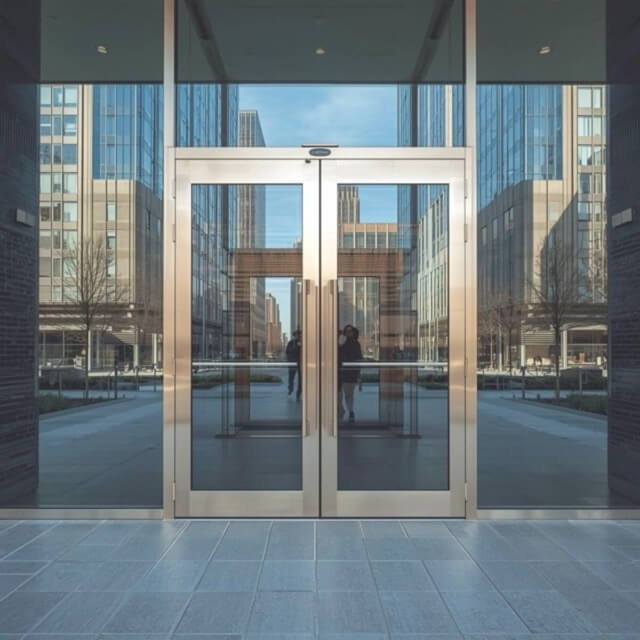
Shields are field-replaceable if vandalized or scratched. Systems can be engineered in custom sizes for double doors, full-height glass, and complex vestibules while maintaining hardware access, ADA clearances, and egress requirements.
Choosing the Right Forced Entry and Ballistic Protection Level
Start with a simple threat assessment: identify likely threats (smash-and-grab, civil unrest, active shooter), estimate local law enforcement response time, and evaluate the value of people and assets behind each glass door.
| Facility Type | Primary Threat | Recommended Protection |
|---|---|---|
| National jewelry chain | Intense smash-and-grab | Forced entry resistant shields on primary glass doors and display windows |
| K-12 school district | Active shooter + forced entry | Forced entry and ballistic glass on main entrances and vestibules |
| City hall / government buildings | Civil unrest + burglary | Upgraded lobby doors and exterior windows with riot glass |
| Healthcare facilities | Workplace violence | Forced entry protection on emergency and pharmacy entries |
Entry resistant doors designed to withstand 5 to 15 minutes of attack with hand tools provide enhanced security for most commercial scenarios. Ballistic doors and ballistic glass are specified by the firearms they are tested against at different levels. FORCEPROTECT glazing meets ASTM F1233 and ASTM F1915 standards for rigorous testing, and Insulgard’s products meet ASTM F1233 and ASTM F1915 standards as well.
Full custom bulletproof doors are more expensive and heavier. Forced entry retrofit shields can often deliver most of the risk reduction for a fraction of the cost. Involve security experts and security glazing specialists early-especially for code issues, fire egress, and anchoring into older curtain wall or storefront systems. Document chosen protection levels in a written security plan to support insurance, compliance, and future budgeting.
Project Planning: From Assessment to Installation
Impact Security follows a proven process across the United States: initial risk and site assessment, measurements and glazing inventory, engineering and fabrication, professional installation, and final inspection with a maintenance plan.
Most forced entry glass door protection projects are retrofits performed while facilities remain operational. Installation windows are scheduled during off-hours to minimize disruption. Custom-cut shields and frames are produced at Impact Security’s fabrication centers in Marietta, GA, and Glendale, AZ, then shipped to certified installers nationwide.
Coordination with other stakeholders is essential:
- IT/Security: camera placement, access control around doors to control access
- Facilities: door hardware, automatic operators, lock mechanisms
- Life-safety: exit paths, ADA compliance, fire marshal review
Key questions to ask any vendor: which forced entry and ballistic standards are met, whether testing was done as a full door system, who performs installation, and what warranties cover. A good partner provides drawings, calculations, and documentation for architects, GCs, and AHJs. Budget for periodic inspections and define timelines for upgrading additional exterior door locations as funding allows.
FAQs: Forced Entry Glass Door Protection
These answers reflect field experience from hundreds of retrofit security glazing projects across U.S. commercial, education, and government buildings over nearly a decade.
How long can forced entry resistant glass doors actually hold off an intruder?
Tested systems typically delay intruders for several minutes under sustained attack with common hand tools-enough time for law enforcement response in most jurisdictions. Performance depends on the product, installation quality, and attacker persistence. Unprotected tempered glass, by contrast, fails in seconds.
Is there really such a thing as a bulletproof door?
No door is truly bulletproof. They are rated bullet resistant to specific UL 752 levels. Pairing a ballistic door slab with ballistic glass vision lites creates a complete ballistic door system. The full range of UL 752 levels covers threats from handguns through rifles, providing different levels of protection for protecting people and property.
Can I retrofit my existing aluminum storefront doors, or do I need full replacement?
In many cases, existing doors and frames can be retained by adding retrofit shields like DefenseLite or BulletShield. Severely corroded or structurally weak frames may require partial or full replacement to achieve the same level of protection. A site assessment determines which approach fits.
Will forced entry glass door protection make my building look like a bunker?
Modern systems are designed to be virtually invisible from a few feet away, preserving storefront branding, daylight, and open lobbies. These are not bars or grates-they are clear, engineered security products that maintain the aesthetic of your house or commercial building.
How does forced entry glass protection interact with fire and life-safety codes?
Properly engineered systems preserve egress function and hardware operation. Work with experienced providers who coordinate with local code officials and fire marshals to ensure compliance with safety requirements for every exterior and interior door.
What does forced entry and ballistic protection typically cost per door?
Retrofits generally cost far less than full custom bulletproof doors. Budget varies with door size, threat level, and whether ballistic performance is required. Forced entry retrofit shields provide enhanced security at a fraction of full-replacement pricing, making phased upgrades achievable for schools, government agencies, and financial institutions.
Why Choose Impact Security for Forced Entry Glass Door Protection
Impact Security has specialized in retrofit security glazing systems for existing glass doors and storefronts since 2016, serving B2B and B2G facilities across the United States for nearly a decade. Core product families include DefenseLite for forced entry and riot protection, BulletShield for ballistic and forced entry overlays, and custom safe-room solutions through SafeSuite for high-risk buildings.
The company delivers turnkey service: threat assessment, engineering, U.S.-based fabrication in Georgia and Arizona, certified installation through a national dealer network, and ongoing warranty support. Impact Security has decades of combined team experience across K-12 and higher education, federal and local government facilities, healthcare facilities, financial institutions, national retail chains, and critical infrastructure where glass door failure is not an option.
Unlike commodity security products, standalone films, or unverified claims, Impact Security’s systems are independently tested with published performance data and backed by longstanding relationships with architects, security consultants, and glazing contractors. Their solution is engineered for each property-not a one-size-fits-all attempt at risk reduction.
Next Steps: Upgrading Your Glass Doors Against Forced Entry
Unprotected glass doors remain among the easiest points for forced entry attempts, but modern retrofit systems can transform them into entry resistant doors without major reconstruction-protecting people, employees, and assets behind every vulnerable opening.
Prioritize a preliminary assessment of your main entries, vestibules, and high-value glass doors within the next 30 to 60 days:
- Document current door conditions and photograph each property vulnerable to forced entry.
- Schedule a consultation with Impact Security or a certified DefenseLite/BulletShield dealer.
- Develop a phased upgrade plan starting with the most vulnerable glass doors at highest risk.
Proactive forced entry prevention is more cost-effective than recovering from a break-in-financially, operationally, and in terms of safety and reputation. Request a free estimate today and connect with local installers who can design a forced entry and ballistic solution tailored to your facility, budget, and risk profile.