When a threat emerges in seconds, the barrier between safety and catastrophe is often just inches of engineered materials. Bulletproof screens now offer a range of solutions for both commercial and residential environments, combining the ability to provide clear visibility with robust protection for building exteriors. Modern systems are designed not only for banks, schools, and businesses but also to enhance the exterior protection of homes, making them an essential part of a comprehensive security infrastructure. This guide covers everything you need to know about selecting, specifying, and installing ballistic glazing systems that actually perform when it matters.
Table of Contents
- What is a Bullet Proof Screen — definitions, construction, and how they differ from standard glass
- Key Benefits — life safety, forced entry resistance, and asset protection
- Types of Bullet Proof Screens — all-glass, polycarbonate, retrofit systems, and transaction screens
- Ballistic Standards and Protection Levels — UL 752, EN 1063, and how to select the right level
- Typical Applications — banks, schools, healthcare, retail, and residential
- Design, Installation, and Retrofitting — professional processes and integration
- Cost, Maintenance, and Lifespan — budgeting and long-term care
- Why Choose Our Bullet Proof Screen Solutions — benefits of choosing our professional installation team
- FAQs — common questions answered
- Conclusion
What Is a Bullet Proof Screen?
A bullet proof screen refers to ballistic-resistant glazing and frame systems engineered to resist specified firearm threats—not to be literally indestructible, but to provide certified protection against defined calibers and velocities. Bullet resistance is achieved through specialized manufacturing processes that ensure compliance with ballistic protection standards such as UL 752, EN 1063, and NIJ 0108.01. Vulnerabilities are present in standard windows, even those with double or triple panes, as they can still be cracked or forced open by criminals. These systems fundamentally differ from ordinary glass, which shatters under low-velocity impacts, and basic security screens like stainless steel mesh (made of high-tensile 304 or 316 stainless steel wire) that primarily deter vandalism but fail against deliberate gunfire. Bullet proof screens are designed to maintain functionality and aesthetic appeal while providing security.
Transparent glazing, or ballistic glass, is constructed by layering glass with materials like polycarbonate or acrylic. These screens are manufactured in controlled facilities to meet strict quality and performance standards. The hard outer layer of ballistic materials often deforms the bullet upon impact, increasing its surface area. Softer inner layers, such as polycarbonate, flex to absorb a bullet’s remaining kinetic energy to prevent it from penetrating the barrier. A typical UL 752 Level 3 assembly features 12-15 layers totaling 45-55mm thickness, and the ability to see clearly through bullet proof screens ensures both safety and visibility.
The performance of ballistic glazing is often classified according to standards such as UL 752 and NIJ ballistic resistance standards, which define the level of protection against specific types of ammunition. These certifications matter critically in 2024-2026 security projects where insurers demand third-party lab reports from accredited facilities. Bullet resistant screens provide life safety, delayed entry for attackers, and protection of cash handling and high-value inventory—while modern designs maintain 80-90% light transmission.
Key Benefits of Bullet Proof Screens
Bullet proof screens deliver layered protection across multiple threat scenarios:
- Life-safety protection against handgun and rifle fire in banks, schools, municipal offices, and pharmacies—UL Level 3 screens stop multiple .44 Magnum hits, containing 95% of handgun threats per FBI robbery data, enabling people to safely conduct daily activities behind bullet proof screens
- Forced entry delay buying 5-15 minutes during robberies or active shooter events, enabling lockdown or evacuation
- Asset protection safeguarding tills, safes, IT equipment, and controlled substances—reducing smash-and-grab losses by 70% according to industry reports, and protecting families in residential settings
- Psychological deterrent where visible security glazing discourages opportunistic attacks through target hardening
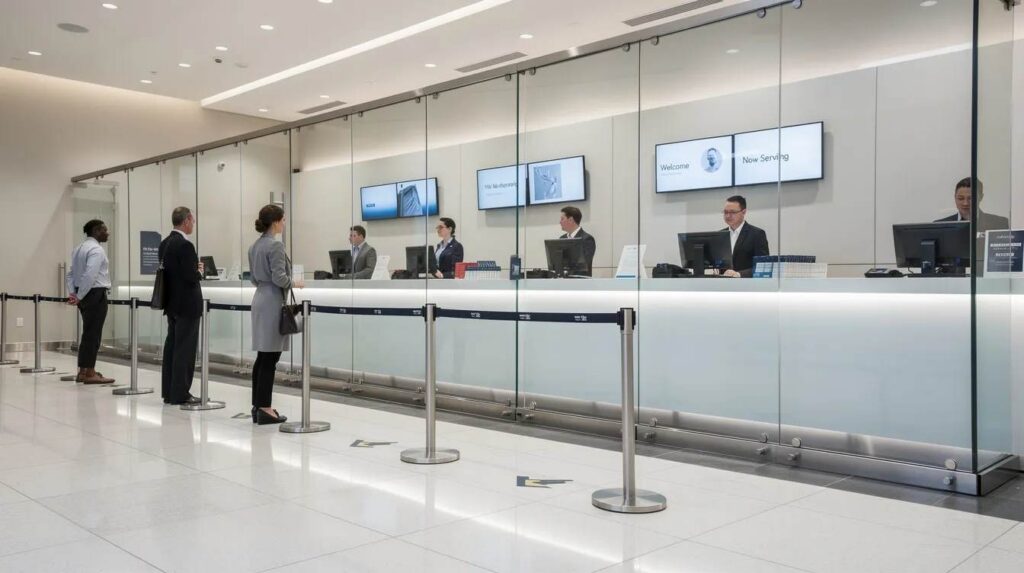
- Design integration with modern low-iron glass and RAL-matched powder-coated frames that avoid the opaque fortress aesthetic, while acting as a shield in both commercial and residential environments
- End-to-end support from certified providers offering threat assessment through installation, ensuring products comply with relevant safety and security standards
Types of Bullet Proof Screens
Ballistic glazing options can include various materials such as glass, polycarbonate, and specialized films, each offering different levels of ballistic protection. Not all bullet proof screens are identical—selection depends on threat level, weight limits, budget, and aesthetics.
- All-glass laminated screens: Excellent clarity (>85% visible light transmittance), common in banks and court buildings, but heavy at 100-120kg/m²
- Glass-clad polycarbonate: Combines hard glass surface with lightweight polycarbonate core, offering 200x the fracture toughness of glass alone with improved multi-hit performance up to 20 shots
- Monolithic polycarbonate: Weight-sensitive applications like schools and interior partitions at approximately 40kg/m² for UL Level 1-2
- Retrofit overglaze systems: Mount in front of existing glass to achieve UL 752 or EN 1063 ballistic levels without full replacement
- Fixed vs. operable units: Fixed screens dominate high-security environments, while operable windows and doors incorporate weather seals and multi-point locks maintaining ratings
- Transaction screens: Include stainless pass-throughs with 300x500mm drawers rated non-defeatable
- Flat, non-opening bullet proof windows: Cost-effective option for residential and commercial security, providing simple and secure protection.
- Custom solutions to suit specific security counter arrangements: Screens can be tailored to fit unique layouts and environments for optimal integration.
- Range of bullet proof screens: Available to withstand different gun calibers, including handguns, rifles, and shotguns, to meet various ballistic resistance standards.
Be sure to review product detail, including diagrams and specifications, to select the right bullet proof screen for your needs.
Higher-end ballistic screens are designed to be non-spalling to prevent injury from shards upon impact. Specialized retrofit panels such as BulletShield ballistic security glazing can be installed over existing windows, and some screens can allow return fire while stopping threats from the attack side, known as one-way ballistics. Mobile ballistic barriers are portable panels used to create secure areas in various settings, including schools and government buildings.
Stainless steel mesh screens are made of high-tensile 304 or 316 stainless steel wire, making them difficult to cut or kick through.
Bullet Resistant vs. Attack Resistant Screens
Understanding the distinction helps match products to actual threats:
- Bullet resistant screens provide bullet resistance that is independently tested and classified according to the type of ammunition and level of threat, following standards such as UL 752 or EN 1063. Protection levels range from Level 1 (handguns) to Level 8 (military rifles), ensuring the screen’s effectiveness against specific calibers and velocities.
- Physical attack resistant screens are tested to EN 356, LPS 1270, or ASTM forced entry standards using hammers, axes, and prybars
- Ballistic glass often provides strong forced entry resistance (P6B-P8B equivalence), but dedicated attack screens may be thinner when firearms aren’t a risk
- Security window film can be applied to existing glass to hold shattered pieces in place and slow down break-ins, but most standard films cannot stop bullets on their own, making it important to compare these options with bulletproof glass and overglazing systems
- Retrofit films improve impact resistance of existing glass but are not bulletproof on their own
- High-crime retail environments (convenience stores facing 25% armed smash-and-grab attempts) need both ratings combined
Frames and Supporting Hardware
Ballistic performance depends on both glazing and frame—weak edges allow bullet bypass, voiding the entire system’s certification.
- Bullet resistant screens are tested to meet standards such as BS EN 1522 and BS EN 1063 as complete assemblies
- Typical frame materials include steel, stainless steel, and heavy-duty aluminum (3-6mm thick), often powder-coated to RAL colors; frame and glazing options can be customized to suit specific security and aesthetic requirements
- Construction details feature reinforced anchors rated for 10x glazing inertial loads, ballistic joints, and overlapping profiles (>50mm edge overlap) to prevent bypass; reviewing installation and construction details is essential to ensure optimal performance
- Transaction features include speak-through grilles, intercoms, sliding trays, and deal drawers, maintaining rating at pass-through points
- Bullet resistant screens can be customized to fit specific security needs, including various frame materials and glazing options to enhance both protection and aesthetics
Ballistic Standards and Protection Levels
Standards exist to create quantifiable threat calibration—matching real-world firearms to tested protection levels. Bullet resistance is measured and certified through rigorous third-party testing, with protocols established by organizations such as Underwriter Laboratories (UL) and the National Institute of Justice (NIJ). The NIJ sets ballistic resistance testing standards, such as NIJ 0108.01, which are widely referenced for security glazing and bulletproof screens. The protection levels of bullet resistant screens are classified according to the type of ammunition they can withstand, with standards ranging from Level 1 for handguns to Level 8 for military rifles.
Bullet-resistant glass is classified into different protection levels according to the Underwriter Laboratories (UL) 752 ballistic standards, which specify the caliber type, velocity, and number of rounds fired per square foot area:
| Level | Caliber | Velocity | Typical Application |
|---|---|---|---|
| UL 1 | 9mm FMJ | 448 m/s | Pharmacies, retail |
| UL 3 | .44 Magnum | 436 m/s | Banks, schools |
| UL 7 | 7.62 NATO | 847 m/s | Military, embassies |
| UL 8 | .50 BMG AP | 853 m/s | Critical infrastructure |
| Level 1 bullet-resistant glass can stop three rounds from a 9mm handgun, while Level 3 can stop three rounds from a .44 Magnum, indicating a significant difference in protection capabilities. EN 1063 BR classes (BR1-BR7) and SG classes for shotgun threats correspond roughly to UL 752 levels. Regional standards like NIJ 0108.01, developed by the US National Institute of Justice, intersect with glazing specifications for government and military work. |
When choosing bullet proof screens, it is important to figure out the appropriate protection level based on your specific security needs and threat assessment. Most residential bulletproof glass typically falls within Levels 1-3, which are designed to stop rounds from handguns, while higher levels (4-8) are used for protection against rifles and more powerful firearms. Higher rifle ballistic levels, such as Levels 4, 5, 7, and 8, are often employed for safe rooms and can be used for entire home exteriors depending on the perceived threat level.
Testing and Certification
Ballistic testing follows rigorous protocols ensuring real-world performance:
- Controlled lab environment with specified firearm, 5-15m distance, 0°/30° angle of attack, and multiple shots at defined impact points
- Multi-hit requirements, complete penetration criteria, and spall limits (rear-face fragmentation must not exceed safe limits)
- Independent, accredited laboratories (UL, H.P. White, VHTC) with traceable test reports valid 10-15 years
- Request certificates matching exact product and configuration to tested specimens
- Complete assemblies—glazing, frame, and fixings—tested together to ensure all tested assemblies comply with relevant ballistic and safety standards, avoiding mismatched combinations seen in 15% of disputed claims
Typical Applications for Bullet Proof Screens
By 2026, over 80% of new U.S. bank branches incorporate UL 752-rated glazing. Applications extend far beyond financial institutions:
- Financial institutions: Teller lines, vault lobbies, ATM areas requiring multi-level ballistic protection
- Education: 500+ U.S. K-12 schools installed ballistic screens post-2010s for reception and vestibule protection, reflecting a broader trend toward reinforcing school window and door glass
- Government/municipal: Courthouses, police stations, permit counters handling sensitive interactions
- Healthcare: Emergency departments and pharmacy windows deterring opioid theft (DEA reports 20% rise)
- Retail: Jewelry stores, pawnbrokers, firearms retailers protecting $2B inventory annually
- Residential: Safe rooms and high-net-worth estates using discreet bulletproof windows and doors for exterior protection, helping families feel secure; higher rifle ballistic levels, such as Levels 4, 5, 7, and 8, are often employed for safe rooms and can be used for entire house exteriors depending on the perceived threat level, and similar layered approaches are increasingly adopted for bullet-resistant glass security in places of worship
Bulletproof windows can be installed into both new and existing residences, with minimal structural changes required for most homes.
Counterline and Transaction Screens
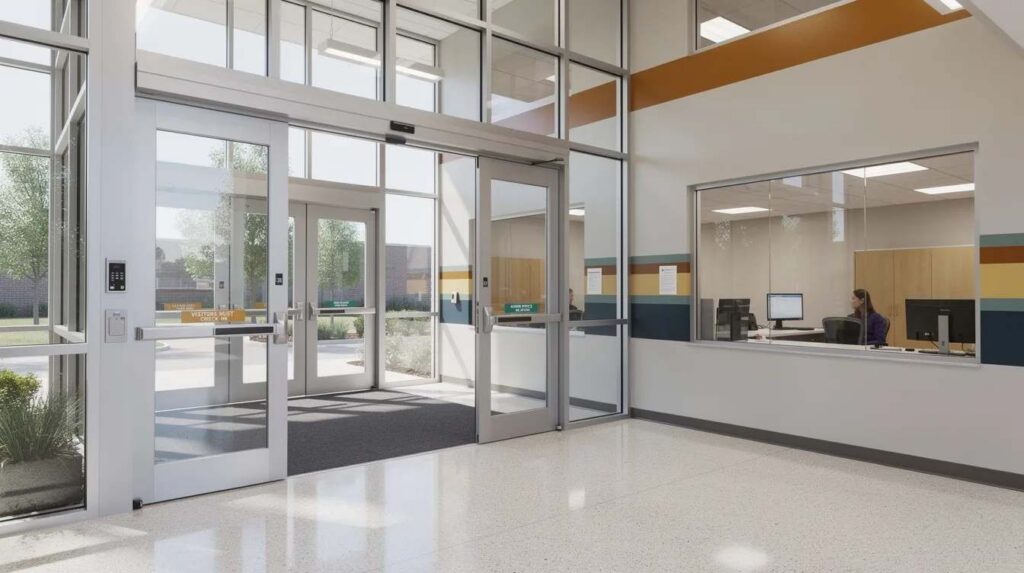
Counterline systems combine ballistic glass, frames, drawers, trays, and talk-through units for face-to-face transactions in banks, city halls, and ticket offices:
- Design priorities: Clear sight lines, natural speech (>70dB clarity), smooth document/money transfer, and the ability to safely and efficiently conduct transactions without compromising functionality
- Configurations: Vertical screens on counters, full-height enclosures, partial barriers with overhead framing
- Code and accessibility compliance for pass-through openings and counter heights (ADA-compliant 900mm-high trays)
Interior Partitions and Enclosures
Ballistic partitions create secure interview rooms, cash-count rooms, or control rooms inside open-plan spaces:
- Integration with ballistic doors, ceilings, and transfer hatches forms complete secure enclosures
- Applications include utilities, data centers, and SCADA control spaces for critical infrastructure
- Modular, demountable systems allow reconfiguration as tenants or security needs change
Design, Installation, and Retrofitting
Professional design and installation are essential—mismatched components or improper anchoring compromise the entire system. Bulletproof windows and doors with integrated glass security solutions must be installed according to manufacturer specifications to comply with safety standards and ensure optimal protection. The installation of bullet-resistant windows typically requires accurate rough opening measurements to ensure a proper fit, as these windows are custom-manufactured to size.
- Start with threat and risk assessment evaluating likely firearms, attack modes, and building vulnerabilities
- Coordinate with architects and MEP engineers for sightlines, ventilation, fire egress, and accessibility
- Structural considerations: Load on floors (up to 150kg/m² at Level 8), fixing into masonry or steel, and the importance of accurate rough opening measurements for custom-manufactured bullet-resistant windows
- Proper installation is critical for the performance of bullet-resistant systems, and it is recommended that installation be performed by local contractors experienced in standard window installations
- Ballistic glazing can be customized to fit existing window frames, allowing for retrofitting without the need for complete replacement, which can be a cost-effective solution for enhancing security when combined with bulletproof window, door, and security film systems
Integration with Other Security Measures
Bullet proof screens work within multi-layered security strategies:
- Pair with access control (card readers, interlocks, mantraps) for controlled entry delaying 2-5 minutes
- Synergy with intrusion detection, CCTV, and monitored alarms documenting attempts, and in some high-risk facilities, complementary blast resistant performance to GSA/ISC standards
- Connect to interior safe rooms or lockdown zones via controlled doors
- Staff training on how employees should act behind screens during an incident
Cost, Maintenance, and Lifespan
Cost scales with ballistic level, glass type, frame complexity, custom shapes, and installation access. Entry-level handgun resistance (UL1) runs approximately $200-400/ft², while rifle-rated assemblies (UL7) reach $1500+/ft².
- Total cost of ownership spans 20-30 years with minimal routine maintenance
- Annual cleaning ($5-10/ft²), gasket swaps every 10 years
- Insurance and liability benefits: Reduced risk exposure can support business continuity and may influence premiums (30-50% cuts reported)
- Optimize cost by matching real-world threats to appropriate levels, avoiding over- or under-specification
Cleaning and Care
Proper maintenance preserves clarity and performance:
- Use ammonia-free, pH-neutral cleaners and soft cloths—solvents and abrasive pads cause haze on polycarbonate
- Dedicated polycarbonate cleaners (like Novus #1) prevent scratching
- Regular visual inspections for chips, delamination, or impact damage; consult installer if defects found
- Protective anti-scratch or sacrificial films can be replaced if vandalized without changing the ballistic core
Why Choose Our Bullet Proof Screen Solutions
Our team brings extensive experience designing and supplying bullet resistant screens for banks, schools, government sites, and high-end residential projects across multiple regions. All products are manufactured to suit each project’s unique requirements. Every system is independently tested and certified, with documentation available for architects, insurers, and compliance officers.
We provide custom engineering—bespoke sizing, framing colors, integrated transaction hardware, and compatibility with existing storefronts. From threat assessment and specification writing through CAD details, manufacturing, logistics, and installation guidance, our end-to-end support provides detailed assistance and ensures all solutions comply with relevant standards. Contact us with drawings or photos of your site for a tailored, standards-compliant bullet proof screen proposal, or request localized assistance through our Hollywood, FL ballistic window glazing team or Houston, TX safety and security glazing specialists.
Frequently Asked Questions About Bullet Proof Screens
Are bullet proof screens truly bulletproof, or just bullet resistant? The term bulletproof is informal language—correct terminology is bullet resistance with defined threat levels. No system claims 100% infallibility; protection is rated against specific calibers, velocities, and shot counts, and products should comply with standards such as UL 752, EN 1063, or NIJ 0108.01 to ensure verified performance.
Which ballistic level do I need for a retail store, school entrance, or bank lobby? Retail typically requires UL Level 2, schools UL Level 3 (post-Sandy Hook mandates), banks UL Level 3-4, and jewelers UL Level 4-5. You can figure out the appropriate level by consulting a specialist, who will help assess your security needs and ensure compliance with relevant ballistic protection standards.
Can I retrofit bullet proof screens over my existing windows without full replacement? Yes—overglaze systems clamp 25-40mm ballistic panels over existing fenestration, achieving Level 3 in hours versus weeks, with 50% cost/time savings in many municipal upgrades. Retrofit films can improve impact resistance of existing glass but are not bulletproof on their own.
Will bullet resistant glass look different from normal glass? Modern bulletproof glass maintains near-normal optics (1.5x thicker, minor tint), with visible light transmittance exceeding 85%.
How much do bullet proof screens cost per square foot? Ranges from $200-400/ft² (UL1) to $1500+/ft² (UL7), driven by thickness, materials, frame complexity, and installation challenges.
Do bullet proof screens also stop break-ins and vandalism? Most ballistic screens provide strong forced entry resistance (P6B-P8B equivalence), combining protection against both forced entry attacks and firearms.
What is the typical lead time for design, fabrication, and installation? Expect 8-16 weeks from approval drawings to commissioning for custom systems.
Do I need special permits for installing ballistic glazing? Coordination with local codes (IBC/UFGS), fire regulations, and AHJ variances is typically required—our team can guide compliance.
Conclusion
Bullet proof screens provide a critical layer of protection for people and property in high-risk or high-value environments, acting as a shield to safely protect families and assets. From banks and schools to healthcare facilities and residential safe rooms, certified ballistic glazing has become essential infrastructure in the 2020s threat landscape.
Success depends on choosing the right ballistic level matched to actual threats, selecting certified products tested as complete assemblies, and ensuring professional installation. View bullet proof screens as part of a broader security plan including access control, policies, and training.
Ready to protect your facility? Contact our team with your project details—including drawings, threat assessment needs, or specific configuration requirements—for a tailored solution engineered for your environment. Always choose bullet proof screens that comply with relevant safety and security standards to ensure maximum protection.