- An Architect’s Guide to the Eight Levels of UL 752 Protection
- How UL 752 Levels Translate to Specific Ballistic Threats
- The Inherent Limitations of Traditional Monolithic BR Glass
- The Retrofit Alternative: Engineered Systems Like BulletShield
- Comparing Retrofit Systems vs. Traditional BR Glass: A Technical Analysis
- Integrating Advanced Ballistic Protection Without Compromising Design
- Conclusion: Specifying the Future of Architectural Ballistic Protection
- Frequently Asked Questions
While the term BR glass is a useful shorthand, professional specifications require precise, standardized language. In North America, the definitive standard for evaluating the ballistic resistance of building materials is UL 752. This standard, published by Underwriters Laboratories, provides a reliable and repeatable methodology for testing and certifying the performance of materials against specific ballistic threats.
For an architect, specifying a UL 752 level is the only way to ensure a glazing system meets a quantifiable, third-party-verified standard of protection. It removes ambiguity and provides a clear benchmark for performance that both clients and contractors understand.
An Architect’s Guide to the Eight Levels of UL 752 Protection
The UL 752 standard is organized into eight primary ballistic protection levels, each corresponding to a specific type of ammunition fired from a specific class of weapon. The test protocol dictates the number of shots, shot pattern, and projectile velocity. A material passes if it prevents perforation by the projectile and stops spall, which is fragmentation from the protected side of the glazing.
Understanding these levels is the first step in matching a security solution to a defined threat.
- Level 1: Protects against medium-power handguns like the 9mm. It is commonly specified for facilities with a baseline risk of armed robbery, such as retail stores and banks.
- Level 2: Protects against high-power handguns like the .357 Magnum. It is suitable for higher-risk environments where more powerful handguns are a credible threat.
- Level 3: Protects against super-power handguns like the .44 Magnum. This level is often used in government buildings, police stations, and high-security corporate facilities.
- Level 4: Protects against high-power hunting and sporting rifles, such as the .30-06. This represents a significant step up in protection, specified for facilities at high risk of a planned attack.
- Level 5: Protects against military assault rifles with 7.62mm ammunition. This level is typically reserved for military installations and critical government infrastructure.
- Level 6: Protects against multiple shots from a high-power handgun like a 9mm Uzi. The focus here is on stopping multiple impacts in a tight cluster.
- Level 7: Protects against multiple shots from a military assault rifle like an M16 with 5.56mm ammunition. Like Level 6, this tests for resistance to a sustained burst of fire.
- Level 8: Protects against high-power military rifles with 7.62mm ammunition. This is the highest common level of protection, reserved for the most critical and high-threat environments.
How UL 752 Levels Translate to Specific Ballistic Threats
The hierarchy of UL 752 ballistic levels allows for a tiered approach to security design. Levels 1 through 3 are primarily concerned with defending against common handguns, which represent the vast majority of ballistic threats faced by public and commercial facilities. Levels 4 through 8 address threats from high-velocity rifles. These threats are less common but far more powerful, requiring substantially thicker and heavier glazing compositions. Specifying a system rated to UL 752 Level 8, for example, often involves a monolithic ballistic resistant glass product that is several inches thick and weighs over 25 pounds per square foot. This has profound implications for a building’s structural design, framing systems, and overall aesthetic.
Specifying the Correct Level: Aligning Protection with Project Risk Profile
Choosing the appropriate UL 752 level is a critical design decision that must be based on a formal risk assessment, not assumption. Over-specifying a solution leads to prohibitive costs, compromised design intent, and unnecessary structural modifications. Under-specifying creates an unacceptable liability and fails to meet the core security objective.
A professional Threat, Vulnerability, and Risk Assessment (TVRA) is the proper mechanism for determining the required level of protection. This analysis, conducted by a qualified security consultant, should consider factors such as:
- The value of the assets being protected.
- The likelihood of credible ballistic threats based on location and facility type.
- The building’s occupancy patterns and public profile.
The outcome of the TVRA provides the architect with a defensible, data-driven basis for specifying a precise UL 752 level, ensuring the solution is commensurate with the risk.
Beyond the Glass: Why Framing and Installation are Critical
A common and critical error in security specification is focusing solely on the security glazing. A UL 752 rating applies to an entire assembly, not just the glass infill. A Level 8 ballistic-rated pane installed in a standard commercial aluminum frame creates a catastrophic vulnerability, as a projectile will easily perforate the frame and defeat the security investment.
True UL 752 compliance requires that the framing system, anchorage, and installation methodology are engineered to withstand the same level of force as the glazing. This holistic system approach is non-negotiable. When evaluating any ballistic resistant system, architects must scrutinize the test reports for the complete assembly to ensure the framing and mounting are integral parts of the certified solution.
The Inherent Limitations of Traditional Monolithic BR Glass
For decades, specifying ballistic-rated glass meant accepting a series of architectural and structural compromises. Traditional monolithic BR glass achieves its rating through sheer mass and thickness, presenting significant challenges that directly conflict with modern design principles of openness, clarity, and structural efficiency. These limitations fundamentally impact a project’s aesthetics, budget, and structural integrity.
The Architectural Challenge of Excessive Weight and Structural Load
The primary drawback of monolithic BR glass is its immense weight. A UL 752 Level 3 rated glass panel can easily exceed 30 pounds per square foot. This substantial mass imposes a significant dead load on the window framing and the surrounding building structure. For new construction, this requires oversized frames and potential reinforcement of structural members. For retrofit projects, the existing structure may be incapable of supporting the additional load without extensive and costly re-engineering, making traditional BR glass impractical.
Aesthetic Compromises: Optical Distortion, Clarity, and Thickness
Beyond weight, monolithic glass presents unavoidable aesthetic trade-offs. As the thickness of the glass stack increases to meet higher UL ratings, several optical issues become more pronounced.
- Reduced Light Transmission: Thick glass assemblies transmit less visible light, resulting in darker interior spaces.
- Color Distortion: Multiple layers of glass and polymer interlayers often impart a noticeable greenish or yellowish tint, altering color perception.
- Optical Distortion: The sheer thickness can create visual distortion, especially when viewed at an angle.
- Bulky Framing: The depth of the glass requires deep, obtrusive framing systems that disrupt clean, minimalist lines.
The High Cost and Disruption of Full Window Replacement
Specifying monolithic BR glass necessitates a full replacement of the existing window system. This “rip-and-replace” approach is disruptive, costly, and time-consuming. The project scope expands to include demolition, potential structural modifications, and installation by specialized crews, inflating the budget and creating significant operational disruption for occupants.
The Problem of Spall and its Impact on Occupant Safety
A critical and often overlooked limitation of some traditional BR glass is the phenomenon of spall. Spall occurs when a projectile strikes the exterior surface and fragments from the interior, or “safe side,” are ejected at high velocity. Even if the glass stops the projectile from penetrating, the resulting spall can create a shower of sharp shards, posing a serious threat of injury to occupants.
The Retrofit Alternative: Engineered Systems Like BulletShield
The inherent drawbacks of monolithic glass have driven the development of a more intelligent and architecturally sensitive approach: retrofit security glazing. Instead of relying on brute-force mass, these engineered systems leverage advanced materials and physics to provide equivalent ballistic protection without compromising a building’s design or structure.
Introducing Retrofit Security Glazing: The “Over-Glaze” Concept
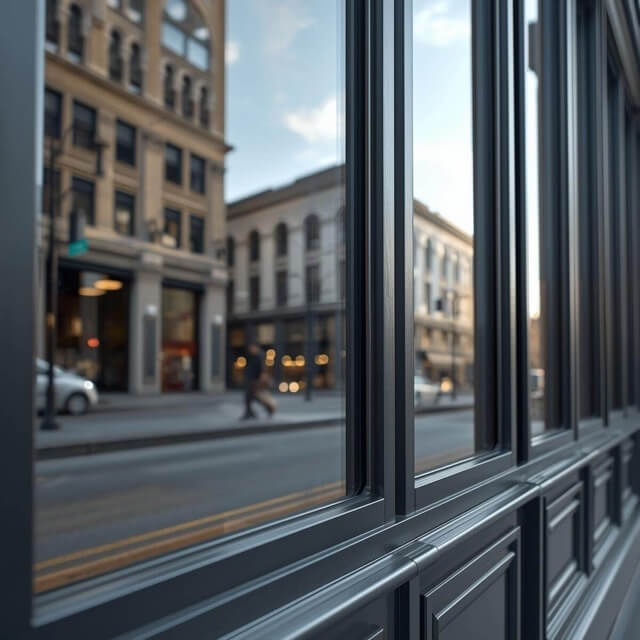
Retrofit security glazing, or an “over-glaze” system, involves installing a separate, independent shield of ballistic-rated material over the existing window and door glass. This shield is mounted into a proprietary framing system that attaches securely to the existing window mullions or surrounding wall structure. The original building envelope remains entirely intact, preserving the building’s thermal performance, weather sealing, and original architectural aesthetic. From the exterior, the system is virtually invisible.
The Patented Engineering Behind the BulletShield System
A leading example of this technology, the BulletShield system, is a comprehensive, patented assembly engineered to manage ballistic energy. Its key components include a high-optic polycarbonate shield, custom-extruded aluminum framing, and a flexible anchoring system. The polycarbonate, 250 times stronger than glass, provides exceptional clarity and forms the primary defense. The proprietary frame and patented anchors allow for dynamic movement and energy absorption during a ballistic attack.
How Retrofit Systems Absorb and Dissipate Ballistic Energy
Unlike monolithic glass that attempts to stop a projectile with rigid mass, a retrofit system works by absorbing and dissipating kinetic energy. Upon impact, the polycarbonate shield flexes and absorbs a significant portion of the initial energy, dramatically slowing the projectile. The air gap between the shield and the original glass allows for continued deceleration. Remaining energy is transferred through the patented framing into the building structure, away from occupants. In this system, the existing window glass acts as the final backstop and an anti-spall layer.
Achieving UL 752 Ratings Without Replacing Existing Glass
This engineered approach allows retrofit systems to be independently tested and certified to meet the same stringent bullet resistant glass standards as traditional, heavy monolithic glass. By leveraging the strength of polycarbonate shields and the physics of energy transfer, a significantly lighter and thinner solution can achieve ratings from UL 752 Level 1 up to Level 8. This allows architects to provide certified ballistic protection without a costly and disruptive full window replacement, avoiding the compromises of traditional br glass.
Comparing Retrofit Systems vs. Traditional BR Glass: A Technical Analysis
When specifying ballistic-resistant glazing, architects must weigh a complex set of variables. The choice between a traditional replacement system and an engineered retrofit solution has profound implications for a building’s structure, aesthetics, budget, and operational continuity.
Head-to-Head on Weight and Thickness
Traditional ballistic-resistant glass achieves its rating through sheer mass. A UL Level 3 glazing panel can be over an inch thick and weigh 15 to 25 pounds per square foot. This substantial weight requires heavy-duty framing and can impose significant structural loads on the building.
In stark contrast, an engineered retrofit system like BulletShield utilizes a much lighter polycarbonate shield. Its patented anchoring system transfers impact loads directly to the building’s structural frame. This decouples the ballistic protection from the primary glass, adding minimal weight and maintaining the building’s existing structural integrity without reinforcement.
Evaluating Optical Clarity and Light Transmission
The optical quality of glazing is paramount to a building’s designed aesthetic. The thick composition of traditional BR glass can introduce a greenish tint and slight optical distortion. In contrast, modern retrofit systems are engineered for maximum optical clarity. The high-grade polycarbonate used is virtually colorless and distortion-free. Because the existing exterior glass is left in place, the system maintains the building’s intended light transmission levels and visual performance.
Installation Efficiency and Minimized Disruption
Specifying traditional BR glass requires a full-scale replacement project involving demolition and significant facility downtime. Retrofit solutions offer a fundamentally more efficient installation. Since the system is mounted on the interior of existing windows, the building envelope is never compromised. Installation is clean, quiet, and can be completed by a small crew without cranes or exterior scaffolding, ensuring operational continuity.
A Comparative Analysis of Long-Term Performance
While both systems are designed to stop projectiles, their long-term performance differs. Traditional laminated glass is a rigid system that can be subject to delamination over time. Upon impact, these systems can also produce significant spall.
Engineered retrofit systems are designed for dynamic performance. The polycarbonate shield is inherently durable and will not shatter. The air gap between the shield and the original glass allows the system to flex and absorb impact energy. This energy absorption dramatically reduces the risk of spall, as any fragments from the primary glass are safely contained within the assembly.
Integrating Advanced Ballistic Protection Without Compromising Design
For architects, the defining challenge in security design is achieving a high level of protection without sacrificing the building’s aesthetic and functional intent. The choice of security glazing is central to resolving this dilemma.
Preserving the Original Architectural Vision
Replacing existing windows with thick, heavy BR glass fundamentally alters a building’s character. The original sightlines and frame profiles are lost, replaced by bulky systems that compromise the design vision. A retrofit window security system, by its nature, preserves the building’s exterior completely. The original glass, frames, and facade remain untouched, ensuring the architect’s vision is maintained.
The “Virtually Invisible” Aesthetic of Modern Retrofit Solutions
The ideal security solution is one that is felt but not seen. From the exterior, a retrofit system is entirely invisible. From the interior, the patented framing that secures the polycarbonate shield integrates discreetly with the existing window mullions. These frames can be color-matched to any finish, blending seamlessly with the surrounding architecture. The result is robust ballistic protection that does not create a fortress-like atmosphere.
Seamless Integration with Existing Fenestration
Advanced retrofit solutions are not one-size-fits-all products but are custom-engineered for each application. The patented anchoring systems are designed to mount securely to a wide variety of fenestration types, from historic punched openings to modern curtain walls. By anchoring directly to the window frame or adjacent structural elements, the system ensures that impact forces are distributed safely without placing stress on the original glass.
Solving the Architect’s Dilemma
Modern retrofit technology resolves the architect’s core dilemma and eliminates the false choice between aesthetics and safety. By decoupling the ballistic-resistant layer from the building’s primary glazing, these systems empower architects to specify robust, UL-rated protection while retaining complete control over the building’s design integrity. Security becomes an invisible, integrated element of a resilient and thoughtfully designed building.
Conclusion: Specifying the Future of Architectural Ballistic Protection
The specification of security glazing has reached an inflection point. For decades, architects faced a trade-off between achieving a desired level of ballistic protection and preserving their design intent. This compromise is no longer a professional necessity. Advances in materials science and engineering have created new standards for what is possible in architectural security.
Key Takeaways: Traditional vs. Retrofit
The decision between traditional replacement and modern retrofit solutions hinges on their respective impacts on a project.
Traditional Laminated Glass typically involves:
- Structural Compromise: Its immense weight necessitates new framing and often requires costly reinforcement of the building structure.
- Aesthetic Distortion: The inherent thickness and noticeable tint can fundamentally alter a building’s appearance.
- Logistical Complexity: Full window replacement is a disruptive process involving demolition and significant construction.
Advanced Retrofit Systems provide:
- Architectural Preservation: The system becomes virtually invisible, preserving the original glass and exterior sightlines.
- Structural Efficiency: The lightweight design imposes no additional dead load on the building structure.
- Performance without Penalty: These engineered systems meet specific UL 752 ballistic protection levels without the physical and aesthetic penalties of thick glass.
Why Patented Retrofit Systems Represent a Paradigm Shift
The availability of patented retrofit solutions marks a fundamental shift in the approach to architectural security. It moves the conversation from one of forced compromise to one of seamless integration. For architects, this means security is no longer an element that must be designed around, but rather a performance layer that can be added to the existing design.
This new paradigm empowers architects to prioritize design integrity without sacrificing occupant safety. By separating the ballistic-resistant component from the primary building envelope, retrofit systems solve the core problem that has long plagued security design. The building’s original aesthetic, its connection to the outdoors through clear glazing, and its structural stability are all maintained.
Next Steps for Incorporating Advanced Security
Integrating advanced ballistic protection begins with a consultative process. Architects and specifiers should first conduct a thorough threat, vulnerability, and risk assessment to define the specific UL 752 ballistic levels required. With these performance requirements established, the next step is to evaluate the existing glazing and framing systems to determine their suitability for a retrofit solution.
Finally, consulting with a specialist in engineered retrofit security systems is crucial. An expert can provide detailed technical analysis, performance data, and guidance on how to integrate the solution into construction documents and specifications. This collaborative approach ensures the final solution meets all security mandates while remaining fully aligned with your architectural vision.
Frequently Asked Questions
What is the difference between bulletproof glass and BR glass?
The term “bulletproof glass” is a common misnomer, as no material is truly bulletproof given enough force or the right projectile. The correct industry term is “ballistic resistant glass,” or BR glass, which refers to glazing materials that are tested and certified to withstand specific ballistic threats according to standards like UL 752. The term “BR glass” accurately reflects that the material is resistant to a defined level of attack, not impervious to all threats.
Can retrofit security glazing stop rifle rounds?
Yes. Advanced retrofit security glazing systems can be engineered and certified to meet the same UL 752 ballistic levels as traditional, thick laminated glass. Patented systems that use polycarbonate shields and specialized anchoring can be specified to achieve ratings up to UL 752 Level 8, which provides protection against high-power military rifles with 7.62mm ammunition. The level of protection is specified based on a formal threat assessment.
Will a retrofit system affect my building’s energy efficiency?
No. Because retrofit security glazing is installed on the interior side of the existing window, it does not compromise the building’s primary thermal envelope. The original window’s U-value, solar heat gain coefficient (SHGC), and weather seals remain intact. In fact, the addition of an interior polycarbonate shield and an air gap can provide a modest improvement in thermal and acoustic insulation.
Is the UL 752 rating for the glass only or the entire system?
This is a critical distinction. A UL 752 rating applies to the entire certified assembly, which includes the glazing, the framing, and the anchorage. A common and dangerous mistake is to install a rated piece of BR glass into a standard, unrated window frame. The frame would fail upon impact, defeating the entire system. When specifying a solution, it is essential to verify that the complete assembly, not just the glazing infill, has been tested and certified to the required UL 752 level.