- Why Standard Construction Materials Fail Against Ballistic Threats
- The Engineering Reality of Ballistic Resistant Panels
- A Superior Approach: Retrofit Security Glazing
- The Science of Invisible Armor: How Patented Retrofit Systems Work
- Conclusion: Reframing Architectural Security Beyond Walls
- Frequently Asked Questions
The search for “bulletproof sheetrock” is a common query in the architectural security sector. While no such off-the-shelf product exists, the search itself reveals a valid objective. It represents the need for a seamless, integrated, and effective method to harden a building’s interior against ballistic threats without creating a visibly fortified bunker.
When architects and security directors search for this term, they are not literally asking for a gypsum board that stops a bullet. They are articulating a need for a solution as ubiquitous and aesthetically invisible as standard drywall. The term “bulletproof” is a colloquialism for a precise engineering requirement, ballistic resistance. The search is for a practical solution, not a mythical material. The core goal is to create a secure envelope that buys critical time for occupants to react and for first responders to arrive.
Why Standard Construction Materials Fail Against Ballistic Threats
Traditional building materials are engineered for structural load, fire resistance, and thermal insulation, not ballistic mitigation.
- Gypsum Wallboard: Drywall offers negligible resistance. Most common handgun and rifle rounds will pass through multiple layers of sheetrock and studs with minimal loss of velocity.
- Plywood and OSB: While denser than drywall, standard wood sheathing does little to stop most firearm projectiles.
- Brick and Concrete (CMU): The performance of masonry is often overestimated. While it may stop some handgun rounds, high-velocity rifle rounds can penetrate or cause dangerous spalling, where fragments of the wall itself are ejected into the protected space.
These materials are not designed to absorb the concentrated kinetic energy of a ballistic impact. They shatter and fail in ways that can create secondary hazards.
The Engineering Reality of Ballistic Resistant Panels
Achieving true ballistic resistance in a wall requires specialized security wall panels, not modified drywall. These products are engineered, tested, and rated to meet specific threat levels defined by standards like UL 752. Common materials include ballistic fiberglass, hardened steel plate, and advanced composites.
These ballistic resistant panels are installed behind the finished wall, attached directly to the studs. The drywall is then placed over them to conceal the system. This assembly, however, is far thicker, heavier, and more complex than a standard wall.
Structural, Financial, and Logistical Challenges
Implementing ballistic wall panels is a major construction project with significant consequences.
- Structural Impact: A panel rated for UL Level 3 can weigh over four pounds per square foot, while a steel plate for rifle protection can exceed 40 pounds per square foot. This adds enormous dead load to the building structure, often requiring costly reinforcement of foundations and columns.
- Financial Cost: Specialty materials, specialized labor, and structural engineering assessments make the cost to fortify walls prohibitively high for most facilities.
- Logistical Disruption: Retrofitting walls is a deeply invasive process. It requires the demolition of existing finishes, installation of heavy panels, and complete reconstruction, resulting in significant downtime and disruption.
Even if an organization overcomes these challenges, a wall-centric security strategy is fundamentally flawed. It ignores the attacker’s primary motivation, finding the path of least resistance. An assailant will immediately turn to the building’s weakest points, its windows and glass doors. This creates a dangerous illusion of security, where resources are spent fortifying the strongest part of the building envelope while leaving the most vulnerable elements exposed.
Identifying the True Vulnerabilities: Windows and Glass Doors
A comprehensive security plan is an exercise in risk analysis, focused on mitigating the most probable points of failure. In modern architecture, the most significant and consistently targeted vulnerabilities are not opaque walls, but the expansive glass openings that define a building’s character.
From a threat actor’s perspective, standard commercial glazing offers the path of least resistance. Glass can be shattered in seconds, providing immediate visual and physical access. For both a forced entry attempt and a ballistic attack, a window or glass door is the most logical point of attack. A thorough security assessment must account for every type of glass opening.
- Vision Glass and Punched Openings: Standard windows are the most common points of entry.
- Storefront Systems: Ground-floor retail and office spaces present a large, accessible, and highly vulnerable attack surface.
- Curtain Walls: These non-structural, floor-to-ceiling glass facades can represent a significant, multi-story security liability.
- Glass Doors: Main entrances and side exits are frequent breach points.
A building is also far more likely to face threats of forced entry, smash-and-grab crime, or civil unrest than a ballistic attack. An effective security solution for glazing must address this full spectrum of impact-based threats. This presents a central challenge for architects, as the design ethos favoring transparency and natural light is at odds with traditional, opaque security measures. True architectural security resolves this paradox by integrating protection so seamlessly that it becomes virtually invisible.
A Superior Approach: Retrofit Security Glazing
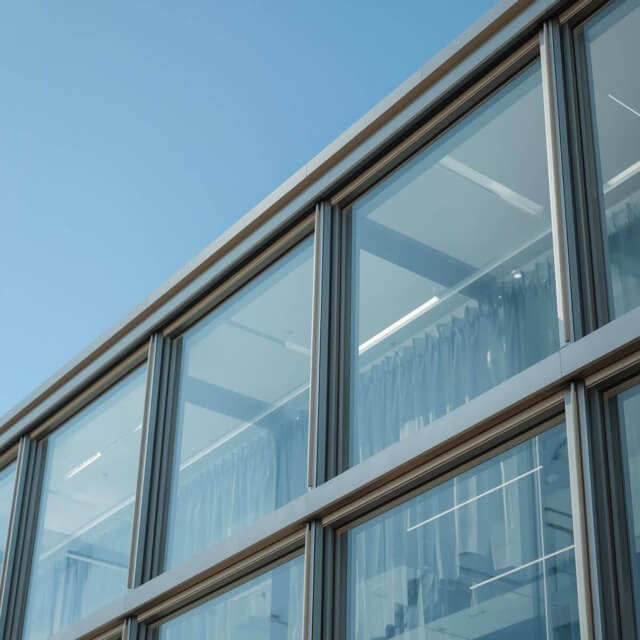
Instead of pursuing the impractical goal of impenetrable walls, the logical strategy is to harden the building’s most vulnerable elements with engineered retrofit security glazing systems. This functions as a sophisticated bulletproof glass alternative, transforming a building’s weakest points into resilient components of its defense system.
Retrofit security glazing is a protective system, typically featuring a core of polycarbonate sheets, that is custom-fabricated and mounted over existing windows and doors. Unlike full ballistic glass replacement, these patented systems are anchored to the existing framing. This creates a protective shield on the interior or exterior of the primary glass, engineered to absorb and dissipate energy from ballistic and physical attacks.
This surgical retrofit application provides a superior return on investment and aligns with the realities of building management. Installation occurs over the existing glass, eliminating the need for demolition or lengthy construction. The systems are designed to be optically clear and virtually invisible, preserving the original architectural design, sightlines, and passage of natural light. The system also creates a buffer zone, protecting the original glass from impact and containing shards. By strategically applying retrofit security glazing, the entire building envelope security is elevated.
The Science of Invisible Armor: How Patented Retrofit Systems Work
Modern retrofit systems offer a calculated, system-based approach to architectural hardening. This is not simply a new layer over an old one, it is a method where every component is engineered to work in concert to defeat a threat.
The BulletShield system, for example, is an engineered assembly that relies on three core components working together.
- The Glazing Infill: A robust sheet of polycarbonate or a multi-laminate composition, selected for the specified threat level.
- The Patented Framing: Custom-extruded aluminum frames are mechanically anchored to the existing window or door mullions. This frame creates a critical air gap and securely holds the glazing infill.
- The Energy-Absorbing Gaskets: Specialized gaskets within the frame cushion the infill, allowing it to flex and deform upon impact to absorb energy without catastrophic failure.
This over-glazing approach isolates the original window from an attack, preserving its weather seal while the BulletShield system stops the threat.
Decoding UL 752 Ratings for Ballistic Resistance
In security engineering, claims must be substantiated by independent testing. The primary standard for ballistic resistance is UL 752, which defines levels of protection based on the firearm, ammunition, and number of shots a material can withstand.
- UL 752 Level 1: Stops three shots from a 9mm handgun.
- UL 752 Level 2: Stops three shots from a .357 Magnum handgun.
- UL 752 Level 3: Stops three shots from a .44 Magnum handgun.
- UL 752 Levels 4-8: Rated for various types of rifle fire, including assault rifles (Level 7) and high-powered military rifles (Level 8).
These systems are rigorously tested and certified by Underwriters Laboratories to meet specific UL 752 levels, providing verifiable proof of performance. The material at the heart of these systems is typically polycarbonate. Unlike brittle glass, polycarbonate is a ductile polymer that deforms, stretches, and absorbs an incredible amount of energy. With light transmission values often exceeding 90 percent, modern security glazing is virtually indistinguishable from standard glass, resolving the conflict between security and design.
Conclusion: Reframing Architectural Security Beyond Walls
The search for a solution like bulletproof sheetrock stems from a valid need for enhanced safety. The concept itself, however, leads to impractical and disruptive outcomes. True architectural security requires a targeted and intelligent approach. It is not about creating opaque, windowless fortresses, but about strategically hardening a building’s most vulnerable points while preserving the openness and design intent that define modern architecture.
Effective security begins with a proper threat assessment that identifies the most likely threat vectors, which are nearly always windows and glass doors. Attackers follow the path of least resistance. Investing heavily in fortifying walls, which are already robust and rarely targeted, is an inefficient use of security budgets. The strategic imperative is to focus resources where they will have the greatest impact. Hardening a building’s glazing with a professionally engineered retrofit system directly addresses the most significant and quantifiable vulnerability, transforming the weakest link into a resilient barrier.
For architects and facility managers, the path forward involves clear, actionable steps. First, commission a professional threat, vulnerability, and risk assessment (TVRA) to provide the objective data needed for informed decisions. Next, re-evaluate the specification process to integrate security glazing considerations into the early stages of design. Finally, consult with specialists in architectural security. Engaging with experts who understand the nuances of ballistics, forced entry, and blast mitigation allows you to specify a solution that is precisely tailored to your project’s unique risk profile, budget, and aesthetic requirements. This collaborative approach is the key to achieving security that is both effective and invisible.
Frequently Asked Questions
What is bulletproof sheetrock?
The term “bulletproof sheetrock” is a conceptual search query, not a real-world product. It represents the desire for a seamless, aesthetically invisible way to harden a building’s interior. The actual engineered solutions are ballistic resistant panels installed behind drywall, a process that is costly, disruptive, and structurally demanding.
Is it better to harden walls or windows?
Security experts and threat assessments consistently show that attackers target the path of least resistance. In modern buildings, this is almost always the glass in windows and doors, not the opaque walls. Therefore, a more effective and efficient security strategy focuses on hardening these known vulnerabilities first.
What is retrofit security glazing?
Retrofit security glazing is an engineered system, such as DefenseLite or BulletShield, that is installed over a building’s existing glass. It consists of a durable glazing material like polycarbonate held in a patented, anchored frame. This system is designed to absorb the energy from ballistic or forced entry attacks without requiring the costly and disruptive replacement of the original windows.
Does security glazing block natural light or views?
No. High-quality retrofit security glazing systems are made from optically clear polycarbonate with light transmission values often exceeding 90%. When professionally installed, the system is virtually invisible, preserving the building’s original aesthetic, access to natural light, and clear sightlines.
What are UL 752 ratings?
UL 752 is the “Standard for Bullet-Resisting Equipment” from Underwriters Laboratories. It is the industry benchmark for certifying the performance of security materials. The standard has multiple levels, from UL 752 Level 1 (resisting 9mm handgun rounds) to Level 8 (resisting 7.62mm rifle rounds), allowing architects to specify protection precisely matched to a facility’s assessed threat level.