Table of Contents
Introduction: Why Security Glazing Matters for Today’s Schools
Where School Security Plans Break Down: Glass as the Weakest Link
The Value of Delay in School Security and Active Shooter Scenarios
Security Glazing Standards for Schools: From Code Compliance to ASTM F3561
Types of School Security Glazing Solutions and Materials
Retrofit Security Glazing for Existing Schools: Process, Cost Drivers, and Real-World Examples
FAQs: Security Glazing for Schools and Educational Settings
Why Choose Impact Security for School Security Glazing Projects
Next Steps and Call to Action for School Leaders
Introduction: Why Security Glazing Matters for Today’s Schools
In multiple K-12 incidents between 2018 and 2025, intruders and active shooters exploited glass doors, sidelites, and ground-floor windows to bypass locked entries in seconds. At the Covenant School in Nashville, a shooter fired through locked glass doors to gain access. At Sandy Hook, the attacker shot through glass next to an aluminum entry door, reached in, and unlatched the lock. Standard glass can fail in seconds under deliberate force, and these tragedies confirmed that glass is routinely the fastest path inside a school building.
Security glazing for schools refers to glazing systems engineered to resist forced entry and, in some cases, ballistic threats. This includes multi-ply laminated glass, polycarbonate shields, and retrofit panels-not ordinary tempered safety glass or basic window film. Specialized glass and films delay intruders and provide valuable time for evacuation and lockdown procedures. Hardened glazing is critical for school security alongside access control measures, staff training, and law enforcement coordination.
This article is written for superintendents, facility directors, architects, security consultants, and school board members making decisions in educational settings. You will learn where school security plans typically fail at the glass, how standards like ASTM F3561 work, what materials and systems are available, and how Impact Security retrofits existing school glass without full replacement.
Where School Security Plans Often Break Down: Glass as the Weakest Link
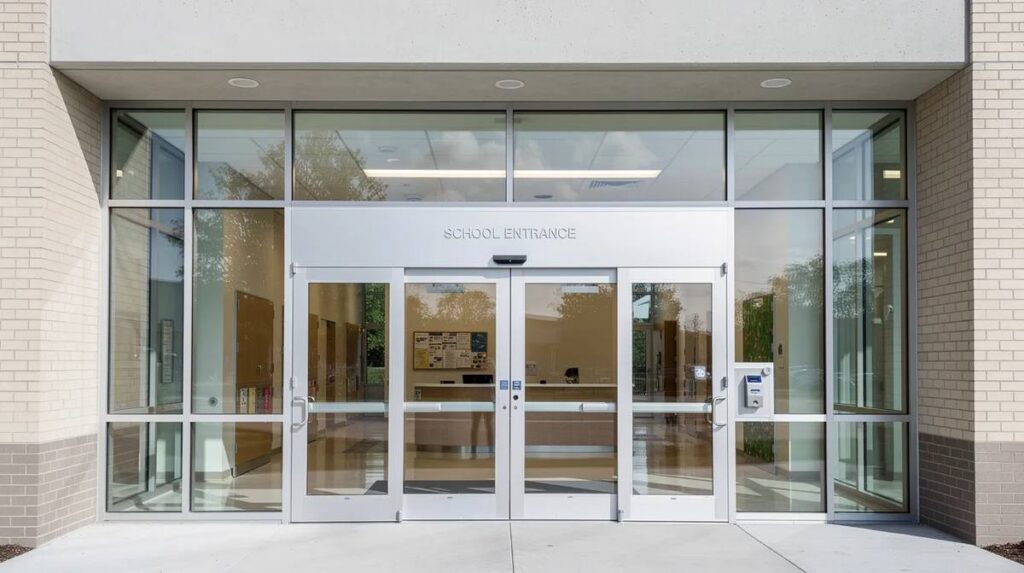
In many school buildings, forced entry begins not at locks or hardware but at glazed openings-doors, sidelites, and ground-floor windows. An intruder can knock out a small area of standard glass next to a door lever in under 30 seconds, reach through, and unlatch the lock from inside, bypassing otherwise secure access control entirely. FBI and ALERRT research confirms that attackers exploit these glazed elements far more often than walls or reinforced hardware.
Code-compliant glazing meeting ANSI Z97.1 and 16 CFR 1201 is designed for impact safety against accidental breakage-protecting occupants from cuts and falls. These standards were never intended to address determined attackers using hammers, tools, or firearms. Standard glass offers little resistance under deliberate force and provides almost no delay, which is why purpose-built forced entry security glazing for doors and windows is increasingly specified for vulnerable openings.
Typical weak points in schools include:
- Vestibule and main entrance doors with sidelites
- Classroom doors with glass panels
- Office transaction windows and interior partitions along corridors
- Large lobby curtain walls near main entrances
Older school buildings from the 1960s through 1990s often have wired glass, monolithic tempered glass, or thin laminated units that fail on first impact. School security glazing should turn glass from a single-hit failure into a time-barrier that slows the intruder and supports lockdown procedures.
The Value of Delay in School Security and Active Shooter Scenarios
Roughly 70% of active shooter incidents end within five minutes. Average law enforcement response times to campuses vary widely-often exceeding that window depending on geography. Every additional minute that security glazing can delay unauthorized entry allows more time for PA announcements, classroom lockdowns, 911 dispatch, and first responders to arrive on scene.
This is the time-distance principle in practice. Security glazing provides valuable time for lockdown procedures by keeping the building envelope intact long enough for occupants to act. Systems engineered for this purpose remain in the frame after repeated impacts-even when cracked-preventing a man-sized opening from being created quickly.
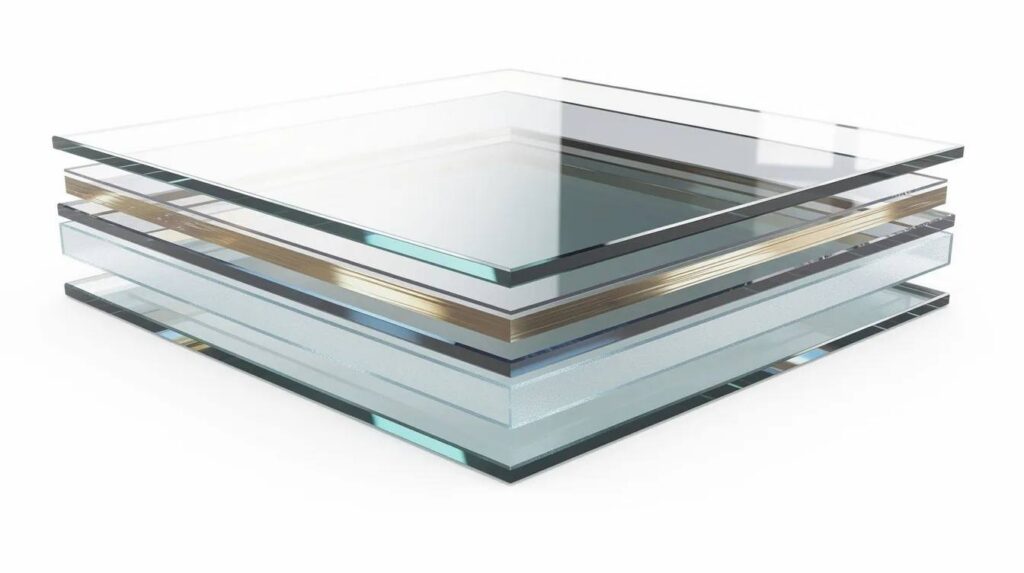
Multi-ply laminated glass holds fragmented pieces together upon impact, absorbing energy across its layers. Polycarbonate sheets are virtually unbreakable and flex rather than shatter, distributing force differently than standard glass. Retrofit shields like DefenseLite Pro advanced impact security glazing or BulletShield mount over existing frames, adding a dedicated forced entry resistance layer. DefendEd systems, for example, provide over 14 minutes of forced entry resistance-security glazing can withstand attacks for over 14 minutes in tested conditions. Replacing standard glass in a typical aluminum-framed school vestibule with forced-entry resistant glazing increased breach time from seconds to minutes, aligning directly with the window needed for effective lockdowns.
Delay Benefits at a Glance:
- More time to detect the threat
- More time to communicate via PA and 911
- More time for students and teachers to secure classrooms
- More time for first responders to reach the building
Security Glazing Standards for Schools: From Code Compliance to ASTM F3561
There is a critical distinction between safety standards and forced entry standards. Safety glazing codes under the international building code, ANSI Z97.1, and 16 CFR 1201 protect occupants from injury during accidental breakage. They do not address a determined intruder.
Security glazing must meet ASTM F1233 and ASTM F3561 standards to qualify as forced-entry or ballistic resistant. ASTM F1233 has long been the benchmark for security glazing materials. Ballistic standards like UL 752 classify resistance by firearm type and round count. BulletShield ballistic-rated retrofit glazing protects against specific firearm threats and is often specified for front office transaction windows or safe rooms.
ASTM F3561-22 is the standard test method for forced entry resistance of fenestration systems after a simulated active shooter attack. It evaluates complete assemblies-glass, framing, and locking hardware together, not components in isolation. Testing includes both glass and locking mechanisms as a complete assembly. The standard includes eight levels of forced entry testing, with a pendulum delivering progressively higher energy impacts, cumulatively reaching up to 3,600 foot-pounds. ASTM F3561-22 focuses on forced entry resistance after glass weakening by ballistic rounds, then determines whether an opening large enough for entry is created. Security glazing is engineered to resist forced entry during attacks, and this standard quantifies exactly how well.
Emerging building codes are catching up. The National Glass Association’s proposal aims to include security glazing in 2027 building codes. State legislation-such as Tennessee’s SB 0274-already requires entry-resistant glazing on exterior doors and windows in new or remodeled public schools. The glass industry is moving toward making forced entry standards a baseline for K-12 construction rather than an optional upgrade. School administrators and architects should track these developments closely.
Types of School Security Glazing Solutions and Materials
School security glazing is a category, not a single product. It spans multiple material families, each suited to different locations and potential threats within a building, and shares many principles with broader bulletproof windows, doors, and security window film solutions.
| Material | Typical School Use | Threat Addressed | Key Benefit |
|---|---|---|---|
| Laminated security glass (proprietary interlayer, SGP, PVB) | Entrance doors, sidelites | Forced entry, fragment retention | Laminated glass holds fragmented pieces together upon impact |
| Polycarbonate / glass-clad polycarbonate | Safe rooms, high-risk windows | Ballistic, heavy forced entry | Virtually unbreakable, lightweight |
| Retrofit shields (DefenseLite, BulletShield) | Doors, windows, storefronts | Forced entry, ballistic | Installs over existing frames, minimal disruption |
| Security window film | Classroom windows, interior glass | Fragment retention, minor delay | Affordable, easy to install, limited forced entry resistance |
| Insulated glass units with security layers | Exterior windows | Forced entry + energy efficiency | Insulated glass units combine security with energy efficiency |
| Advanced fire-rated glass | Corridor partitions, stairwells | Fire and intrusion | Advanced fire-rated glass offers protection against fire and intrusions |
Heavy-duty films can be retrofitted to existing windows for improved security, and ballistic window films that enhance anti-breach performance keep shattered glass intact, preventing injury. However, film alone does not make glass bulletproof and provides only marginal delay under serious attack. It is not a substitute for tested forced entry or ballistic glazing.
Transparent security glass allows visibility for supervision throughout hallways and classrooms. Security glazing balances natural light and safety for schools, maintaining the open, student-centric atmosphere that modern educational environments require and aligns with many bulletproof window and glass security system offerings. Choosing security glazing requires a risk assessment for threat mitigation-performance levels should be tailored by location, with higher-rated systems at main entrances and front offices, and impact-resistant options for interior spaces.
Retrofit Security Glazing for Existing Schools: Process, Cost Drivers, and Real-World Examples
Many districts prefer retrofit over full replacement because it upgrades existing windows and doors without major demolition. Security glazing integrates with existing door and window systems, preserving existing frames and allowing work to be completed during summer or midterm breaks with minimal disruption.
Impact Security’s typical process for K-12 projects follows a clear line, reflecting the company’s broader mission and expertise in advanced security glazing solutions at Impact Security, LLC:
- Site assessment and risk review – mapping all glazed openings, evaluating threat levels, and reviewing framing conditions
- Engineering and fabrication – custom solutions manufactured at U.S. facilities in Marietta, GA and Glendale, AZ
- Professional installation – completed by certified dealers with coordination around school schedules
- Warranty and service – ongoing support and performance verification
Key cost drivers include square footage of glass, threat level (forced entry only versus ballistic), complexity of framing, phasing across multiple campuses, and schedule constraints. Security glazing supports broader safety planning in schools by fitting into existing capital improvement cycles, as outlined in this comprehensive school security update on reinforcing window and door glass.
When budgets are limited, school administrators should focus first on main entrances and vestibules, then reception and front office transaction windows, then highly exposed classroom doors and sidelites. This prioritization addresses the locations where intrusion risk is highest and where delay provides the greatest benefit to occupants.
Practical considerations include maintaining clear sightlines for supervision, ensuring ADA-compliant egress hardware on all doors, coordinating with fire marshals on evacuation routes, and preserving natural light in classrooms and common spaces.
FAQs: Security Glazing for Schools and Educational Settings
What is the difference between safety glass and school security glazing? Safety glass (tempered, wired, or basic laminated) is designed to reduce injury from accidental breakage by controlling fragmentation. School security glazing is engineered to resist forced entry during deliberate attacks-tools, fists, or firearms-and is tested under standards like ASTM F3561 and ASTM F1233.
Does ASTM F3561 testing mean the glass is bulletproof? No. ASTM F3561-22 includes eight levels of forced entry testing and focuses on whether the system resists entry after ballistic weakening-not whether it stops every round. Separate ballistic standards like UL 752 address projectile stoppage.
Can we retrofit security glazing into existing school windows and doors? Yes. Most glazed openings can be retrofitted using shield panels or laminated glass replacements that install over existing frames. Full replacement is typically only necessary when frame conditions cannot support the retrofit or when high-level ballistic resistance is required.
How does security glazing interact with access control, alarms, and lockdown procedures? It is complementary. Security glazing delays the intruder so that lockdowns can take effect, alarms can trigger, and law enforcement gains valuable time. It reinforces other measures rather than replacing them.
Will forced-entry glazing darken classrooms or make our school feel like a fortress? Not typically. Security glazing enhances learning environments by maximizing natural light. Modern materials maintain clarity and visibility, and retrofit shields are often nearly invisible once installed.
How long does a school security glazing retrofit take? For entrances and sidelites at a single building, installation can take approximately one week. Larger multi-campus projects may take several months. Summer breaks are the ideal scheduling window.
How does security glazing compare to security window film in cost and performance? Film is more affordable and easier to install but provides only minor delay and limited forced entry resistance. Tested security glazing or retrofit shields like DefenseLite compared with traditional security glass film deliver significantly higher performance and longer delay, making them the preferred choice for high-threat locations in educational settings.
Why Choose Impact Security for School Security Glazing Projects
Impact Security is a U.S.-based manufacturer and installer specializing in retrofit security glazing systems for K-12 and higher-education campuses. Founded in 2016 and headquartered in Marietta, Georgia, the company delivers turnkey service-from assessment and engineering through fabrication, installation, and warranty-via a national dealer network of certified professionals.
Key product families for schools include DefenseLite for forced entry resistance, BulletShield for ballistic protection, and custom safe-room solutions. These systems are designed to comply with and exceed emerging forced entry standards like ASTM F3561, helping districts stay ahead of evolving building codes and state mandates. Security glazing is engineered to resist forced entry attacks while maintaining the natural light, durability, and welcoming atmosphere that school communities expect. Impact Security’s retrofit approach offers a cost-effective alternative to full window replacement, minimizing construction disruption and preserving the technology and materials already in place across your campuses.
Next Steps and Call to Action for School Leaders
Security glazing transforms vulnerable school glass into a verified time-barrier against forced entry and active shooters, supports lockdown procedures, and aligns with evolving standards like ASTM F3561. Security glazing can delay unauthorized entry by several minutes-time that directly protects children, students, and staff.
If you are a facilities director, superintendent, architect, or security consultant responsible for protecting school spaces, request a free site assessment from Impact Security. Identify your highest-priority glazed locations, get a detailed estimate, and connect with a certified installer in your region. The ideal time to begin planning security glazing upgrades is six to nine months before your next major school break, giving your team the course of action needed for summer installation.
Bring this article to your next school safety committee meeting or board session as a shared resource. The decisions you make about your building envelope today determine how much protection your schools provide tomorrow.