Table of Contents
Why Forced Entry Resistant Doors Matter in 2026
What Are Forced Entry Resistant Doors and How Do They Work?
Testing & Rating Standards for Forced Entry and Ballistic Resistance
Ballistic vs Forced Entry: Choosing the Right Level of Protection for Your Facility
Applications, Budgeting, and Why Choose Impact Security
FAQs About Forced Entry Resistant Doors and Security Glazing
Introduction: Why Forced Entry Resistant Doors Matter in 2026
The threat landscape facing U.S. buildings has shifted dramatically. Between 2020 and 2024, the FBI reported that flash mob shoplifting incidents across the country involved more than $8 million in stolen property and over $51,000 in property destruction-events that frequently begin with forced entry through doors and windows using blunt tools. At the same time, 67% of public schools reported at least one violent incident during the 2021–22 school year, according to the School Survey on Crime and Safety. A 2026 study by the Security Industry Association and the ALERRT Center found that unsecured or propped-open doors were involved in roughly 69% of school shooting incidents where the perpetrator gained access, confirming that locked, hardened entry points directly reduce casualties.
These converging trends-organized retail crime, active shooter risk, and rising awareness of building vulnerabilities-are pushing facility managers, school districts, and government agencies to rethink what their entry doors can actually withstand. Forced entry resistant doors are engineered assemblies-door slabs, frames, hardware, and often glazing-that are designed and tested to delay or prevent intrusion by attackers using sledgehammers, pry bars, battering rams, and other tools. FE doors slow or prevent unauthorized building entry, and they are now widely used in schools, retail, and government buildings. When combined with ballistic resistance, these assemblies create a barrier that addresses both physical and firearm threats.
This article is written for B2B and B2G decision-makers-facility managers, security directors, school boards, and procurement officers-who need to evaluate whether to specify or retrofit forced-entry-resistant doors and security glazing. Throughout, we’ll reference Impact Security, a U.S.-based manufacturer and installer of retrofit forced entry resistance and ballistic glazing systems (including DefenseLite and BulletShield) that strengthen existing entry doors and fenestration systems rather than requiring full tear-out replacements.
Here’s what you’ll learn: how forced entry doors are tested under ASTM F3038 and DOS SD-STD-01.01 Rev G, what an entry bullet resistant assembly really means, typical costs and real-world use cases, and how retrofit glazing can deliver forced entry bullet resistant performance on your existing openings without replacing every door in the building.
What Are Forced Entry Resistant Doors and How Do They Work?
Forced entry resistant doors are engineered assemblies-door leaf, frame, hardware, and frequently integrated glazing-designed to withstand timed, tool-based attacks by one or more intruders. Unlike a standard commercial hollow metal door or a residential steel door from a big-box store, a true forced entry door has been subjected to rigorous third-party tested protocols that measure how long the complete assembly resists sustained physical assault. FE doors provide time for law enforcement to respond to burglaries, active threats, or other security emergencies. The goal is delay, not invincibility.
How FE Doors Differ from Standard Doors
Most commercial entry doors sold in the U.S. have never been tested against any forced entry standards. They may carry a fire rating or meet basic building code requirements for egress, but they offer minimal resistance to a determined attacker with a pry bar or sledgehammer. Forced entry resistant doors, by contrast, are rated at specific delay intervals-5, 15, 30, or 60 minutes-during which the assembly must prevent an exploitable opening (typically no larger than 12″ × 12″) from being created.
No forced entry resistant door is “attack-proof.” The performance goal is buying critical minutes while maintaining no exploitable opening-enough time for lockdown procedures, alarm activation, and law enforcement arrival.
Forced entry resistant doors are designed to withstand intense physical attacks. They are not required to be ballistic resistant, though many high-threat facilities now specify combined ballistic and forced entry protection. That distinction matters for budgeting and specification, and we’ll cover it in detail below.
Materials and Construction
FE doors can be made from aluminum, composites, wood, or steel. However, steel is the strongest material for FE doors, and most high-rated assemblies rely on heavy-gauge steel (10–12 gauge or thicker) for the door leaf and frame. These doors are constructed from durable materials like heavy-duty steel or impact-resistant fiberglass, with composite cores adding rigidity and impact absorption.
The door leaf is only one piece of the puzzle. Reinforced frames are crucial as many forced entries occur due to frame failure-attackers exploit the weakest point, and a strong door in a weak frame is functionally no better than no door at all. Key hardware considerations include:
- Multi-point locking systems make it much harder to pry doors open. Multi-point locking mechanisms engage the door frame at multiple points for enhanced security, distributing force across the lock edge and hinge edge rather than concentrating it at a single strike.
- Heavy-duty strike plates with long screws improve door security significantly, anchoring the lock engagement directly into structural framing rather than just the door jamb.
- A strong deadbolt should have hardened steel components and security certification to resist cutting, drilling, and forced rotation.
- These doors feature tamper-proof hardware to prevent removal from outside, including security hinges with non-removable pins and concealed fasteners.
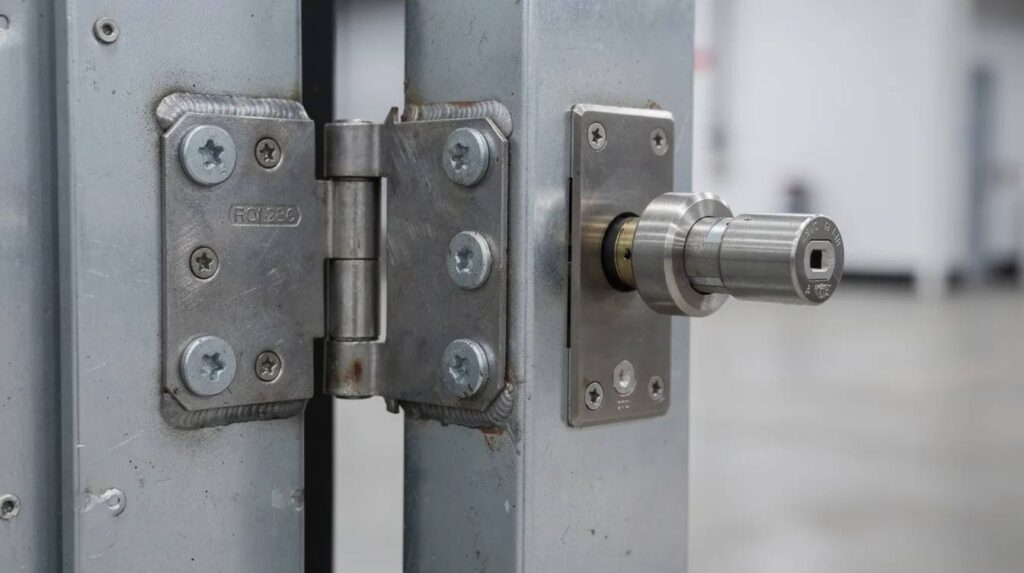
Door thickness also plays a role. Thicker door leaves accommodate heavier cores and deeper lock pockets, but they must be matched with frames and hardware rated for the same forced entry resistance level.
The Role of Glazing
Many entry doors include vision lites, sidelites, or adjacent storefront glass-and these are frequently the weakest link. Reinforced glazing with laminated security glass provides added protection against forced entry, but only when the glazing is tested as part of the complete assembly. Polycarbonate shields, glass-clad polycarbonate, or laminated layups that resist impact and prying are standard in rated forced entry resistant systems.
This is where Impact Security’s approach is particularly relevant. Rather than selling complete door slabs, Impact Security focuses on protecting the vulnerable glass in existing entry doors, sidelites, and storefronts with forced entry resistant retrofit systems that integrate with current hardware and frames. Their DefenseLite retrofit security glazing and BulletShield products mount directly over or behind existing glazing, creating a tested protective layer without full window or door replacement.
Proper installation enhances the security of a forced entry-resistant door. Even the best materials fail if installed incorrectly-gaps at the frame, improperly anchored hardware, or glazing with insufficient “bite” (the depth of glass held within the frame) can create exploitable weaknesses. Robust construction serves as an immediate visual deterrent to potential burglars, and forced entry-resistant doors provide exceptional peace of mind as a physical barrier against intruders for the personnel inside.
Testing & Rating Standards for Forced Entry and Ballistic Resistance
Independent, third-party tested performance is what separates a genuine forced entry resistant door from a marketing label. Terms like “heavy-duty” or “high-security” have no standardized meaning. Testing standards evaluate complete door assemblies for forced-entry resistance-not just the door leaf, not just the lock, but the entire system including frame, hardware, and glazing performing together under attack.
Impact Security’s systems are tested at accredited laboratories to recognized forced entry standards, not through in-house demonstrations alone. For specifiers and security consultants comparing products, understanding these standards is essential.
ASTM F3038: The Standard Test Method for Timed Evaluation of Forced Entry Resistant Systems
ASTM F3038-21 is a widely used forced entry standard for evaluating how long an assembly resists a coordinated physical attack. The standard test method calls for a man concentrated assault team of up to six attackers armed with tools including sledgehammers, pry bars, bolt cutters, battering rams, and other implements. The team targets the most vulnerable areas of the assembly-the lock edge, hinge edge, center of the door, and any glazing.
F3038 has four timed test levels: 5, 15, 30, and 60 minutes. At each level, the assembly must prevent the attackers from creating an opening large enough for passage. FE doors are tested against attacks using various tools, and the timed evaluation measures real-world delay capability.
Key details for specifiers:
- Forced entry tests simulate attacks by 2 to 6 attackers depending on the rating level and test configuration. A 5-minute test may use fewer attackers; the full 60-minute test deploys the complete team with the broadest toolset.
- FE doors can withstand focused attacks for up to 60 minutes at the highest rating tier, though many school and commercial applications target the 15- or 30-minute levels.
- FE doors can withstand attacks from multiple intruders working simultaneously on different attack points.
- The standard requires testing the complete assembly. If you change any component-a different lock, a different frame profile, a different glazing type-the assembly must be retested.
US Department of State SD-STD-01.01 Rev G
The Department of State standard SD-STD-01.01 Rev G was originally developed to protect U.S. diplomatic facilities and embassies from coordinated attacks. It remains one of the most stringent department standards for security doors and fenestration systems, and it is now referenced for mission critical buildings, courthouses, guard houses, control rooms, executive offices, and critical infrastructure across the federal government.
The Rev G standard includes timed tests for forced entry, combined with ballistic resistance requirements. Rev G tests include 5, 15, and 60-minute scenarios (with the time dos st std protocol varying by threat level). In a typical FEBR test sequence, the assembly is first subjected to ballistic fire at the specified level, and then the man concentrated assault team attacks the damaged assembly with tools for the rated duration. This simulates a real-world scenario: a mob attack attempting to breach a building after initial gunfire.
The DOS standard is where the concept of the forced entry bullet resistant (FEBR) assembly originates. A FEBR assembly combines ballistic resistance against specified calibers with forced entry resistance against timed tool attacks-the assembly must survive both.
Anywhere the highest level of protection is specified, you will likely encounter SD-STD-01.01 Rev G in the project documents. The stringent department requirements under this standard mean that every component-frame, glazing, hardware-must be validated together.
Ballistic Standards: UL 752 and NIJ
Ballistic resistance is rated separately from forced entry resistance. UL 752 defines eight levels of bullet resistance:
| UL 752 Level | Threat | Typical Application |
|---|---|---|
| Level 1–3 | Handgun rounds (9mm, .357 Mag, .44 Mag) | Retail counters, bank teller lines, school entries |
| Level 4–5 | Higher-velocity handgun and some rifle | Government lobbies, courthouses |
| Level 6–8 | Rifle rounds (5.56mm, 7.62mm, .30-06 AP) | Embassies, military, critical infrastructure |
NIJ standards provide parallel ballistic ratings used primarily by law enforcement and defense agencies, and detailed UL 752 and NIJ ballistic resistance standards help define appropriate protection levels. Specifiers must list both the ballistic resistance level and the forced entry resistance duration in Division 08 specifications.
Related Standards for Fenestration and Active Shooter Scenarios
Several additional standards apply specifically to glazing, fenestration systems, and simulated active shooter attack scenarios:
- ASTM F1233 covers security glazing materials and systems for combined ballistic and forced entry performance.
- ASTM F3561 (2022) tests forced entry resistance of fenestration systems after a simulated active shooter attack-meaning the window or door is first shot, then attacked with tools. This standard is increasingly specified for schools and public buildings, and recent school security updates on reinforcing window and door glass highlight its growing adoption.
Some FE and FEBR systems achieve both an entry bullet resistant assembly rating (UL 752 Levels 1–8) and forced entry resistance (ASTM F3038 or SD-STD-01.01 durations). For applications durability and long-term performance, specifiers should verify that the tested assembly matches the exact configuration being installed.

Fire Rating Considerations
Fire rating is a separate issue from forced entry or ballistic resistance. Individual components like cores or glazing may carry a UL 10C 60- or 90-minute fire rating, but a true fire + FEBR rating requires the entire assembly to be tested as a unit. Combining fire, ballistic resistance, and forced entry resistance in a single assembly greatly increases complexity, weight, and cost. These are important considerations during the specification process, especially for corridors and stairwell doors where both life-safety and security requirements converge.
Ballistic vs Forced Entry: Choosing the Right Level of Protection for Your Facility
Understanding the difference between ballistic resistance and forced entry resistance-and knowing when you need both-is the most consequential decision in specifying security doors and glazing for a building.
Ballistic resistance stops bullets. Forced entry resistance delays physical intrusion. Many high-risk facilities now specify combined ballistic and forced entry protection for entry doors, glass lobbies, and storefronts because modern threats rarely fall into a single category. An active shooter may fire through a door and then attempt to force it open. A mob attack may involve thrown objects and then sustained prying. The protection and applications durability requirements depend on the threat profile.
Comparing the Two Approaches
- Ballistic resistance focuses on stopping projectiles at rated calibers (UL 752 or NIJ levels). A door that stops a rifle round may still be vulnerable to a sustained attack with a pry bar or sledgehammer if its frame, hardware, or glazing aren’t rated for forced entry.
- Forced entry resistance focuses on delaying physical intrusion using tools for a specified duration. A 60-minute FE door may offer no protection against rifle fire unless it incorporates ballistic materials.
- A FEBR assembly combines ballistic resistance with forced entry resistance and is typically required by the US Department of State and other federal agencies. This is the assembly quick cut sheet that procurement officers look for on high-threat projects.
Threat Scenarios by Sector
Schools and universities. The primary threats are active shooters and forced entry into classrooms or main entries. Locked doors are a critical factor in reducing school shooting casualties. Many districts address this through ballistic retrofit glazing such as BulletShield combined with forced entry retrofit glazing over existing doors and sidelites-upgrading the glass portions without replacing entire door assemblies. Schools often target 15- to 60-minute forced entry resistance on primary entries.
Retail chains and pharmacies. Smash-and-grab events, rioting, and organized retail crime typically involve attackers using bats, bricks, and sledgehammers against glass entry doors and storefront fenestration systems. Storefront security solutions for glass doors and windows focus on forced entry resistance as the primary need, though some high-value retail locations (pharmacies, jewelry stores) add ballistic glazing at lobbies or service counters.
Government, courts, and critical infrastructure. Coordinated attacks require DOS-style FEBR doors and windows with 15–60 minute ratings and rifle-level ballistic resistance. Guard houses, control rooms, executive offices, and secure corridors at mission critical buildings all fall under this category.
How Retrofit Systems Deliver Both
Impact Security’s retrofit systems-DefenseLite for forced entry resistance and BulletShield for ballistic protection-are applied over existing entry doors and windows to create a forced entry resistant and/or ballistic resistant barrier. The approach works through:
- Non-invasive attachment to existing frames, preserving the original door and surrounding structure
- Clear polycarbonate or laminated shields forming a “sacrificial” outer layer that absorbs impact energy
- Tested performance to specific forced entry protocols and ballistic levels, validated at accredited labs
- Compatibility with existing access control, alarm systems, and egress hardware
Cost Realities
High-performance FE doors require significant investment for security, but the cost differences across tiers are dramatic. FEBR doors cost six times more than bullet-resistant doors. FEBR doors cost 35 times more than standard steel security doors. A factory-built FEBR assembly with frame, leaf, hardware, ballistic core, and certified glazing can run into the tens of thousands of dollars per opening.
For many organizations, retrofitting existing entry doors and glass with forced entry and ballistic retrofit glazing delivers the needed level of protection at significantly lower cost and minimal downtime. Instead of replacing every door, you upgrade the vulnerable glass-often the weakest point-and achieve measurable forced entry resistance and ballistic performance on the portions that matter most.
Certified impact-resistant doors can also qualify homeowners for insurance discounts, and similar insurance and risk-reduction benefits apply to commercial and institutional properties that demonstrate hardened entry points.
How to Decide
- Forced entry only is adequate for burglary resistance at back-of-house entries, warehouse doors, or locations with no realistic firearm threat.
- Ballistic plus forced entry (FEBR) is justified at K-12 front entries, city halls, courthouses, religious facilities, law enforcement lobbies, and anywhere the highest level of security is required against combined threats.
- When in doubt, involve a security consultant or architect to perform a risk assessment and create a layered protection strategy combining doors, glazing, access control, and electronic security. The location, response time of local law enforcement, occupancy type, and threat history all factor into the right level of protection.
Applications, Budgeting, and Why Choose Impact Security
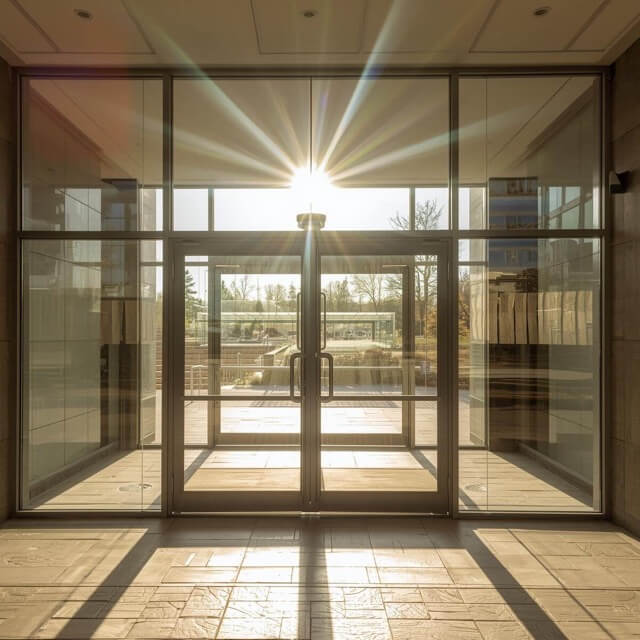
Forced entry door and glazing solutions are typically installed at the most vulnerable and highest-traffic openings in a building: main entry doors, vestibules, storefronts, glass lobbies, reception counters, server rooms, safe rooms, and secure corridors. You’ll find them in schools, government buildings, hospitals, banks, national retail chains, and anywhere personnel need a dependable barrier between the interior and an external threat.
Budget Guidance
Complete factory FEBR door assemblies-with frame, leaf, hardware, ballistic core, and certified glazing-can reach tens of thousands of dollars per opening depending on rating, size, and finish. For an entire facility with dozens of openings, the numbers escalate quickly. Rifle-grade ballistic glazing alone can run $700 to $3,000 or more per square foot including framing and support, with lead times of 8 to 16 weeks for custom assemblies.
Impact Security’s forced entry security glazing for doors and windows works with existing doors and frames, often cutting project costs and installation time dramatically while achieving the required forced entry resistance and ballistic performance on the glass portions. Basic forced entry retrofit glazing for a standard entry door or storefront opening costs a fraction of a full FEBR door replacement, making it feasible for school districts and retail chains operating under tight security budgets.
Impact Security’s Process
- Threat and vulnerability assessment of existing entry doors and fenestration systems-available through remote consulting or on-site review by certified personnel, often leading to AccessShield advanced door retrofit solutions where full door replacement is required.
- Engineering and specification of the appropriate retrofit system (DefenseLite, BulletShield, or a custom FEBR-style configuration) to meet targeted forced entry and ballistic standards for the specific building and threat profile.
- Custom fabrication at Impact Security’s U.S. facilities in Marietta, GA and Glendale, AZ, with precise tolerances matched to existing entry doors and window frames.
- Professional installation by certified dealers and installers nationwide, including coordination with access control, alarms, and life-safety egress requirements to ensure the system doesn’t compromise emergency exit or fire code compliance.
- Post-install support, warranty, and periodic inspection recommendations to maintain protection and applications durability over the system’s lifespan.
Why Choose Impact Security
- Retrofit specialization. Impact Security focuses on forced entry resistance and ballistic glazing retrofits instead of full tear-out replacements, minimizing downtime and disruption to operating facilities. You don’t have to close a school or shut down a retail location to install protection.
- Proven track record. Systems installed across U.S. school districts, Fortune 500 retailers, and government facilities since 2016, with documented real-world performance during riots, smash-and-grab waves, and attempted break-ins.
- Nationwide certified installer network. Dealers and installers who understand local building codes, Department of State and GSA requirements where applicable, and school security funding constraints specific to each department and jurisdiction.
- Turnkey support. Design assist for architects, stamped engineering where required, and documentation for grant applications or security funding programs. From initial assessment through final inspection, one team handles the entire process.
- Advanced materials and tested assemblies. Impact Security’s systems use advanced materials including high-performance polycarbonate and laminated composites, including DefenseLite Pro impact security glazing, all validated through accredited lab testing-not just marketing demonstrations.
If your facility has glass entry doors, sidelites, or storefronts that represent a security vulnerability, you likely don’t need to replace every door. Request a free assessment from Impact Security to find out how retrofit forced entry resistant or ballistic glazing can secure your building at a fraction of the cost and timeline of full door replacement.
FAQs About Forced Entry Resistant Doors and Security Glazing
Are forced entry resistant doors and forced entry bullet resistant doors the same thing?
They are not. An entry resistant door tested only to forced entry standards (such as ASTM F3038) has been validated against physical attacks-prying, hammering, ramming-but not against bullets. A forced entry bullet resistant door or FEBR assembly has been tested for both ballistic resistance (typically to UL 752 or NIJ levels) and forced entry resistance (to ASTM F3038 or DOS sd std 01.01 Rev G durations). FEBR assemblies are most commonly required on high-threat government projects, courthouses, and facilities protecting critical infrastructure, where the threat profile includes both firearms and sustained physical assault.
Can I retrofit my existing entry doors instead of replacing them with FEBR units?
Yes-and for many facilities, it’s the most practical path. Impact Security’s retrofit glazing systems mount over existing glass door lites, sidelites, and storefronts, turning vulnerable glass into a forced entry resistant and/or ballistic barrier while keeping existing frames and hardware in place. This approach avoids the cost and disruption of full door replacement, preserves architectural aesthetics, and can often be completed in hours rather than weeks. The retrofit system must be tested in the installed configuration to be valid, which is why Impact Security uses lab-validated attachment methods matched to common frame types.
Will forced entry or FEBR doors still meet fire and egress codes?
Life-safety egress cannot be compromised. Locks and hardware on any forced entry resistant door must still allow emergency exit from the interior, and any combined fire + FEBR rating must be validated at the assembly level-not assumed from individual component ratings. Impact Security works directly with authorities having jurisdiction (AHJs), architects, and fire marshals to ensure that retrofit glazing installations comply with egress, fire, ADA, and local building codes. A security upgrade that blocks emergency exit creates a different kind of life-safety hazard, and responsible manufacturers design around this from the start.
How long should my forced entry resistant door or glazing resist an attack?
The answer depends on your facility’s response timeline and threat profile. Common rating durations are 5, 15, 30, and 60 minutes. Schools and government facilities often target 15 to 60 minutes on primary entries because law enforcement response times in many jurisdictions average 7 to 15 minutes, and additional time may be needed for building-wide lockdown and evacuation. Retail locations focused on after-hours burglary resistance may find 5- to 15-minute ratings adequate when paired with alarm systems and monitoring. The key question is: how many minutes does your building need to withstand a break attempt before help arrives?
Do I need ballistic resistance if my main concern is burglary or rioting?
Not necessarily. Many retail and commercial clients focus exclusively on forced entry resistance to defend against smash-and-grab or mob attack scenarios where attackers use blunt tools and improvised weapons rather than firearms. Schools and government facilities, on the other hand, often add ballistic resistance because of the documented firearm threat in active shooter scenarios and blast protection requirements. A short risk assessment with Impact Security can help you determine whether forced entry only or a combined ballistic and forced entry solution is appropriate for your specific threat environment and budget.
How does forced entry resistance for fenestration systems differ from door-only solutions?
Entire fenestration systems-doors, windows, curtain walls, storefronts-must perform as an integrated system. Frames, anchors, and glazing all need to be tested to the relevant forced entry and ballistic standards together, because an attacker will target the weakest component. A secure door next to an unprotected sidelite or storefront window provides an illusion of safety rather than real protection. Impact Security’s systems are designed as integrated protective glazing shields for existing fenestration rather than standalone door slabs, ensuring that every opening in the entry zone meets the specified level of protection. This whole-system approach is what separates a truly secure entry from a building with one strong door and several easy targets.
What’s the difference between “tested” and “rated” when manufacturers describe their security doors?
A product is “tested” when it has undergone evaluation at an accredited laboratory under a recognized standard test method. A product is “rated” when the test results have been formally certified by a listing body or standards organization. Some manufacturers use language like “designed to withstand” or “meets the intent of” a standard-these phrases typically mean the product has not completed full assembly-level testing. Always request the actual test report, the name of the testing laboratory, and confirmation that the tested configuration matches what will be installed at your location. Impact Security provides this documentation as part of every project.