Table of Contents
- Introduction
- Understanding Ballistic Protection Fundamentals
- Types of Bulletproof Materials and Their Properties
- Transparent Bulletproof Materials and Advanced Solutions
- Common Implementation Challenges and Solutions
- Conclusion and Next Steps
- Frequently Asked Questions
Introduction
Bulletproof materials—more accurately termed bullet resistant materials—are engineered substances designed to stop or slow projectiles under specific tested conditions. No material is truly “bulletproof”; instead, products labeled as “bulletproof” are actually bullet-resistant, meaning they can withstand a certain number of rounds from specific calibers of bullets. This critical distinction shapes how security professionals, architects, and individuals should evaluate ballistic protection options.
This guide covers the major types of ballistic materials (metals, ceramics, fibers, and transparent systems), the testing standards that define their performance (UL 752 and NIJ 0101.06), real-world applications across various protection needs, and selection criteria based on threat profiles, weight constraints, and budget. The target audience includes security engineers designing facility protection, property owners evaluating building upgrades, law enforcement agencies selecting protective equipment, and individuals seeking personal or structural defense against ballistic threats.
Understanding bullet resistant materials matters now more than ever. Threats have diversified significantly, with higher-velocity rifle rounds becoming more accessible. Civil infrastructure, public spaces, schools, and commercial facilities face risks that demand thoughtful protection strategies matching specific threat levels to appropriate materials.
Direct answer: The best bulletproof material depends entirely on your application. Options include hardened steel plates (AR500, AR550), ceramic materials like silicon carbide and boron carbide, fiber composites such as Kevlar and UHMWPE, and transparent systems including bulletproof glass and polycarbonate shields. Each corresponds to specific protection levels with distinct trade-offs in weight, cost, durability, and performance.
Key outcomes from this guide:
- Understand how different ballistic materials function to effectively stop bullets
- Navigate UL 752 and NIJ testing standards to select appropriate protection levels
- Compare material properties including weight, cost, and durability for specific needs
- Identify solutions for common implementation challenges
- Make informed decisions about bulletproof products for your application
Understanding Ballistic Protection Fundamentals
Ballistic protection relies on materials engineered to absorb, disperse, and redirect the kinetic energy of incoming projectiles. Ballistic standards are used to test and classify bullet-resistant materials based on their ability to withstand specific rounds from firearms, providing a measurable way to assess their effectiveness.
Testing Standards and Protection Levels
UL 752 Standard for Architectural Protection
The Underwriters Laboratories (UL) has established a set of ballistic standards, known as UL 752, which ranks materials on eight levels of bullet resistance, from Level 1 to Level 8. This standard governs bullet-resisting equipment for buildings, including glazing, barriers, doors, and frames.
The newer 12th edition reclassifies protection using performance designations: UL-HG-A/B/C/D for handgun threats and UL-RF-A/B/C for rifle threats. For example, UL 752 Level 5 requires stopping one shot of 7.62mm (.308) military ball FMJ lead core at velocities between approximately 2,750 to 3,025 fps. Level 7 demands stopping five shots of 5.56mm (.223) rifle ball FMJ at approximately 3,080–3,383 fps.
UL 752 testing requires no penetration and no spall (fragmentation) that could injure someone behind the barrier. Testing also evaluates environmental conditioning, shot grouping, frame anchorage, and overall system integrity.
NIJ 0101.06 Standard for Body Armor
The National Institute of Justice (NIJ) has its own set of ballistic standards that classify bullet-resistant materials into grades ranging from IIA to IV, based on their protective capabilities against different types of ammunition. This standard governs body armor worn by law enforcement and civilians.
- Level IIA: Protects against 9mm FMJ and .40 S&W from short-barrel handguns
- Level II: Higher velocity 9mm FMJ and .357 Magnum JSP
- Level IIIA: Highest handgun protection; tested against .357 SIG FMJ FN, .44 Magnum SJHP
- Level III: Rifle protection; six shots of 7.62×51mm NATO M80 FMJ at approximately 2,780 fps
- Level IV: Ultra-high threat; tested with .30-06 M2 armor-piercing rounds
Understanding which standard applies depends on your application. Building security in high-risk environments often utilizes bullet-resistant doors, windows, and wall panels tested to UL 752 and NIJ ballistic resistance standards, while personal protective equipment follows NIJ standards.
How Ballistic Materials Function
Stopping a projectile requires converting its kinetic energy through multiple mechanisms: decelerating the bullet via hard strike faces, deforming or fragmenting the projectile, spreading impact forces across wider areas, and preventing transmission of fragments.
Hard Armor Principles
Hard armor uses rigid strike faces—metals or ceramics—to shatter or deform incoming bullets. The impact on a hard ceramic face shatters the bullet into smaller fragments that are then caught by a softer backing material to absorb remaining energy. This combination of hardness and energy absorption defines effective hard armor performance.
Soft Armor Principles
Soft armor employs flexible textiles that absorb energy through fiber deformation. When a bullet impacts woven fibers like Kevlar, the fibers stretch and twist to absorb kinetic energy, distributing force across a large area. Soft body armor is generally made of materials like Kevlar or UHMWPE, providing discreet protection against handguns.
The integration of multilayer structures in bulletproof materials is a trend that enhances protective capabilities by combining hard materials like ceramics with flexible materials to absorb impact energy more effectively. This hybrid approach delivers excellent protection while managing weight and cost.
Types of Bulletproof Materials and Their Properties
Each category of ballistic materials offers distinct advantages for various applications. Understanding these differences enables selection of the best bulletproof material for your specific needs.
Steel Armor Materials
Steel is a commonly used bulletproof material, with its effectiveness determined by thickness and special surface treatments, such as abrasion-resistant (AR) steel. AR500 and AR550 designations indicate Brinell hardness levels of approximately 500-550, which helps resist deformation and penetration.
Thickness Requirements and Performance
Steel’s bulletproof performance is primarily determined by its thickness and surface treatment, making it effective against various mechanical attacks. To satisfy UL 752 Level 5 protection against 7.62mm FMJ rounds, steel plates typically require thickness exceeding 6-8mm (0.25-0.3 inches), depending on steel quality and alloy composition.
Weight Considerations
Steel armor carries significant weight penalties. With a density of around 7.8 g/cm³, steel plates for NIJ Level III protection commonly weigh 8-10 pounds per plate. This weight makes steel less suitable for wearable applications but highly effective for stationary installations.
Applications
Steel excels in bullet-resistant doors, wall panels, vehicle armor, and protective barriers where weight is less critical than durability and cost effectiveness performance. Military vehicles frequently incorporate steel armor for protection against high velocity projectiles in harsh environments.
Advantages: Excellent durability, cost-effective for large installations, capable of absorbing multiple hits, long lasting protection
Limitations: Heavy weight, potential corrosion issues, spall generation requiring additional containment, challenging to form into curved shapes
Ceramic Materials
Ceramic materials, such as boron carbide and silicon carbide, are known for their high hardness and lightweight properties, making them effective for bulletproof applications, especially in military and security fields. Ceramics function by shattering incoming projectiles while distributing impact energy across their structure.
Material Types and Properties
Three primary ceramics dominate ballistic applications:
- Alumina (Al₂O₃): Density approximately 3.9 g/cm³, hardness around 15 GPa Vickers. Lowest cost ceramic option but requires greater thickness for equivalent protection.
- Silicon carbide (SiC): Density approximately 3.2 g/cm³, hardness around 26 GPa. Premium choice for Level III/III+ ballistic plates offering superior performance-to-weight ratios.
- Boron carbide (B₄C): Density approximately 2.5 g/cm³, hardness around 35 GPa. Highest performance ceramic with lightest weight, used in critical military applications where cost is secondary to performance.
Performance Characteristics
Ceramic materials effectively disperse bullet energy and prevent penetration through their high hardness. When struck, the ceramic fractures the projectile while a fiber backing (typically UHMWPE or Kevlar) captures resulting fragments. This combination provides excellent protection against rifle rounds while minimizing weight.
Cost Considerations
Cost ratios between ceramics vary significantly. Silicon carbide typically costs 2-3 times more than alumina, while boron carbide can reach 4-8 times alumina pricing. These costs reflect both raw material expenses and manufacturing complexity.
Limitations
Ceramic brittleness presents challenges. Dropped or damaged plates may develop cracks compromising protection. Multi-hit capability in concentrated areas is limited compared to steel. Edge protection and proper backing are essential for maintained performance.
Fiber-Based Materials
Aramid fibers, such as Kevlar and Twaron, are synthetic fibers with extremely high tensile strength used in soft body armor. These materials represent the foundation of flexible ballistic protection worn by law enforcement and available to civilians.
Kevlar and Aramid Fibers
Kevlar offers proven performance against most handgun rounds with density around 1.44 g/cm³. The material maintains strength at high temperatures (400-500°C) and provides consistent protection across various applications. Bulletproof vests utilizing Kevlar weaving patterns effectively stop bullets through energy absorption across multiple layers of tightly woven fibers.
UHMWPE (Ultra-High Molecular Weight Polyethylene)
Polyethylene (UHMWPE) has superior strength-to-weight ratios and is used in soft inserts and hard plates. This lightweight material offers density around 0.97-0.98 g/cm³ with tensile strength of 2.8-3.6 GPa—approximately 30-40% higher specific strength than aramid fibers.
UHMWPE advantages include exceptional chemical resistance, low moisture absorption, and buoyancy. The material excels in applications requiring the lightest possible protection. However, temperature limitations exist: melting point around 130-145°C restricts use in high temperature resistance applications.
Applications
Soft body armor provides discreet protection suitable for law enforcement daily wear and civilian applications. Civilians in high-risk areas may use soft armor, such as inserts designed to fit into standard backpacks. Vehicle armor typically includes Kevlar-lined panels and ballistic glass, alongside other types of bulletproof materials ranked by effectiveness, to protect occupants.
Key Benefits and Limitations Summary
Fiber-based materials offer flexibility, comfort, and reduced weight compared to other materials. However, stopping rifle rounds requires combination with ceramic or steel strike faces. Proper care and replacement scheduling maintain protection levels, as fibers can degrade under exposure to ultraviolet rays and moisture over time.
Transparent Bulletproof Materials and Advanced Solutions
Transparent protection addresses critical needs for windows, observation points, and barriers requiring visibility alongside ballistic resistance.
Ballistic Glass Systems
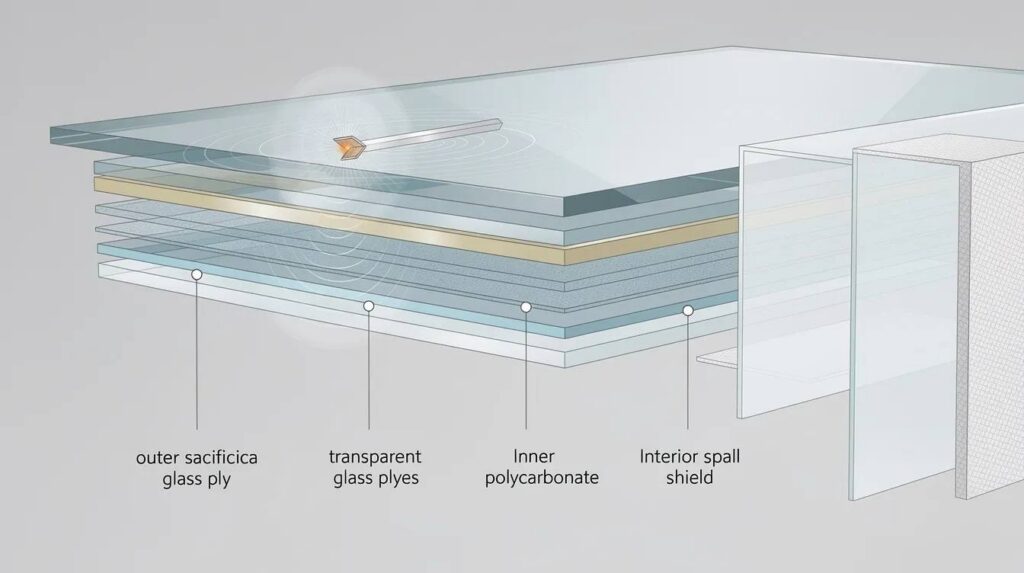
Bullet-resistant glass typically consists of laminated layers of standard glass and plastic fused together under high heat and pressure. This construction creates a composite that provides both optical clarity and ballistic protection and is one of several bulletproof glass options for ultimate ballistic resistance.
Construction and Function
Hard glass layers in bullet-resistant materials flatten the bullet, while flexible plastic interlayers absorb shock and prevent shattering. The glass layer provides initial projectile deformation while polycarbonate or PVB interlayers contain fragments and prevent spall from reaching protected individuals.
Thickness and Protection Levels
Bulletproof glass thickness correlates directly with threat level:
- UL 752 Level 1-3: Approximately 1-2 inches for handgun protection
- UL 752 Level 4-5: Approximately 2-3 inches for rifle protection
- UL 752 Level 6-8: 3 inches or more for high velocity rifle rounds
Installation Considerations
Proper framing and anchorage are essential for ballistic glass performance. Window frames must be tested and certified alongside glazing to ensure system integrity. Weight considerations require structural assessment, as ballistic glass can exceed 25-30 pounds per square foot at higher protection levels.
Polycarbonate Shields
Polycarbonate is a transparent, high-strength plastic used in bulletproof applications, offering better impact resistance than ordinary glass. Clear polycarbonate shields are used in riot gear to maintain visibility while protecting against impacts and projectiles, leveraging the strength and durability of polycarbonate and how it is made.
Monolithic and Laminated Options
Both single-layer and laminated polycarbonate configurations serve ballistic applications. Laminated versions combine polycarbonate with glass layers for enhanced protection at higher threat levels. Pure polycarbonate excels at lower protection levels where weight and cost efficiency are priorities.
Optical Clarity and Durability
Polycarbonate offers excellent impact resistance but can degrade in appearance when exposed to UV light. Protective coatings extend service life and maintain optical clarity. Regular maintenance and eventual replacement scheduling ensure continued protection and visibility.
Cost Effectiveness
Polycarbonate typically costs less than equivalent ballistic glass configurations, making it cost effective for larger installations at lower threat levels. The material also offers easier field replacement compared to heavy glass assemblies, especially when used in retrofit BulletShield security glazing systems.
Material Comparison and Selection
Selecting appropriate ballistic materials requires balancing protection level, weight, cost, and application requirements. The following comparison table provides guidance for common scenarios:
| Material Type | Protection Level | Weight (per plate/sq ft) | Cost Range | Primary Applications |
|---|---|---|---|---|
| Steel (AR500/AR550) | NIJ III-IV, UL 752 Level 5+ | 8-10+ lbs per plate | $75-200/plate | Doors, walls, vehicle armor, barriers |
| Alumina Ceramic | NIJ III-IV | 5-7 lbs per plate | $150-300/plate | Body armor, military applications |
| Silicon Carbide | NIJ III-IV | 4-6 lbs per plate | $300-600/plate | Premium body armor, military vehicles |
| Boron Carbide | NIJ IV | 3-5 lbs per plate | $500-1000+/plate | Elite military, special operations |
| Kevlar (soft armor) | NIJ IIA-IIIA | 4-5 lbs (full vest) | $200-800/vest | Law enforcement, civilian protection |
| UHMWPE | NIJ IIA-III+ | 3-5 lbs (soft/hybrid) | $300-700/plate | Lightweight tactical, civilian use |
| Ballistic Glass | UL 752 Level 1-8 | 15-30+ lbs/sq ft | $50-600+/sq ft | Windows, transaction areas, vehicles |
| Polycarbonate | UL 752 Level 1-3 | 8-15 lbs/sq ft | $30-150/sq ft | Shields, lower-threat glazing |
| Interpretation Guidance |
Match material selection to your specific threat assessment. For handgun-only threats, fiber-based soft armor or lower-level glass provides adequate protection at reduced cost. Rifle round protection requires ceramic or steel hard armor, or thicker glass configurations such as UL 752-rated bullet-resistant wall panels.
Consider environmental factors: steel may corrode in humid environments without proper coating, while UHMWPE performs excellently in wet conditions but cannot withstand high temperatures. Multi-hit requirements favor steel over ceramics. Weight-sensitive applications like personal armor benefit from UHMWPE or ceramic-hybrid configurations.
Common Implementation Challenges and Solutions
Installing ballistic protection involves practical obstacles beyond material selection. Understanding these challenges enables successful project planning, especially when retrofitting workplace environments with advanced ballistic protection.
Weight and Structural Requirements
Heavy ballistic materials—particularly steel panels and thick bulletproof glass—require structural assessment before installation. Existing walls, frames, and foundations may need reinforcement to support added loads.
Solutions:
- Conduct structural engineering assessment before specifying materials
- Distribute weight across multiple support points using engineered framing systems
- Consider lighter alternatives: ceramic-UHMWPE hybrids for body armor, laminated polycarbonate for lower-threat glazing
- Use modular prefabricated bullet-resistant enclosures designed for easy installation
- Focus the highest protection levels on critical zones (entry points, exterior-facing windows) while using lighter solutions elsewhere
Cost vs Protection Level Balance
Higher protection levels increase costs exponentially. UL 752 Level 7-8 installations or NIJ Level IV plates cost significantly more than lower-level alternatives. Budget constraints require strategic prioritization.
Strategies:
- Conduct a thorough threat assessment to identify realistic protection requirements
- Select a minimum protection level adequate for credible threats rather than the maximum available
- Implement phased upgrades, starting with the highest-priority areas
- Use hybrid approaches: higher protection at critical entry points, standard construction elsewhere
- Consider the total cost of ownership, including maintenance and replacement scheduling
Aesthetic Integration
Many facilities require ballistic protection without obvious fortress-like appearance. Modern solutions offer aesthetic options maintaining architectural appeal, such as discreet bullet-resistant glass security solutions for churches and other public buildings.
Solutions:
- Conceal opaque ballistic panels behind decorative facades or standard wall finishes
- Use flush-mounted glazing systems that integrate seamlessly with existing window configurations
- Select colored or textured panel finishes matching surrounding materials
- Specify maintenance-friendly coatings for long-lasting protection and appearance
- Plan for regular inspections addressing UV discoloration, scratching, and seal integrity
Proper planning addresses these challenges while delivering effective protection. Working with experienced ballistic protection specialists ensures appropriate material selection, proper installation, and long-term performance.
Conclusion and Next Steps
Selecting bullet resistant materials requires matching specific threat profiles to appropriate protection levels while balancing weight, cost, and practical constraints. Steel plates offer cost effective durability for fixed installations. Ceramic materials provide lightweight high-performance options for body armor and military applications. Fiber-based solutions like Kevlar and UHMWPE deliver flexible protection against handgun rounds. Transparent systems enable protected visibility for windows and barriers.
Sequential steps for material selection:
- Conduct threat assessment: Identify credible ballistic threats, including caliber, velocity, and potential shot count
- Determine applicable standards: Select UL 752 for architectural applications or NIJ for personal protection
- Evaluate weight constraints: Assess structural capacity for fixed installations or mobility requirements for wearables
- Establish budget parameters: Balance protection level requirements against available resources
- Consult qualified specialists: Work with certified ballistic protection providers for material specification and installation
Immediate actions:
- Document your protection requirements, including threat level, coverage area, and environmental conditions
- Request material specifications and test certifications from potential suppliers
- Obtain a structural assessment for building modifications
- Schedule a consultation with ballistic protection professionals for project-specific recommendations
Related topics worth exploring include proper installation methods ensuring tested performance, maintenance requirements for different material types, and emerging technologies like graphene and engineered spider silk that may shape future bulletproof technology.
Frequently Asked Questions
What is the difference between bulletproof and bullet-resistant?
No material is truly “bulletproof.” Products labeled as “bulletproof” are actually bullet-resistant, meaning they can withstand a certain number of rounds from specific calibers of bullets under tested conditions. Industry professionals use “bullet-resistant” to accurately describe materials that resist penetration according to defined standards.
How thick does steel need to be to stop bullets?
Steel thickness requirements depend on bullet type and velocity. To stop typical rifle rounds like 7.62×51mm, hardened AR500/AR550 steel plates generally require 6-8mm (0.25-0.3 inches) thickness. Higher velocity or armor-piercing ammunition requires greater thickness. Surface treatments and alloy composition also affect performance.
What is the lightest bulletproof material available?
UHMWPE (Ultra-High Molecular Weight Polyethylene) offers the lightest weight protection, with density around 0.97 g/cm³—it actually floats on water. Ceramic-UHMWPE hybrid plates for Level IV protection can weigh as little as 5-6 pounds compared to 10+ pounds for equivalent steel plates. Graphene is emerging as a potential core material for the next generation of bulletproof technology due to its tensile strength, which is 200 times stronger than steel.
How much does bulletproof glass cost per square foot?
Bulletproof glass costs vary significantly by protection level. Lower levels (UL 752 Level 1-3) typically range from $50-150 per square foot. Higher rifle-rated levels (UL 752 Level 5-8) can cost $200-600+ per square foot, including specialized framing and installation requirements.
Can bulletproof materials stop all types of ammunition?
No single material stops all ammunition types. Each material and construction is rated against specific threats defined by testing standards. Armor-piercing rounds, high-velocity rifle projectiles, and newer ammunition designs may exceed rated capabilities. Always match protection level to realistic threat assessment rather than assuming universal protection.
What protection level do I need for my specific threat?
Protection level selection depends on credible threat analysis. For handgun-only threats (most civilian scenarios), NIJ Level IIIA or UL 752 Level 1-3 typically suffices. Rifle threats require NIJ Level III/IV or UL 752 Level 5-8. Consult ballistic protection specialists for site-specific threat assessment and appropriate recommendations.
How long do bulletproof materials last?
Lifespan varies by material type. Steel armor properly maintained can last decades. Soft armor (Kevlar, UHMWPE) typically carries 5-10 year warranties as fibers degrade from moisture, UV exposure, and wear. Ceramic plates should be inspected regularly for cracks. Ballistic glass may require replacement if seals fail or polycarbonate layers yellow from UV exposure.
Can existing buildings be retrofitted with bulletproof materials?
Yes, most existing buildings can accommodate bullet-resistant retrofits. Options include adding steel or composite panels to walls, replacing windows with ballistic glazing, and installing bullet-resistant doors, often starting with a security window glazing assessment for commercial and residential properties. Structural assessment ensures existing construction supports added weight. Modular systems enable installation without major renovation.
What maintenance do bulletproof installations require?
Maintenance requirements include regular visual inspection for damage, seal integrity verification, cleaning according to manufacturer specifications, and environmental protection (UV coatings, corrosion prevention). Spider silk is being researched as a groundbreaking material for armor technology, potentially offering reduced maintenance requirements in future applications. Document inspection schedules and replace materials according to manufacturer guidelines.
Are there building codes for bulletproof installations?
Building code requirements for ballistic protection vary by jurisdiction. Insurance requirements may specify UL-listed materials and installations, and in some cases adherence to GSA/ISC blast-resistant performance standards. Educational facilities and government buildings in some regions face specific mandates. Consult local authorities and insurance providers for applicable requirements. Working with certified installers ensures compliance with relevant standards and codes.