Table of Contents
- Introduction: Why Polycarbonate Safety Shields Matter in 2026
- What Is a Polycarbonate Safety Shield?
- Key Features of High-Quality Polycarbonate Safety Shields
- Common Applications
- Compliance & Safety Standards
- How to Choose the Right Shield
- Why Choose Our Business
- FAQs
Introduction: Why Polycarbonate Safety Shields Matter in 2026
Polycarbonate safety shields protect staff and students from flying debris, chemical splashes, and high-velocity impacts across laboratories, manufacturing plants, and public-facing spaces. These barriers are commonly used in environments that utilize chemicals, such as universities, to protect workers during experiments.
By 2026, facilities are upgrading from temporary acrylic to durable polycarbonate shields designed to meet ANSI Z87.1 standards. Modern units use 3–6 mm thick impact-rated polycarbonate, capable of absorbing high-energy impacts without shattering. This guide helps you review hazards, size requirements, and compliance to fit your needs.
What Is a Polycarbonate Safety Shield?
A polycarbonate safety shield is a rigid, transparent barrier made from polycarbonate sheet that protects personnel from impact, splashes, and airborne hazards. Polycarbonate’s molecular structure allows it to absorb and dissipate energy by flexing, unlike acrylic which is brittle.
Material comparison:
- Polycarbonate: 250x stronger than glass, half the weight
- Acrylic: Lighter but prone to cracking under impact
- Tempered glass: Scratch-resistant but shatters and weighs 6x more
Typical thickness ranges: 4 mm for lab screens, 4.7 mm for benchtop shields, and 19–32 mm multi-layer systems for bullet-resistant enclosures.
Key Features of High-Quality Polycarbonate Safety Shields
- Impact resistance: 4–5 mm panels meet ANSI Z87.1 High Mass and High Velocity tests
- Optical clarity: Offers approximately 88–90% light transmission for glass-like visibility
- Weight and stability: Weighted steel bases (18–20 lb) with three-sided construction prevent tipping
- Temperature tolerance: Stable up to 120°C (248°F), withstands ranges from -40°C to 120°C
- UV protection: Can be UV stabilized to prevent yellowing; specialized grades extend outdoor lifespan beyond 10 years
- Fire safety: Self-extinguishing with V-0 flame rating, higher than acrylic
- Chemical resistance: Handles diluted acids/bases; verify compatibility with strong solvents
Common Applications
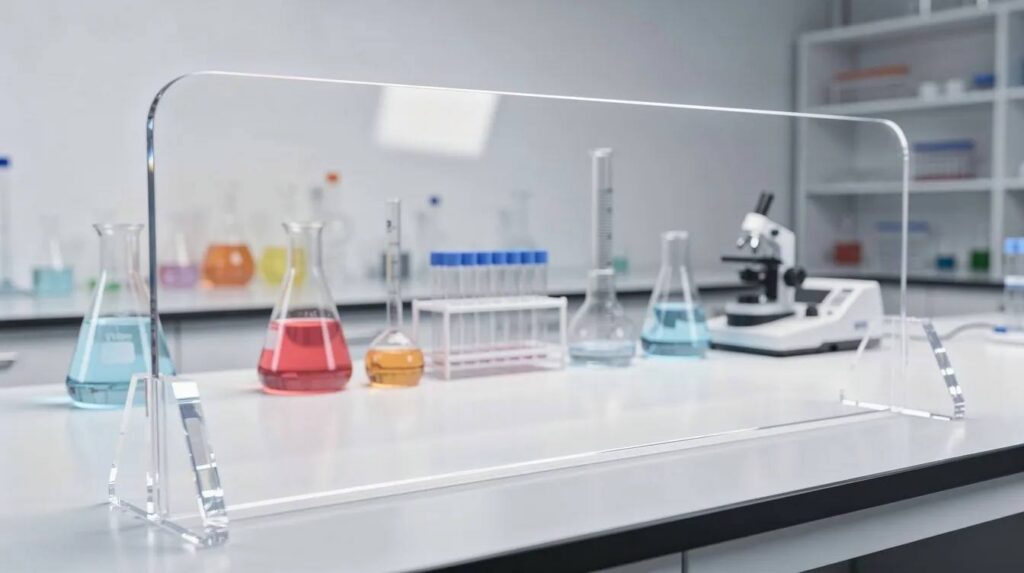
- Laboratories and universities: Shields surround centrifuges, reaction setups, and prep areas—ballistic-rated polycarbonate shields for high-threat labs are products designed for teaching demos since the 2010s
- Manufacturing and machining: Machine guards protect against flying metal chips; polycarbonate is the industry standard for high-risk applications including riot-resistant windows and shields
- Pharmaceutical facilities: Modular, easy-to-disinfect polycarbonate security glazing systems around hoods and assembly lines
- Retail and government: Countertop shields in grocery stores, gas stations, and permit offices create barriers between staff and customers; polycarbonate sneeze guard systems protect against physical abuse, graffiti, and frequent cleaning
- Education: STEM classrooms use shields during cutting and grinding demonstrations
Compliance & Safety Standards
ANSI/ISEA Z87.1 governs eye and face protection, with Z87+ marking indicating high-impact performance for grinding and machining. OSHA 29 CFR 1910 Subpart I requires employers to provide appropriate protective devices—properly rated shields help meet this duty.
Bullet-resistant enclosures follow UL 752 or NIJ ballistic standards. Always verify datasheets and test reports, especially in regulated industries where you must share documentation for audits.
How to Choose the Right Shield
| Factor | Action |
|---|---|
| Hazard type | Define debris, splash, or ballistic risk |
| Size | Measure work area; benchmark: 19.5” × 6.5” × 30” (width × depth × height) |
| Mobility | Weighted bases for flexible labs; fixed frames for machines |
| Visibility | Use cutouts over large gaps |
| Chemical compatibility | Confirm tolerance to facility disinfectants |
| Budget | Higher upfront cost reduces replacement frequency |
Why Choose Our Business
We deliver engineering-driven shields that exceed minimum requirements. Our team customizes dimensions, panel thickness, and mounting hardware to fit your specific equipment. We use only certified, traceable high quality polycarbonate with UV-stabilized and anti-scratch options (accessories sold separately).
Connect with us for design consultation—share your process photos and hazard scenarios for tailored recommendations, or request impact-resistant glazing support for your facility.
FAQs
How long do shields last? Several years in typical lab use; shorter with heavy abrasion. Write to us about your environment for specific guidance.
How do I clean without scratching? Use non-abrasive cloths and mild detergent. Avoid ammonia-based cleaners unless rated.
Does polycarbonate yellow? Modern UV-stabilized sheets resist yellowing for years under indoor lighting.
Can shields stop bullets? Only purpose-designed, tested multi-layer systems provide ballistic protection.
Is ANSI Z87.1 mandatory? It ties to OSHA’s requirement for appropriate protection—document compliance to protect your rights.
Have application-specific questions? Contact us with dimensions, photos, and hazard details for a custom recommendation.