Table of Contents
Why ASTM F3561 Security Glazing Matters
What Is ASTM F3561 and What Does It Actually Test?
Inside the ASTM F3561 Test: From Active Shooter Simulation to Forced Entry
Where ASTM F3561 Security Glazing Is Being Used
How ASTM F3561 Fits into a Layered Security Strategy
Impact Security’s Approach to ASTM F3561 Security Glazing Retrofits
Frequently Asked Questions
Why Choose Impact Security
Next Steps
Introduction: Why ASTM F3561 Security Glazing Matters in 2026
Since 2018, active shooter events and violent forced entry incidents across U.S. schools, healthcare facilities, and retail properties have forced a hard look at building vulnerabilities. The data is sobering: according to the K-12 School Shooting Database, instances where a gun was fired at or hit a school increased roughly 722% between 2015 and 2024. In nearly every scenario, standard architectural glass-windows, doors, storefronts, curtain walls, sidelites, and transoms-failed early, giving attackers an immediate path inside.
ASTM International developed ASTM F3561 (first published in 2023, latest revision F3561-25) as a standard test method specifically designed to evaluate the forced entry resistance of fenestration systems after a simulated active shooter attack. Unlike older standards that test bullet resistance or forced entry in isolation, this test method addresses the real-world scenario: an attacker shoots through glazing to weaken it, then immediately tries to gain entry through the compromised opening.
This article breaks down what ASTM F3561 is, how the test works, where it’s being adopted, how it fits alongside bullet resistant glass ratings, and what facility managers and architects should ask when evaluating security glazing products. We’ll also explain how Impact Security’s retrofit systems-including DefenseLite and BulletShield-are engineered to perform under this standard.
What Is ASTM F3561 and What Does It Actually Test?
The full name tells you exactly what it does: Standard Test Method for Forced-Entry-Resistance of Fenestration Systems After Simulated Active Shooter Attack (ASTM F3561-23). Published by ASTM International, this test evaluates whether an attacker can create a usable opening through a glazing system that has already been weakened by gunfire. ASTM F3561 is not a ballistic rating-it assumes prior penetration has occurred. That distinction is critical and often misunderstood.
What makes ASTM F3561 security glazing evaluation unique is its insistence on testing the complete fenestration system as a cohesive unit. The glass or polycarbonate panel, the frame, the anchorage, the hardware, the locks on a door system-everything must be tested together. Security glazing materials on their own, including window film applied to existing glass, cannot claim full system compliance under this standard. The entire assembly must perform as one.
The test’s goal is to determine whether an attacker can force open a breach large enough for a standardized test shape-representing a person-to pass through. If the test shape can be pushed through the damaged opening with minimal force, the system fails. This means ASTM F3561 does not address blast threats, does not function as a bulletproof glass guarantee, and does not replace ballistic standards like UL 752. It fills a gap that no other standard previously covered: what happens after the shooting, during the critical time when an intruder tries to break through.
Inside the ASTM F3561 Test: From Active Shooter Simulation to Forced Entry
The standard includes a two-phase attack simulation involving ballistic weakening and physical impact, and ASTM F3561 involves a two-phase testing procedure that mirrors how real attacks unfold.
Phase 1: Active Shooter Weakening. The test panel is fired upon using a prescribed 10-shot pattern with M193 5.56mm ammunition-the same round commonly used in AR-15-style rifles. Eight shots are arranged in a compass-rose pattern around a central point, with two additional shots near the center. For door systems, the lock and hardware receive five additional repetitive shots in a diamond pattern, with one shot directly on the locking device. This phase simulates an active shooter attack compromising the glass and framing. The standard assumes bullets penetrate; the point is to weaken the system in a controlled, repeatable way before the forced entry phase begins.
Phase 2: Mechanical Forced Entry. After ballistic weakening, a 100-pound pendulum impactor with a hemispherical nose is swung into the damaged fenestration system at progressively increasing drop height increments. The test evaluates whether the system can resist forced entry at each energy level. Performance is rated across eight levels based on impact resistance against forced entry, ranging from approximately 50 ft-lbf (about 68 joules) at Level 1 up to 400 ft-lbf (roughly 542 joules) at Level 8.
| Level | Impact Energy | Drop Height |
|---|---|---|
| 1 | ~68 J (~50 ft-lb) | ~152 mm |
| 3 | ~203 J (~150 ft-lb) | ~457 mm |
| 5 | ~339 J (~250 ft-lb) | ~762 mm |
| 8 | ~542 J (~400 ft-lb) | ~1,219 mm |

A system earns its rating at the highest level where two consecutive impacts do not produce a breach. Failure occurs when the impactor penetrates, when an opening admits the standardized test shape with about 4 lbf of force, or when operable units like doors or windows open due to hardware failure. Test results apply only to the exact configuration tested-change the glass type, framing, anchors, or hardware, and the rating no longer holds.
Where ASTM F3561 Security Glazing Is Being Used: Real-World Safety Concerns
Safety concerns about active shooter events and violent forced entry are driving adoption of ASTM F3561 across multiple building types. ASTM F3561 is crucial for buildings like schools and government facilities needing enhanced security, and it provides criteria for delaying unauthorized entry in high-risk environments.
ASTM F3561 is crucial for K-12 school security glazing upgrades and K-12 schools’ security systems. School districts are leading adoption. New York State’s “Safe Schools by Design” guide (April 2025) now requires that all entry doors and adjoining windows in K-12 schools meet ASTM F3561, specifying minimum Level 3 for replacement glazing and Level 1 where window film or existing glass is hardened. Medford, Oregon Public Schools included the standard in bid documents for entry vestibule renovations. Entry vestibules, classroom sidelites, and ground-floor openings are the most commonly addressed zones because they represent the fastest path an attacker could use to gain entry.
Healthcare facilities use ASTM F3561 to protect staff and patients in emergency departments, behavioral health units, and pharmacy windows-areas where open visibility must coexist with protection against an active shooter or violent visitor. Retail properties apply ASTM F3561 to enhance security against attacks at storefronts, cash-wrap areas, and employee entrances, where delaying forced entry for even 60 to 120 seconds can be the difference between life and death.
Municipal buildings utilize ASTM F3561 for public safety and access balance at permit counters, court lobbies, and city halls where staff sit close to exterior glass. Corporate offices implement ASTM F3561 for discreet security solutions in lobbies, executive suites, and data centers where threats range from an active shooter event to corporate espionage.

How ASTM F3561 Fits into a Layered Security Strategy (with UL 752 and ASTM F1233)
No single glazing standard replaces training, drills, first responders coordination, or electronic access control. Security works in layers: deter, detect, delay, respond. ASTM F3561 quantifies how long a glazing system can delay an intruder after a ballistic attack-the “delay” layer.
UL 752 focuses solely on ballistic resistance ratings. It determines whether security glazing materials can stop specific calibers and numbers of test projectiles from penetrating. It’s the baseline for selecting bullet resistant glass but says nothing about what happens when those bullets compromise the glass and someone tries to break through. ASTM F1233 tests ballistic and forced-entry resistance separately, covering blunt impact, sharp impact, and sustained attacks over time-useful for riot protection and burglary scenarios, but it doesn’t simulate the combined sequence of an active shooter weakening glazing followed immediately by forced entry.
ASTM F3561 is the missing piece. It requires testing of complete fenestration systems only and evaluates performance after ballistic damage occurs. A robust design for a high-risk facility might combine UL 752-rated bullet resistant glass for initial bullet resistance, ASTM F1233 for general forced entry and riot scenarios, and an ASTM F3561-tested system for post-ballistic breach resistance. For example, a school entry vestibule might specify UL 752 Level 3 glazing paired with framing tested to ASTM F3561 Level 5 or higher, integrated with lockdown hardware and access control. The industry is moving toward this layered approach, and the National Glass Association has submitted a code change proposal for the 2027 International Building Code that would reference ASTM F3561 for educational occupancies.
Impact Security’s Approach to ASTM F3561 Security Glazing Retrofits
Impact Security is a U.S.-based manufacturer headquartered in Marietta, GA, with fabrication centers in both Marietta and Glendale, AZ, specializing in retrofit security glazing systems installed over existing glass, and offers advanced security glazing and building products to enhance life-safety and asset protection. Our product families address different threat levels in plain terms: DefenseLite impact-resistant overglaze security system provides forced-entry resistant clear shields, BulletShield delivers ballistic and post-ballistic protection, RiotLite handles civil unrest and smash-and-grab defense, and AccessShield offers safe-room solutions.
What sets our approach apart from simply adding a film to existing glass is full system design. Our engineering team designs each retrofit as a complete fenestration system-polycarbonate or laminate shields, proprietary framing, engineered stand-off distances, and custom anchorage-so the entire assembly can perform under ASTM F3561 testing. DefenseLite Pro advanced impact security glazing, for instance, has achieved ASTM F3561 Level 8 (the highest rating) on overglazed fixed window specimens up to 49¾ × 97¾ inches, using 3/8-inch polycarbonate over existing ¼-inch tempered glass.
The typical process for a school district, hospital, or retail chain follows a clear path: security assessment, threat-level definition, selection of appropriate bullet resistance and forced entry resistance levels, engineering review, fabrication, professional installation, and warranty service.
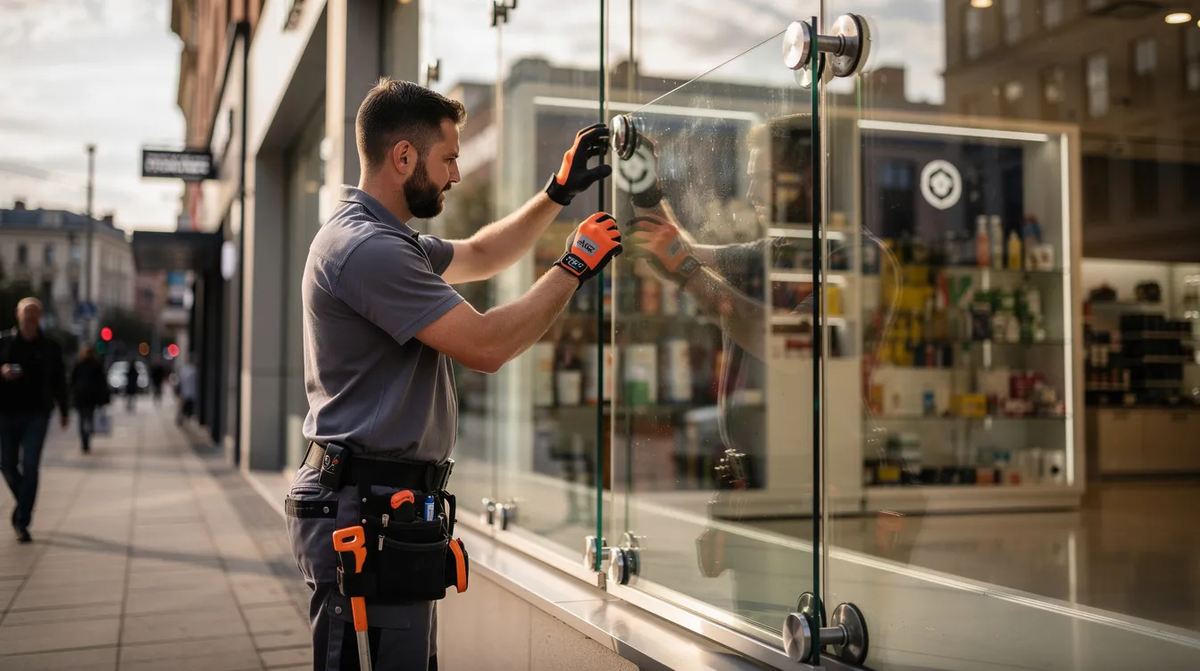
Retrofit fenestration systems offer significant advantages over full window replacement-lower construction disruption, faster deployment, the ability to keep existing insulated glass units intact, and better cost control, especially when you compare DefenseLite vs. traditional security glass film for forced-entry mitigation. Architects and security consultants can work directly with our team to specify systems aligned with ASTM F3561, UL 752, or ASTM F1233 as project requirements dictate.
Frequently Asked Questions About ASTM F3561 Security Glazing
Does ASTM F3561 require bullet resistant glass to pass the test? No. ASTM F3561 assumes ballistic penetration has already occurred and focuses entirely on forced entry resistance after that damage. Bullet resistant glass may improve overall system performance, but it is not mandated by this standard. The test method starts with active shooter weakening, not bullet stopping.
How is ASTM F3561 different from traditional forced entry tests like ASTM F1233? ASTM F1233 tests ballistic and forced entry resistance separately, treating them as independent threat scenarios. ASTM F3561 simulates the combined sequence where gunfire precedes forced entry attempts-a scenario that mirrors how real active shooter attacks unfold. It also requires the complete fenestration system to be tested, not individual components.
Can security film alone achieve ASTM F3561 compliance? Window film applied to existing glass cannot be certified as a complete fenestration system under this standard. The frame, hardware, and anchorage must all be part of the tested assembly. Film may contribute to performance, but manufacturers claiming system-level compliance based on film alone are misrepresenting the standard.
What forces does the ASTM F3561 forced entry phase simulate? The test uses a 100-pound steel pendulum impactor swung from calibrated drop heights to deliver controlled impact energies. This mechanical method was chosen to provide repeatable, measurable results rather than the variability inherent in testing with hand tools like crowbars or sledgehammers. It does not simulate tool-based attacks.
How do I determine what ASTM F3561 performance level my building needs? Start with a risk assessment. Consider your threat profile-is the primary concern an active shooter scenario, smash-and-grab, or both? Factor in how quickly local first responders can arrive and whether state guidelines or grant requirements specify a minimum level. A security glazing specialist can help you match protect priorities to specific performance levels.
What documentation should I ask for from manufacturers? Request accredited lab reports (from labs like Intertek) showing the exact configuration tested: glass type, thickness, interlayer, frame profile, anchorage method, and hardware. Confirm whether the test was a full system evaluation or glazing-only (appendix). Ask for the performance level achieved and any size or application limitations. A credible white paper or technical brief should accompany any serious proposal.
Why Choose Impact Security for ASTM F3561-Oriented Security Glazing
Impact Security brings nearly a decade of focused experience in security glazing, a nationwide network of certified installers, and thousands of installed DefenseLite and BulletShield systems across schools, hospitals, banks, and retail chains. Our turnkey service model-threat assessment, engineering, fabrication, installation, and post-install maintenance-runs through a single manufacturer, which eliminates coordination headaches for facilities teams.
Our systems are designed to resist forced entry, rioting, and, when specified, ballistic threats, providing meaningful delay time during the critical time before law enforcement arrives and supporting broader active shooter mitigation strategies. They’re clear, low-profile, and maintain sightlines and natural light so buildings don’t feel like fortresses while still meaningfully upgrading forced entry resistance. We also support grant-driven projects with documentation, engineered drawings, and test reports aligned with ASTM F3561-making it easier for school districts and government agencies to address security without navigating the paperwork alone.
Next Steps: Planning an ASTM F3561 Security Glazing Upgrade
ASTM F3561 gives building owners a measurable, standardized way to evaluate whether their glazing system can delay an intruder after gunfire. It tests the full fenestration system, rates performance across eight levels, and fits into a layered security strategy alongside bullet resistance and forced entry standards. If your building has standard architectural glass at entry vestibules or ground-floor openings, those openings are likely compromised in the opening moments of an attack.
We encourage facility managers, school administrators, security directors, and architects to evaluate their current glass and framing honestly. Contact Impact Security for a no-obligation assessment and estimate or submit a project inquiry through the DefenseLite contact form. Our team can help you interpret test data, choose appropriate forced entry and bullet resistance levels, and connect you with a local certified installer. Schedule a site walk-through, share existing plans for review, or request sample drawings and performance data for your next project.