Table of Contents
This guide covers:
- The Weakest Link in Modern Buildings
- What Makes Glass Doors Vulnerable to Forced Entry?
- Laminated Glass vs. Laminated Security Glass
- Retrofit Security Shields for Existing Doors
- Where Break-In Resistant Glass Doors Matter Most
- Beyond Security: Energy Efficiency, Noise Reduction, and Day-to-Day Performance
- Frequently Asked Questions
- Why Choose Impact Security
- Next Steps: Request a Break-In Resistance Assessment
Introduction: The Weakest Link in Modern Buildings
Standard glass doors – front doors, lobby entrances, interior doors with decorative glass panels – remain among the first targets in smash-and-grab incidents, forced entry attempts, and active shooter events across the U.S. From retail storefronts to school vestibules, regular glass gives intruders a fast, low-effort path inside. Most burglars know that a single blow to a tempered glass panel can open a building in under 90 seconds. Especially at ground floor windows and entry points hidden from street view or hiding spots for surveillance.
Break-in resistant glass doors are not about making glass unbreakable. They deter intruders by delaying entry long enough for alarms, on-site security, or law enforcement to respond. They reinforce the weakest points of entry in any building. Security glass doors should always be part of a comprehensive security system that includes monitoring, access control, and response protocols.
At Impact Security, we specialize in retrofit security glazing that hardens existing glass door systems without replacing frames. Below, you will learn how laminated glass, laminated security glass, and polycarbonate retrofit shields differ – and how to choose the right combination of protection for your doors and windows.
What Makes Glass Doors Vulnerable to Forced Entry?
Most commercial doors installed since the early 2000s use tempered glass set in thin aluminum frames with narrow stiles and single-point locks. This construction was designed for safety and cost efficiency, not security against determined attack. Tempered glass is a heat-treated safety glass that prioritizes safe breakage rather than forced entry resistance.
- Tempered glass breaks into small, less-sharp pieces compared to regular glass – a safety feature that prevents large glass shards from causing lacerations. But once shattered, the opening is completely clear, allowing intruders to step or reach through and gain entry within seconds.
- Common attack methods include a hammer or brick to the lowest glass panel, a crowbar at the latch or bottom rail, or repeated kicking. Industry testing shows standard glass doors can be breached in under 90 seconds in typical storefront settings.
- High-visibility front doors and all-glass storefronts on the first floor face the greatest risk, especially those set back from the street or shielded from police patrol routes.
- Interior doors with glass panels – for example, between a lobby and secure corridors in office buildings – often use the same standard glass as exterior doors, creating a false sense of security for restricted areas.
- Glass and frame must be considered as a unified system. Strong resistant glass in a weak frame, or a reinforced frame with ordinary glass, both fail quickly under determined forced entry.
Laminated Glass vs. Laminated Security Glass: How Much Protection Do You Really Get?
Laminated glass is composed of layers of glass and PVB (polyvinyl butyral) or ethylene vinyl acetate interlayers bonded under heat and pressure. Unlike tempered glass, laminated glass holds shards in place when broken – the interlayer keeps the panel together, preventing the kind of instant opening that makes standard glass so vulnerable. Laminated glass is ideal for residential and commercial security applications and is widely used in storefronts for shard retention and noise control.
Laminated security glass takes this further. It uses thicker glass plies, multiple layers of interlayer material, or hybrid glass-polycarbonate stacks that are independently tested and engineered specifically for forced entry resistance. High-security glass panes are classified by their resistance to break-ins under standards like EN 356 (P6B through P8B) and ASTM F3561. Community discussions across the facilities management industry consistently emphasize the effectiveness of laminated glass combined with strong doors for maximum protection.
Here is how the various types compare:
| Feature | Tempered Glass | Architectural Laminated Glass | Laminated Security Glass |
|---|---|---|---|
| Impact resistance | Low – shatters on first major blow | Moderate – retains shards | High – multiple layers absorb repeated strikes |
| Forced entry delay | Seconds | A few minutes | Several minutes under sustained attack |
| Noise reduction | Poor | 10–20 dB improvement | Strong acoustic reduction |
| Cost | Lowest | Medium | Higher – heavier, thicker panels |
Laminated security glazing provides better break-in resistance than tempered glass by a wide margin. Shatter-resistant glass absorbs impact without shattering into pieces and can withstand impacts from an 8lb steel ball. P6B rated glass can resist up to 50 axe strikes, and higher-rated shatter-resistant glass can withstand up to 70 axe strikes before an opening forms. Laminated glass remains intact after heavy impact, preventing entry and preventing shattering – it can delay forced entry by several minutes, giving response teams critical time and aligns with broader safety and security glass solutions. Although many people refer to these products as shatterproof glass, no glazing system is completely unbreakable; the goal is to delay entry and contain broken glass.
Laminated security glass in doors can also be engineered for bullet resistance at UL 752 Levels 1–3, though thickness and weight increase significantly. For many existing glass doors, retrofitting a shield of laminated security glass or polycarbonate in front of the existing glass is more practical and cost-effective than full door replacement, particularly with retrofit BulletShield ballistic panels. Laminated glass also reduces noise and blocks UV rays, delivering sun control and UV protection alongside security.
The Role of Frames, Hardware, and Installation
Glass alone cannot deliver true break-in resistance without reinforced framing and hardware. Here is what matters:
- Typical aluminum door frames can deform or split under prying unless reinforced with steel backing or retrofit extrusion systems. Reinforced frames help prevent doors from being forced open, and reinforced frames prevent twisting or breaking when force is applied. Reinforced materials like steel or heavy aluminum enhance structural integrity across the entire door assembly.
- Multi-point locking systems improve the security of glass doors significantly. Multi-point locking systems secure doors at multiple points along the frame, and multi-point locking mechanisms make doors harder to pry open – a critical upgrade when pairing upgraded glass with existing commercial doors.
- Structural silicone bonding, mechanical capture, and tested anchoring methods keep the glass or shield attached to the frame during repeated impacts. In one documented forced entry test, a door with laminated glass but poor anchors failed in under 60 seconds; the same glass specification, properly anchored with full mechanical capture, held for over three minutes.
Installation quality matters as much as material selection. Tolerance slips, improper sealant, and inadequate edge protection all compromise long-term durability and performance of any security glazing system.
Retrofit Security Shields for Existing Glass Doors
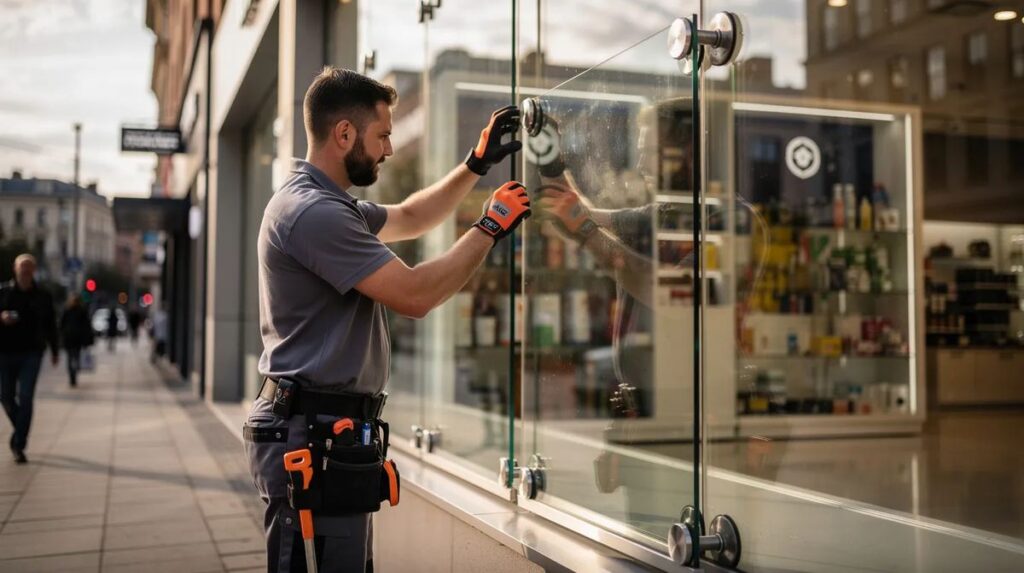
Retrofit security glazing systems – like Impact Security’s DefenseLite impact-resistant overglaze and BulletShield – mount over existing glass doors to create an almost invisible barrier. These shields are engineered to add forced entry protection or ballistic protection without removing or replacing the original door, frame, or lock hardware. The result: your building stays open, visible, and welcoming while gaining unmatched protection at every vulnerable opening.
- Materials include abrasion-resistant polycarbonate, laminated security glass, or glass-polycarbonate composites. Polycarbonate panels are significantly harder to break than glass, and DefenseLite is 250 times stronger than standard glass. Security films can also be applied to existing glass to enhance protection as a lighter-weight option.
- Shields are typically installed on the exterior side of glass doors within a custom aluminum or steel framing system, creating an airspace that also improves thermal and acoustic performance.
- In most commercial applications, the original glass door and frame remain in place – minimizing disruption, dust, and downtime for retail or office operations.
- A typical retrofit process includes: on-site assessment of door types and glass construction, threat and code review, engineering, fabrication at a U.S. facility (Marietta, GA or Glendale, AZ), and after-hours installation by certified installers.
- Shields can be specified for different threat levels: smash-and-grab resistance, riot and mob protection, or UL 752 bullet-resistant performance for higher-risk sites. Many facility managers compare DefenseLite vs. security glass film as they evaluate options, and experts recommend using break-in resistant doors with other security measures – cameras, alarms, access control – for the right combination of defence.
- Damaged shields from an attempted break-in are usually replaceable without touching the original door, reducing long-term maintenance and repair costs.
Break-In Resistance vs. Bullet Resistance
Forced entry ratings and bullet resistant ratings address different threats. Many facilities need one, the other, or both.
- Forced entry testing uses repeated hits with hammers, crowbars, and similar tools. The goal is to delay entry long enough – several minutes – for security or law enforcement to respond. It can delay forced entry by several minutes, turning a 90-second smash into a sustained, noisy, and visible struggle.
- Bullet resistance testing follows UL 752 Levels 1–8. Level 1 stops 9mm handgun rounds; Level 8 resists 7.62×51mm rifle fire. Ballistic door systems absorb bullets while maintaining structural integrity rather than staying perfectly clear. Riot Glass products resist high-speed AK-47 attacks, and Impact Security engineers BulletShield as a non-spalling ballistic system that reduces interior hazards from glass and bullet fragments in occupied lobbies.
- Convenience stores or pharmacies may focus on forced entry protection for nighttime break ins. Police stations, courthouses, or embassies may require both ballistic and forced entry performance at every glass door.
Where Break-In Resistant Glass Doors Matter Most
Any public-facing glass door is a candidate for hardening, but some sectors face higher risk and stricter requirements that benefit from purpose-built commercial security window solutions.
- Office buildings and corporate campuses: main lobby entrances, executive floors with glass interior doors, and data center access points. Threats include targeted vandalism, disgruntled employees, and unauthorized entry.
- Retail and financial institutions: glass front doors at jewelry stores, pharmacies, electronics retailers, and banks face acute smash-and-grab risk after hours.
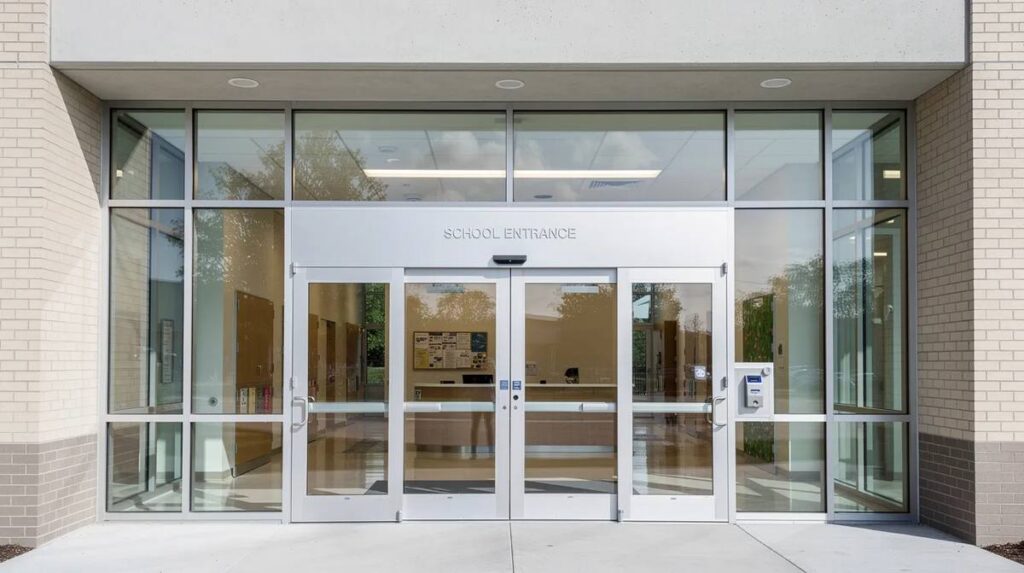
- Schools and universities: glass doors at main entries and interior vestibules. Laminated security glazing and retrofit shields delay entry in active shooter scenarios, protecting students and staff as part of a broader active shooter mitigation strategy.
- Healthcare facilities and government buildings: emergency department entrances and court lobbies must stay welcoming yet highly protected in high-risk environments.
- Industrial and critical infrastructure: control room doors, substation vision lites, and security checkpoints where both visibility and protection from sabotage matter.
Combined security features greatly enhance overall home security and commercial safety alike. High-level residential security often involves impact-rated doors, and the same principles apply at scale for any building. In one 2024 project, a multi-story commercial building experiencing recurring storefront vandalism received DefenseLite BulletShield panels over street-facing windows and automatic doors. After retrofit, break-in attempts dropped sharply, and glazing replacement costs fell to near zero. These doors also provide additional safety against severe weather – an added benefit for coastal and storm-prone regions. The same security principles can also improve protection for a house with large glass entry doors or sidelights.
Front Doors vs. Interior Doors: Different Roles, Different Solutions
Exterior front doors face direct public attack and require the highest level of impact resistance, optional bullet resistance, weather seals, and hardware upgrades. Interior doors with glass – between a lobby and a secure corridor, for instance – benefit from thinner laminated security glass or retrofit polycarbonate panels that resist hand tools and kicks but do not need heavy weather protection.
Use a layered approach: install hardened exterior glass doors at the property perimeter, then secure interior vestibule doors with laminated security panels to further delay entry if attackers breach the first layer. Impact Security can engineer both exterior and interior door solutions as a coordinated system at the same level of quality, not as separate, mismatched upgrades.
Beyond Security: Energy Efficiency, Noise Reduction, and Day-to-Day Performance
Break-in-resistant glass doors in 2026 are expected to perform as building envelope components, not just security barriers.
- Laminated glass and laminated security glass improve energy efficiency by adding insulating layers. Paired with low-E coatings, they reduce solar heat gain at south- and west-facing entrances. Safety and security glass systems and triple-pane glass units enhance security and energy efficiency simultaneously.
- The airspace created by retrofit shields like DefenseLite acts as a secondary insulating layer, reducing drafts and improving comfort in lobbies. Natural light passes through with minimal distortion.
- Acoustic benefits are significant: multiple layers and air gaps cut street noise in busy urban corridors, improving productivity and visitor experience.
- UV filtering from laminated interlayers and polycarbonate shields protects interior finishes, flooring, and merchandise near glass doors from fading – a key benefit for retail.
- Maintenance is straightforward: non-abrasive cleaners, periodic hardware inspection, and scheduled checks of anchoring points keep both security and aesthetic clarity intact over the life of the system.
Frequently Asked Questions About Break-In Resistant Glass Doors
Can break-in resistant glass doors completely stop a determined intruder?
No door system is truly unbreakable. The goal is to delay entry by several minutes – long enough for alarm systems and response teams to engage. Laminated glass delays entry by a few minutes under sustained attack, and layered protection combined with monitoring protocols provides peace of mind and genuine defense.
What is the difference between laminated glass, laminated security glass, and polycarbonate shields?
Laminated glass uses two panes of glass bonded with a PVB interlayer for shard retention. Laminated security glass adds thicker plies and multiple interlayers for tested forced entry protection. Polycarbonate shields mount over existing glass and are significantly harder to break, offering maximum protection without replacing the original door, as detailed in DefenseLite product FAQs.
Will upgrading my glass doors require replacing the entire door frame?
In most cases, no. Retrofit solutions mount over existing glass within custom extrusions. When structural issues or code changes require new framing, Impact Security’s engineering team will identify that during assessment.
How do these systems affect visibility and the look of my lobby or storefront?
High-optical polycarbonate and laminated security panels maintain clarity and allow natural light through. Low-profile frames keep the original architectural design intact with minimal visual change.
Are break-in resistant glass doors bulletproof?
The industry uses “bullet resistant” rather than “bulletproof.” UL 752 levels define protection from handgun (Level 1) through rifle rounds (Level 8). Courthouses, government buildings, and other high-risk environments often require ballistic protection. Installed costs range from roughly $60 per square foot for handgun-level protection to $400–$500+ per square foot for rifle-resistant systems.
What is the typical project timeline?
From initial assessment through fabrication and installation, most commercial door retrofit projects in 2026 take four to eight weeks. Timelines vary based on door count, threat level, and custom engineering requirements.
Why Choose Impact Security for Break-In Resistant Glass Doors?
Since 2016, Impact Security has focused exclusively on retrofit security glazing for doors, windows, and storefronts. We are not a general glass company – every product we manufacture is engineered to protect existing openings against real-world threats, as outlined in our About Impact Security, LLC company overview.
- Turnkey capabilities: threat assessment, engineering, fabrication in Marietta, GA and Glendale, AZ, a nationwide certified installer network, and ongoing warranty support.
- Proven security products: DefenseLite Pro meets ASTM F3561 Level 8 for forced entry resistance. BulletShield delivers tested ballistic protection. Both are specifically engineered to retrofit existing glass doors – not generic off-the-shelf panels.
- Experience across sectors: schools, hospitals, government facilities, office buildings, national retail chains, and critical infrastructure sites in multiple U.S. regions.
- Unlike bars, gates, and roll-down shutters, our solutions maintain curb appeal, clear sightlines, natural light, and 24/7 peace without daily deployment.
- Every system is independently tested to recognized standards, with custom engineering for unique door and frame configurations.
In a 2024 multi-location retail chain project, Impact Security retrofitted over 200 glass entry doors across 40 locations. Within twelve months, the chain reported zero successful forced entry incidents at retrofitted locations. This was down from dozens annually, and the doors maintained their original welcoming appearance.
Next Steps: Request a Break-In Resistance Assessment
The best way to start is with a site-specific evaluation of every glass door and adjacent glazing in your facility.
- During an Impact Security assessment, our team inventories door types, glass construction, hardware condition, frame integrity, and critical areas like front doors and interior access control points.
- The assessment considers your threat level – forced entry, riot risk, ballistic threats – alongside operational constraints like 24/7 access, historic façades, and branding requirements.
- Facilities managers, security directors, architects, and property owners can prepare by gathering door schedules, photos of existing openings, and any incident history.
Request a free estimate or consultation through Impact Security’s website or by phone. Our certified dealers and installers serve clients nationwide.
Upgrading to break-in resistant glass doors is one of the highest-impact steps a building owner can take to protect people, property, and operations – without turning a welcoming entrance into a fortress.