Table of Contents
Entry Door Ballistic Protection Basics
Bulletproof vs Bullet Resistant Doors Explained
Ballistic Standards, Ratings & Compliance
Materials & Door Construction
Forced Entry vs Ballistic Threats
Application Scenarios
How the Process Works with Impact Security
FAQs About Bullet Resistant Entry Doors
Why Choose Impact Security
Next Steps: Plan Your Upgrade
Entry Door Ballistic Protection Basics
Since 2020, active shooter incidents, smash-and-grab burglaries, and mob-style attacks have risen sharply across the United States. Schools, financial institutions, retail stores, healthcare campuses, and government buildings face growing ballistic threats at their most visible and accessible weak points: front entry doors and surrounding glass.
Entry door ballistic protection refers to a complete system-door leaf, frame, glazing, hinges, lock hardware-engineered to resist bullets and forced entry attempts. No single component provides safety on its own. A bullet resistant glass panel installed in a weak frame or paired with standard hinges leaves your opening vulnerable. Every element must work together.
Common threat types range from handguns (9 mm, .357 Magnum, .44 Magnum) to rifles (5.56 mm, 7.62 mm), along with smash-and-grab break ins and mob-style forced entry. Impact Security specializes in retrofit ballistic and forced-entry glazing systems-like DefenseLite, BulletShield, and AccessShield-that upgrade existing doors, sidelights, and windows without full replacement.
Key benefits of hardening entry doors:
- Buys critical minutes for law enforcement response
- Deters opportunistic criminals and casual attackers
- Protects occupant safety-staff, students, visitors, patients
- Preserves operations and avoids costly damage or downtime
“Bulletproof” vs Bullet Resistant Doors: What You’re Really Buying
There is no truly “bulletproof” door. The accurate terms are “ballistic resistant” or “bullet resistant,” and the distinction matters. Even high-rated bulletproof doors will eventually be defeated by sustained fire, armor-piercing ammunition, or repeated shots concentrated in one area. Ballistic ratings classify the threat a door can stop, from Level 1 through Level 10, under specific test conditions-not against unlimited punishment.
Marketing language like “bullet proof doors” or “bulletproof entry” can oversell performance. What you are actually buying is a system tested to stop specific calibers, at specific velocities, for a defined number of shots. If a vendor cannot tell you the exact UL 752 level or equivalent rating, that is a red flag.
Here is how the key terminology breaks down:
- Bullet resistant doors – rated to stop defined rounds per UL 752 or equivalent
- Ballistic glazing – glass or polycarbonate inserts rated for bullet resistance in vision panels and sidelights
- Forced entry resistance – measured resistance to tools, prying, and impacts over time
- Blast resistance – protection against explosive pressure waves (a separate rating)
- Low spall / no spall – prevents interior glass fragmentation that can injure occupants
Within a broader high security strategy, you will encounter different types of resistant doors. All-glass bullet resistant doors serve aesthetic lobbies. Wood doors with ballistic cores suit historic or architectural environments. Steel and hollow metal armored doors deliver the highest level of rifle-grade protection for industrial or government facilities. Each fits a specific role based on design requirements and threat profile.
Ballistic Standards, Ratings & Compliance
UL 752, published by Underwriters Laboratories, is the most common standard for ballistic-resistant doors in the United States and serves as the gold standard for ballistic door ratings. Bullet-resistant doors meet UL 752 standards for ballistic protection, and UL 752 ratings range from Level 1 to Level 8, covering threats from handguns through high-powered military rifles.
Here is a practical summary of the various levels:
| UL 752 Level | Threat | Rounds Tested |
|---|---|---|
| Level 1 | 9 mm handgun (124 gr) | 3 shots |
| Level 2 | .357 Magnum JSP | 3 shots |
| Level 3 | .44 Magnum semi-wadcutter | 3 shots |
| Level 4 | .30 cal rifle (soft point) | 1 shot |
| Level 5 | 7.62 mm rifle (military ball) | 1 shot |
| Level 6 | 9 mm (higher velocity) | 5 shots |
| Level 7 | 5.56 mm (AR-15 / M16 style) | 5 shots |
| Level 8 | 7.62 mm military ball | 5 shots |
Level 3 doors can stop three shots from a .44 Magnum handgun and are often recommended for maximum protection against common handgun-related crimes, making Level 3 a frequent choice for bank lobbies and credit unions. Levels 4 and 5 doors stop single shots from high-powered rifles. Level 8 doors resist five hits from a 7.62 mm rifle. Levels 6 to 10 doors stop multiple rounds from military-style assault weapons or heavy machine guns.
Beyond UL 752, NIJ 0108.01 ballistic resistance standards cover ballistic resistant protective materials, and the U.S. Department of State SD-STD-01.01 Rev G/H combines forced entry and ballistic resistance for diplomatic and other government buildings. Impact Security understands multi-standard compliance across these frameworks.
A critical point: a ballistic door is tested as a complete assembly including frame and hardware. Testing includes evaluating the door frame, hinges, and locks to ensure structural integrity under impact. Glazing, the door leaf, and the frame must all be tested together-a UL 752 glass panel means little inside an unrated frame. Architects, security consultants, and facilities managers should select ratings based on a formal threat assessment rather than simply choosing the strongest door possible.
Materials & Construction: How Bullet Resistant Entry Systems Work
Ballistic resistance is achieved by layering reinforced materials-not relying on a single “magic” component. Bullet-resistant doors can be made from steel, wood, or composites, and armored doors are made with multiple layers of reinforced materials including ballistic steel, polycarbonate, aramid sheets, and laminated glass. Retrofit BulletShield ballistic security glazing can further enhance protection at existing glass openings. The door core determines performance: composite materials, fiberglass, or honeycomb metal stiffeners hidden behind exterior finishes.
Steel and hollow metal doors use cold rolled steel faces, welded stiffeners, and dense cores. They can reach UL 752 Level 8 in certain configurations and are common in government facilities, back-of-house areas, and industrial settings. Bulletproof doors in this category weigh over 400 lbs for installation. The trade-off: they are heavy, less aesthetically flexible, and require robust structural support.
Aluminum and glass storefront doors with ballistic glazing serve retail, financial institutions, and public lobbies where transparency matters. Impact Security’s BulletShield and DefenseLite Pro storefront security systems retrofit shields mount over existing glass on the interior side, converting standard storefronts to tested ballistic protection without full tear-out. These storefront security solutions for glass doors and windows accommodate polycarbonate or glass-clad shields in thicknesses from roughly 0.25 inches to over one inch.

Wood and wood-clad bullet resistant doors fit architectural or historic environments. Fiberglass or composite cores are concealed behind veneers, delivering high security construction that blends with the building’s exterior and home’s exterior finishes. Bulletproof doors can integrate into standard wood or masonry frames, preserving aesthetics while meeting ballistic requirements.
Reinforced frames are crucial as the frame is typically the weakest point in a door assembly. The hinge side, lock side, sidelights, transoms, and full-vision panels all need matched ballistic ratings. A single unprotected sidelight next to a Level 3 door gives an attacker an easy bypass. Ballistic doors can withstand multiple projectiles without penetration-but only when every adjacent opening is addressed, and in many facilities a complementary focus on blast resistant performance standards is also necessary.
Forced Entry vs Ballistic Threats at Entry Doors
Forced entry resistance and bullet resistance are two distinct threat types. A door rated to stop rifle rounds may fail in seconds under a crowbar attack if its frame anchoring or lock hardware is inadequate. Conversely, a forced-entry rated security door may not stop a single handgun round. Facility owners should never assume one rating covers both.
Forced entry standards like ASTM F3038 simulate mob attacks with realistic toolkits-sledgehammers, chisels, crowbars-using two to six attackers over timed intervals (5, 15, 30, or 60 minutes). Armored doors and forced entry security glazing systems resist forced entry per US DoS standards such as SD-STD-01.01 Rev G, which tests hinge side, lock side, and center panel with progressive tools and attack durations.
Practical scenarios include smash-and-grab attacks at jewelry stores and electronics retailers, mob-style assaults on pharmacies, and active shooter attempts to breach a locked lobby after initial shots fail. In each case, the entry door is the first line of defense. AccessShield forced-entry-resistant doors and related AccessShield door retrofit systems, including Access Shield BR bullet-resistant doors, are examples of retrofit shields engineered to slow both bullet penetration and brute-force attack, buying minutes for law enforcement or internal response teams.
Where Entry Door Ballistic Protection Is Most Critical
Entry door ballistic protection is not reserved for embassies. Since 2020, everyday commercial spaces have faced escalating threats that demand practical security solutions.
Key sectors and priorities:
- Schools and universities – active shooter mitigation, lockdown protocols, delaying forced entry at main entrances
- Financial institutions and credit unions – secure vestibules, ballistic transaction windows, protecting staff and customers
- National retail chains and jewelry stores – storefront smash-and-grab defense, mob protection, protecting inventory
- Healthcare campuses – emergency department entrances, pharmacy windows, controlling access
- Government buildings and government facilities – courthouses, service centers, other government buildings requiring multi-threat protection
- Critical infrastructure – data centers, utilities, secure buildings with restricted access
Common architectural scenarios include glass-heavy storefronts, multi-door vestibules, and side or service entrances that often become overlooked weak points.
A facility might invest heavily in its main entry while leaving a single door at a loading dock or side corridor completely unprotected. Many models of attack exploit exactly these gaps.
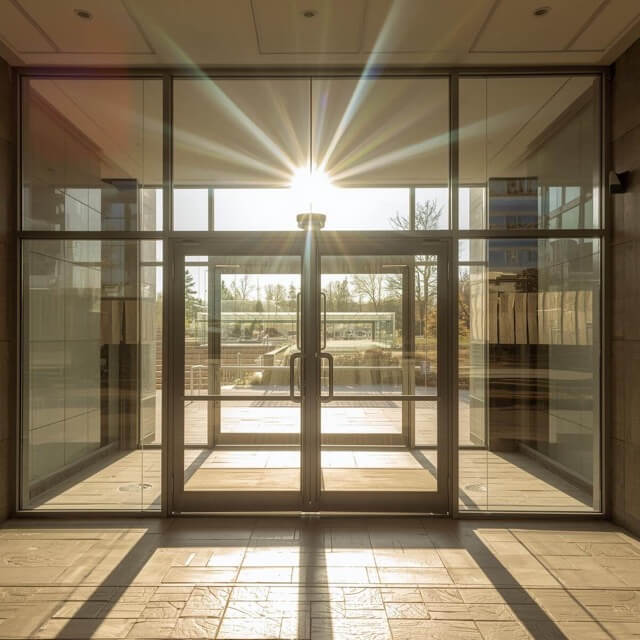
Consider a mid-size credit union that retrofitted its front vestibule-two glass doors plus four sidelights-with ballistic glazing rated to UL 752 Level 3. The project preserved the open, welcoming aesthetic while upgrading every opening to withstand handgun threats. No full door replacement was needed. The retrofit was completed over a weekend with minimal disruption to operations.
How an Entry Door Ballistic Retrofit Project Works with Impact Security
Impact Security’s process follows a clear sequence designed to protect businesses and institutions without unnecessary disruption:
- Site and threat assessment – Evaluate existing doors, frames, glass, hinges, lock hardware, and adjacent windows. Review crime history, threat profiles, and operational constraints.
- Rating selection – Choose the appropriate UL 752 level and forced entry duration based on risk, budget, and aesthetic needs.
- Engineering – Design retrofit shields or door assemblies tailored to existing openings. Account for frame reinforcement, hinge side capacity, and design requirements.
- Fabrication – Manufacture at U.S.-based factory locations in Marietta, GA and Glendale, AZ. Custom bulletproof doors typically take 6-8 weeks to manufacture.
- Installation – Installation requires a plumb, level, and square rough opening. The process is similar to standard door installation processes, minimizing disruption. Crews coordinate with building security teams, working nights or weekends for occupied facilities. Easy installation of retrofit shields over existing glass avoids full tear-out.
- Support and maintenance – Warranties on ratings, glass, and hardware. Periodic inspections. Planning for phased expansion from a single door to full perimeter protection.
Impact Security’s retrofit approach-mounting engineered shields over existing glass in doors, sidelights, and transoms-avoids the cost and downtime of complete replacement. Facilities can install protection on the most vulnerable openings first, then expand coverage over time.
Frequently Asked Questions About Bullet Resistant Entry Doors
How much does entry door ballistic protection typically cost? Basic UL 752 Level 1-2 ballistic glazing runs roughly $25–$100 per square foot for materials alone. Higher rifle-grade levels (5-8) can reach $700–$1,200 per square foot, with premium configurations exceeding $1,500. Retrofit over existing glass typically reduces total project cost by 30–60% compared to full frame and glass replacement.
Can we retrofit our existing glass doors, or do we need new bulletproof doors? Most existing aluminum, steel, or wood-framed glass doors can be retrofitted using overlay shields like BulletShield or AccessShield. These mount over existing glazing in thicknesses from 0.25 to 1.25 inches. If the frame cannot support reinforcement or the opening geometry is incompatible, full replacement may be required. Contact factory representatives for a site-specific evaluation.
What UL 752 level do we need for our facility? For retail storefronts and credit union lobbies, Level 1–3 typically addresses handgun threats. Banks and government service windows may require Level 4–5 if rifle threats are credible. Critical infrastructure and military-adjacent facilities may need Level 7–8. Bullet-resistant doors are tested against various firearms and ammunition at each level-always base your selection on a formal threat assessment.
How long does installation take? Retrofit glazing projects often complete in 1–3 days per door. Full custom door or assembly replacement typically takes 6–10 weeks from approval to install, including engineering and manufacturing lead time. Entrances may need temporary closure, but mitigation options like temporary barriers keep operations running.
Will bullet-resistant doors still look like normal storefront doors? Yes. Ballistic glazing can be optically clear. Wood veneers, powder-coated frames, and narrow mullions preserve the building’s appearance. Retrofit shields mounted on the interior are often invisible to people approaching from the exterior.
Do ballistic doors also protect against forced entry and rioting? Not automatically. Ballistic ratings and forced entry ratings are separate. A door rated to stop bullets may not resist sustained prying. Dual-rated systems-sometimes called FEBR (forced entry/bullet resistant)-exist for facilities needing both. Impact Security’s full line of retrofit solutions addresses multiple threat types, including riot and mob-style attacks.
Every opening and threat profile is different. A site-specific assessment is the only reliable way to determine the right solution for your facility.
Why Choose Impact Security for Entry Door Ballistic Protection
Impact Security is a U.S. manufacturer and installer focused exclusively on retrofit ballistic and forced-entry glazing for doors, windows, and storefront systems. Founded in 2016, the company delivers turnkey service-from initial assessment through fabrication, installation, and ongoing support-with a nationwide network of certified installers and authorized dealers. You can learn more about Impact Security, LLC and its security glazing expertise to understand how these solutions are developed and supported.
The core advantage: strengthening existing doors and frames instead of full replacement. This approach reduces cost, shortens project timelines, and minimizes disruption for operational facilities across different types of sectors. Impact Security’s products-DefenseLite Pro, BulletShield, AccessShield, and other products in the portfolio-are tested, engineered, and manufactured at U.S. fabrication centers.
- In business since 2016 with proven B2B and B2G experience
- U.S. manufacturing at facilities in Marietta, GA and Glendale, AZ
- Tested and certified products across UL 752 and forced entry standards
- Diverse facility experience – schools, retail chains, hospitals, government buildings, financial institutions
- Post-install support including warranties, maintenance, and phased upgrade planning
Whether you need to secure a single door at a local contractor’s office or harden every entry across a national retail chain, Impact Security has the configurations, expertise, and manufacturing capacity to deliver.
Next Steps: Plan Your Entry Door Ballistic Upgrade
Upgrading entry door ballistic protection is a practical, phased investment-not an all-or-nothing overhaul. Start with your most vulnerable entry points: the glass doors, sidelights, and transoms where an attacker would focus first. Then build outward toward a comprehensive perimeter defense strategy.
Before reaching out, gather this information to streamline the conversation:
- Building type and number of entrances
- Existing door and glazing types (steel, aluminum, wood, glass)
- Known threats, incidents, or local crime data
- Budget range and timeline expectations
Request a free assessment today. Impact Security’s team and certified dealers across the United States are ready to evaluate your facility, recommend the right protection level, and deliver a solution that fits your operations, budget, and aesthetic. Your entry doors do not have to be your weakest link-they can be your strongest.