Table of Contents
This guide covers:
Standard glass shatters immediately upon impact, creating easy access for intruders. That single vulnerability is responsible for the majority of smash-and-grab break-ins at retail stores, schools, pharmacies, and government buildings across the country. Burglar resistant glass exists to close that gap, not by making glass “unbreakable,” but by turning windows and doors into barriers that resist forced entry long enough for law enforcement to respond.
Retrofit security glazing systems solve these forced entry risks without tearing out existing glass windows. The result is a layered defense that buys valuable time while preserving the building’s appearance and improving indoor comfort.
Key benefits at a glance:
- Enhanced security against tools, repeated impacts, and coordinated attacks
- Time delay measured in minutes, not seconds, giving responders a realistic window
- Improved thermal performance and energy efficiency from added airspace
- Reduced noise and UV protection without altering your building’s look
What Is Burglary Resistant Glass and How Does It Work?
Burglary resistant glass, also called anti-burglary glass or burglar proof glass, is glazing engineered to resist deliberate, tool-driven forced entry attempts. Unlike standard tempered glass or annealed safety glass, which are designed to reduce injury from accidental breakage, security glass is built to keep intruders out. It provides enhanced security for windows and doors by turning them into formidable barriers. Applications include retail storefronts, banks, and luxury homes.
The core mechanism relies on multiple layers. Laminated glass bonds panes together with tough interlayers so that even when the outer surface cracks, the panel holds together in the frame. Polycarbonate shields absorb repeated blows without shattering. Combined with engineered framing and secure anchors, these systems prevent attackers from creating an opening large enough to gain access.
The real security goal is time delay. A determined burglar with tools can eventually breach almost anything. But burglar proof glass significantly enhances security against forced entry by making the process noisy, slow, and physically exhausting. This acts as a strong deterrent for intruders and buys valuable time for police or on-site security to arrive.
Think of it this way: safety glazing protects people from glass (a child running into a patio door). Security glazing protects what’s behind the glass from people (an attacker with a crowbar at a school entrance, a pharmacy drive-through, or a bank vestibule). The distinction between passive and active protection is critical when choosing the right glass for any building.
Types of Burglar Resistant Glazing: Laminated, Polycarbonate & Hybrid Systems
There is no such thing as truly “unbreakable glass.” But layered systems can be effectively burglar proof against real-world threats when engineered correctly for the resistance class your facility needs.
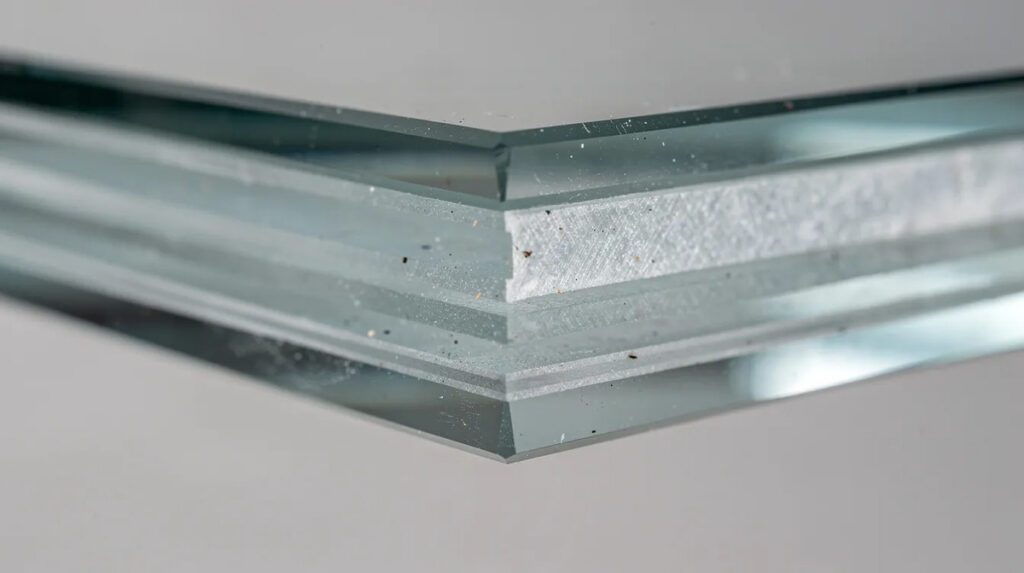
Laminated glass consists of multiple panes bonded with polyvinyl butyral (PVB) or ionoplast interlayers. Laminated glass adheres to interlayers, creating a durable barrier against break-in attempts. Under the European standard EN 356, burglar resistant glass is classified from P1 to P8 based on resistance. P1-P4 glass is suitable for private homes, while P5-P8 glass is recommended for higher-risk locations like jewelry stores and electronics retailers. A residential upgrade might target P4A, while a high-value retail storefront needs P6B or above for serious burglary protection.
Polycarbonate and acrylic/polycarbonate composites offer a different profile. Polycarbonate glass is stronger and lighter than glass, designed for high-impact absorption. It withstands repeated blows from tools without cracking open, making it ideal for forced entry resistance in demanding applications. In retrofit scenarios, polycarbonate shields are often preferred because they place less structural load on existing frames and provide better edge containment. Our DefenseLite overglaze security system uses abrasion-resistant coated polycarbonate that stays clear and nearly invisible once installed.
Hybrid and insulated units combine the best of both approaches. Laminated safety glass can serve as the interior lite of an insulated unit, maintaining energy savings and acoustic insulation. Retrofit shields that sit over existing insulated glass create an airspace that delivers improved thermal performance without replacing the original windows.
Quick comparison of the three main options:
- Laminated glass: excellent clarity, rigid, heavier, higher replacement cost, strong forced entry resistance at high EN classes
- Polycarbonate shields: lighter, faster to retrofit, superior under repeated impacts, times stronger than standard glass, requires UV coating for durability
- Window film: lowest cost, retains fragments, but minimal protection against tools or a determined manual attack – not suitable for most demanding applications
Testing, Standards, and Real-World Forced Entry Performance
Standards matter because they let you compare products objectively and ensure your glazing meets insurance, code, and procurement requirements. Without standardized test procedures, “burglar proof glazing” is just a marketing claim.
European Norm EN 356 is the most widely referenced classification for anti-burglary glazing. Lower classes (P1A through P5A) test impact resistance by dropping a 4050 g steel ball three times from increasing heights. EN 356 tests glass with a 4.11 kg steel ball to evaluate how well it holds together under blunt pieces of impact. These classes confirm basic safety but do not represent serious burglary resistance.
The higher classes, P6B through P8B, shift to manual attack testing. An axe strikes a 40 x 40 cm opening in EN 356 testing, simulating a real attacker trying to create a man-sized breach. High impact resistant classes range from P6B to P8B, where P8B withstands over 70 blows. Resistance classes P6B, P7B, and P8B provide burglary protection. It is rigorously tested against European standards P6B-P8B with various types of tools including axes and crowbars. Security glazing is evaluated based on its resistance to repeated impacts and ability to deter intrusions. The resistance class directly correlates to expected attack time: P6B resists about 10 minutes of manual attack, P7B about 15 minutes, and P8B roughly 20 minutes.
Related European norms include EN 1063 for bullet-resistant glazing (a separate threat profile from burglary) and EN 13541 for bomb blast resistance. Some systems are engineered for a combination of threats.
In the U.S., UL 972 covers burglary resistant glazing material intended to resist hit-and-run smash-and-grab attacks on glass windows in retail stores. ASTM F3561, ratified recently, goes further by testing the entire system – glass or polycarbonate, framing, and anchorage – after simulated ballistic weakening followed by mechanical forced entry. Levels range from 1 to 8, with Level 8 requiring cumulative impact energy exceeding 3,600 ft-lb.
True forced entry resistance depends on the complete system. Even the strongest proof glass fails if the frame, anchors, or mounting hardware are weak. A pharmacy retrofitted with commercial security window solutions using engineered polycarbonate shields and secure doors withstood over 20 minutes of crowbar and hammer attacks without a breach – because the entire system was designed to work together.
Retrofit Burglar Proof Solutions vs. Full Window Replacement
Most commercial buildings and schools already have structurally sound insulated glass windows. The problem is vulnerability to forced entry, not aesthetics, making retrofitting far more practical than full replacement.
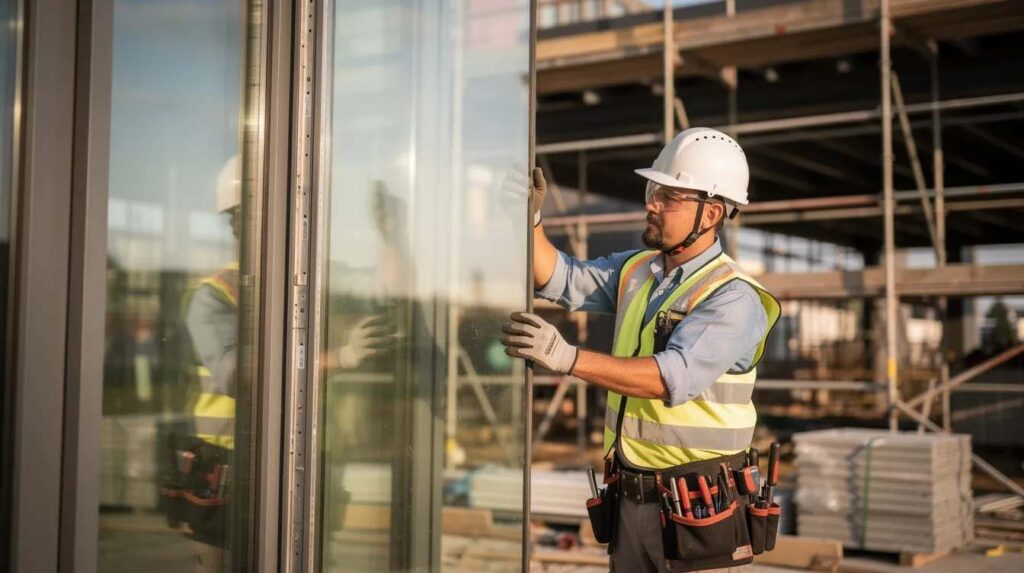
Retrofit forced entry security glazing systems mount clear polycarbonate or laminated shields over existing glass and frames. Custom-engineered aluminum framing flexes and absorbs impact instead of transferring high impact forces directly to the original window. For occupied buildings, this means minimal disruption – work is typically completed after hours with no need to remove existing storefront or curtain wall systems.
Burglar resistant glass offers long-lasting durability over time, and retrofit systems add significant additional benefits beyond security. It improves energy efficiency by enhancing insulation: the added airspace between the shield and existing glass can improve thermal performance by over 50%. Burglar resistant glass reduces noise pollution indoors, cutting sound transfer by up to 40% – critical for schools and healthcare facilities that need indoor comfort. UV protection from coated shields also reduces fading of interior furnishings and merchandise.
Full replacement solutions involve higher material and labor costs, longer construction timelines, more permits and inspections, and are often unnecessary when the existing glass is structurally sound, especially when engineered DefenseLite vs. security glass film systems can be retrofitted over current windows.
A typical Impact Security project flows through clear steps: site assessment and risk analysis, engineering and fabrication at U.S. facilities in Marietta, GA and Glendale, AZ, professional installation by certified dealers, and ongoing warranty and maintenance support.
When to Upgrade to Burglar Resistant Glass (and Common Mistakes to Avoid)
Since 2020, smash-and-grab attacks on pharmacies, gun stores, cannabis dispensaries, and high-end retail have surged. Retail inventory loss from theft now exceeds $112 billion annually. School districts and municipal facilities have also accelerated glazing upgrades after high-profile security events between 2022 and 2025.
Signs it is time to act:
- Recent break-in or attempted forced entry through glass windows or secure doors
- High-value items near the perimeter (electronics, firearms, jewelry, controlled substances)
- Location in high-risk areas with repeated vandalism or civil unrest
- Requirements from insurers, risk managers, or government security audits
Common mistakes to avoid:
- Relying solely on alarms and cameras without mechanical delay at the glass line
- Installing basic laminated safety glass at low EN 356 classes and assuming it is fully burglar proof
- Using thin safety film on at-risk openings where a determined attacker with tools is expected
- Ignoring the framing and hardware – weak anchors create easy opening points even with strong glass
Prioritize main entry points, cash handling areas, and street-facing storefronts first. Coordinate glazing upgrades with lock, access control, and surveillance improvements. Engage security glazing experts early, especially for schools and government buildings subject to public procurement rules.
Why Choose Impact Security for Burglar Resistant Glazing?
Impact Security and the DefenseLite product family are U.S. leaders in retrofit security glazing for forced entry, ballistic, and riot protection, supporting regional projects like Chicago window security and safety glazing. Founded in 2016 and headquartered in Marietta, Georgia, we deliver turnkey B2B and B2G service: assessment, engineering, fabrication, installation, and after-care handled entirely by security glazing specialists.
What sets us apart:
- Nationwide certified DefenseLite dealer and installer network with experience across schools, hospitals, national retail chains, government buildings, and financial institutions
- U.S.-based fabrication centers in Marietta, GA and Glendale, AZ for predictable lead times and quality control
- Solutions for various types of threats: forced-entry retrofit shields for storefronts and doors, ballistic add-ons for high security buildings, and custom safe-room glazing for reception counters and transaction windows, all supported by our forced entry resistant doors and windows product family
- Systems that maintain your building’s existing appearance – clear, discreet, and suitable for public-facing environments
- A high level of forced entry resistance with less downtime and cost than full replacement, backed by engineering data, standardized testing, and field-proven performance
Request a free security glazing assessment or use our DefenseLite contact form to identify which openings to protect first and what level of protection fits your risk profile and budget.
FAQs About Burglar Resistant Glass
Is there really such a thing as burglar proof glass? No glazing is infinitely impenetrable. The goal of burglar resistant glass is time delay – making it so difficult and noisy to breach that intruders abandon the attempt or are caught before they can gain access. System design (glass, frame, anchors) determines how many minutes of resistance you get.
What is the difference between laminated safety glass and true burglar resistant glass? Laminated safety glass holds fragments together after breakage to prevent injury. True anti-burglary glass uses thicker multiple glass layers, stronger interlayers, and engineered framing to resist sustained manual attack with tools. The difference shows up in EN 356 classifications: safety-rated products typically fall in the P1A–P5A range, while burglar resistant glass starts at P6B.
How thick does burglar resistant glass need to be for retail or school applications? Thickness varies by threat level and product type. Laminated solutions for retail might range from 12 mm to over 25 mm. Polycarbonate retrofit shields can achieve equivalent or greater forced entry resistance at lower thickness and weight. Engineering is always project specific.
Can I retrofit burglar resistant glass onto my existing aluminum storefront or curtain wall?
Yes. Retrofit shields, such as DefenseLite overglaze systems, mount over existing glass windows and doors using custom aluminum extrusions and security-tipped anchors. The existing glazing stays in place, and the shield absorbs attack energy through controlled flex rather than rigid transfer.
How does burglar resistant glazing affect energy efficiency and daylight? Clear polycarbonate shields transmit daylight with minimal optical distortion. The added airspace between the shield and existing glass delivers improved thermal performance, energy efficiency gains, and reduced condensation. Most occupants don’t notice any visual difference.
How long does installation take, and will my business need to close? Certified installers complete most retrofit projects within one to three days, depending on the number of openings. They routinely perform installation after hours to avoid business disruption, especially for retail stores and schools