Table of Contents
- What Are Commercial Security Door Systems? – Core concepts explained in under 2 minutes
- Key Requirements for Commercial Security Doors in 2026 – Security, safety, and compliance essentials
- Types of Commercial Security Doors – Wood, steel, glass, and specialty options
- How to Choose the Right Commercial Security Door System – Decision frameworks for your facility
- Integrating Security Systems with Commercial Doors – Locks, access control, and video
- Planning a Commercial Security Door Solution – Risk assessment and stakeholder collaboration
- Moving Toward Smart, Connected Door Security – Centralized management and scalability
- Why Choose Our Team – Our process and service advantages
- FAQs – Answers to common questions
What Are Commercial Security Door Systems?
Commercial security door systems combine physical doors, hardware, and electronic security—including access control, locks, and sensors—to protect offices, retail spaces, industrial sites, and public buildings. A commercial door is a specialized solution designed for commercial buildings to enhance safety, protection, and operational efficiency. In 2026, these systems must do more than lock a doorway: they manage access, support audits, and integrate with video and alarms, with the ability to improve threat detection, response times, and overall security effectiveness.
Facilities using these systems include multi-tenant office buildings, logistics warehouses, hospitals, schools, and data centers. The structure of both the building and the doors, along with the use of security tools, plays a crucial role in ensuring overall safety, durability, and functionality. This guide covers three pillars: door construction (wood, steel, glass), integrated technology (locks, access control, video), and planning (risk assessment, code compliance, stakeholder input).
Key Requirements for Commercial Security Doors in 2026
Commercial doors must meet security, life safety, energy, and regulatory requirements simultaneously. Durable commercial security doors are essential to withstand environmental and security threats, including high daily use, attempted forced entry, and in coastal regions, extreme weather events projected through 2026 hurricane seasons.
Compliance with IBC, NFPA 80 for fire doors, local fire marshal regulations, and ADA accessibility rules is essential. Doors must comply with Americans with Disabilities Act (ADA) standards for dimension and operation. Advanced electronic locking systems help by eliminating risks associated with traditional keys, such as loss or unauthorized duplication. Well-specified security doors reduce long-term maintenance costs, lower HVAC bills through better insulation, and improve tenant satisfaction. Heavy-duty hardware is required in high-traffic areas to ensure longevity and security.
Types of Commercial Security Doors
Commercial security doors are available in various materials including wood, metal, and reinforced glass, each suited for different applications and security needs. Exterior security doors are a critical component for protecting commercial properties, offering enhanced safety and customization for different business environments. Common categories include heavy-duty security doors like fire-resistant doors, bullet-resistant doors designed for ballistic protection, and doors designed to shield against radiation.
Hollow metal doors are commonly used in commercial security applications due to their heavy-duty construction, featuring a metal outer surface and a hollow core designed to absorb impact. The structure of these doors, as well as the overall structure of the building, contributes significantly to safety, durability, insulation, and reinforcement. Exterior commercial security doors are typically designed to withstand extreme weather conditions and provide additional protection against environmental elements, while interior security doors focus on access control. Traffic condition assessments influence the choice of door materials to withstand wear and tear.
Commercial Wood Security Doors
Wood doors feature solid-core construction (particleboard, stave core, or mineral core) with decorative high-pressure laminate or veneer. They’re rated for specific fire durations—20, 45, 60, or 90 minutes depending on application.
These doors commonly appear in law offices, medical suites, conference rooms, hotel corridors, and executive areas requiring privacy and design appeal. Benefits include natural sound dampening, good insulation, and compatibility with modern electronic hardware. However, wood doors are less suitable for harsh exterior environments, high-moisture areas, or locations with repeated impact risk.
Steel and Metal Security Doors
Steel doors form the backbone of high-security commercial entry points, offering durable solutions for businesses seeking long-term protection. Hollow metal doors are commonly used in commercial security applications due to their heavy-duty construction, which includes a metal outer surface and a hollow core designed to absorb impact.
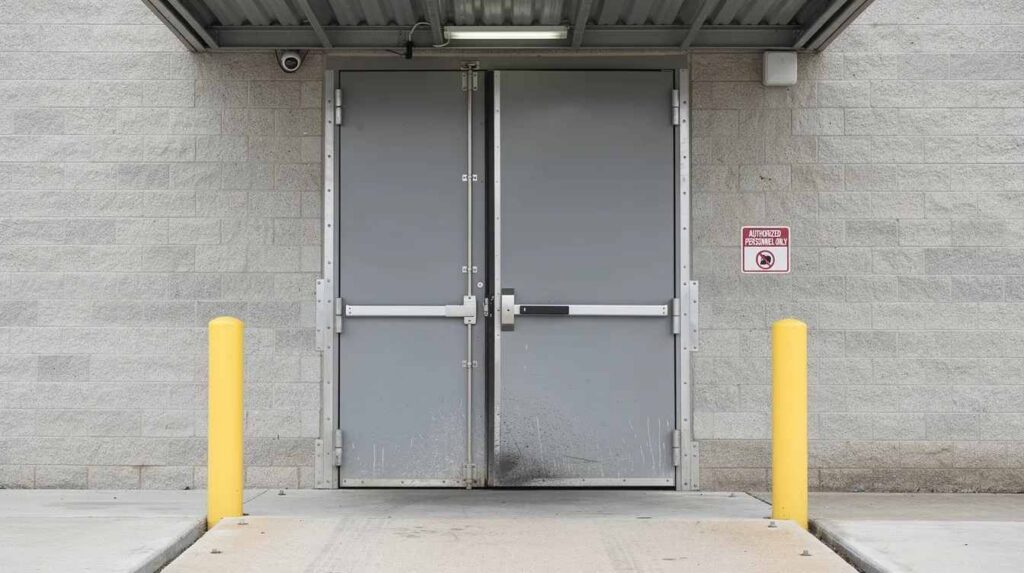
Metal security doors provide greater durability and are suitable for both exterior and high-security interior applications in commercial settings. Key advantages for businesses include superior resistance to forced entry, durability under constant use, and excellent performance in harsh climates. Additionally, metal security doors can help reduce maintenance costs and increase energy efficiency in commercial buildings, contributing to the overall value for businesses. Strong hinges and frames are crucial for preventing tampering in high-security areas.
Reinforced Glass and Security Glazing Doors
Many commercial buildings require transparency for visibility and aesthetics. These doors typically feature aluminum or steel frames with laminated, tempered, or polycarbonate-reinforced glazing. Secondary glazing and over-glaze systems work well for retrofits.
Common applications include storefronts, corporate lobbies, interior vestibules, and retail entries that must showcase merchandise while deterring smash-and-grab attacks. While modern security glazing significantly delays intrusion, pure glass doors have lower structural strength than solid metal doors and may require complementary measures like advanced safety and security glass solutions or interior grilles.
Specialty High-Security Doors
Some facilities require bullet-resistant doors for banks and high-risk retail, blast-resistant doors for petrochemical sites, or radiation-shielding doors for radiology suites. The selection of specialty doors should be based on the specific protection needed for each facility, taking into account the building’s function, risk level, and regulatory requirements. These doors are part of certified systems including specialized frames and glazing tested to UL, NIJ, and FEMA standards.
Specialty doors involve higher upfront costs—often $1,500 to $3,000+ per unit—but are essential where forced entry resistant door systems provide the highest level of ballistic protection.
How to Choose the Right Commercial Security Door System
Selection balances risk level, building type, traffic volume, aesthetics, technology integration, and budget. There is a wide selection of commercial security doors systems available, including interior, exterior, and specialty options, so it’s important to choose the right type to suit your specific security needs. Categorize each opening by role: primary entry, emergency exit, restricted area, service entry, or internal circulation door.
In 2026, many projects weigh sustainability (recycled content steel, low-VOC laminates, energy performance) alongside security. Traffic condition assessments are crucial, as high-traffic areas require door materials that can withstand greater wear and tear to ensure long-term durability. Plan for future upgrade paths with frames that can accept advanced electronic hardware later. Insulated doors and proper weatherstripping can enhance energy efficiency and reduce utility costs significantly.
Balancing Materials: Wood vs. Metal vs. Glazed Systems
| Material | Best For | Maintenance | Cost Range |
|---|---|---|---|
| Wood | Interior offices, conference rooms | Refinishing every 3-5 years | $700-$1,500 |
| Steel/Metal | Perimeter entries, loading docks | Painting every 5-7 years | $1,200-$3,000+ |
| Glass/Glazed | Lobbies, storefronts | Regular cleaning | $1,000-$2,500 |
| Many buildings mix materials strategically—steel for loading docks, wood doors for office corridors, glass for reception—to control cost while maintaining security across your commercial property. |
Security Level and Threat Profile
Evaluate doors by threat categories:
- Vandalism and graffiti
- Opportunistic theft
- Organized burglary
- Workplace violence
- Active assailant risk
- Environmental hazards (storms, wildfires)
When planning security door solutions, it is essential to consider the specific vulnerabilities of the property, including its location and the types of threats it may face. The use of appropriate security tools—such as reinforced locks, alarms, and surveillance—alongside commercial security doors systems helps address these various threat categories. Increasing threat levels drive upgrades from standard solid-core to reinforced steel or ballistic-rated systems. Overly light-duty doors at vulnerable areas often become the first failure point in incidents.
Code Compliance, Fire Ratings, and Egress
Compliance with local fire safety and building codes is essential for door installation. Fire rated doors are labeled assemblies with specified ratings (20-180 minutes), self-closing requirements, and restrictions on hardware modifications.
Emergency exit doors must swing in the direction of egress. Panic bars are horizontal bars that allow for immediate egress during emergencies. Coordinate with local authorities, especially during 2025-2026 code updates in major metro areas.
Integrating Security Systems with Commercial Doors
Doors work best when paired with coordinated electronic systems: locks, access control, video, and sensors. Integrated systems have the ability to improve threat detection and response, making your commercial security doors systems more effective. Think in layers: physical barrier (door and frame), locking hardware, electronic control, detection (sensors and cameras), and response protocols.
Commercial access control systems are designed to manage access by identifying, validating, authorizing, and recording each individual entering a building or a specific restricted area. Integrated door systems support compliance reporting for employees and visitors. Integrating access control systems with commercial security doors enhances security by providing comprehensive information on access activity, including incidents such as unauthorized entry attempts.
Advanced Locking Hardware and Electronic Locks
Modern locks include:
- Mortise locks: Heavy-duty locks installed inside a pocket in the door
- Electric strikes: Replace standard strike plates and use an electronic signal to release the latch without a key
- Magnetic locks: 600-1200 pounds-force holding capacity
Heavy-duty hardware is required in high-traffic areas to withstand frequent use. Credential-based unlocking eliminates problems with lost keys and uncontrolled duplication, effectively eliminating the risks associated with traditional keys such as loss, theft, or unauthorized duplication. Many facilities now monitor activity with real-time door-ajar alerts.
Access Control Systems for Commercial Doors
These systems require users to present access credentials at a security door reader, leveraging the system’s ability to efficiently validate and authorize users by identifying them from a database of authorized personnel and granting or denying access accordingly. Access credentials include RFID keycards/fobs, numeric keypads, mobile apps, and biometrics.
Common integration points include elevator control access, parking gates, and visitor management, especially where forced entry security glazing and door systems are protecting high-value areas. Cloud-based management enables multi-site oversight from a single dashboard—restrict data center doors to IT staff and automatically revoke access upon employee termination.
Video Surveillance and Door Monitoring
Pairing security cameras with secure doors and impact-resistant security glazing systems enhances situational awareness. Place cameras at main entries, secondary exits, loading docks, and sensitive internal doors. Video analytics have the ability to detect tailgating and loitering around entry points, significantly improving threat detection and helping protect occupants.
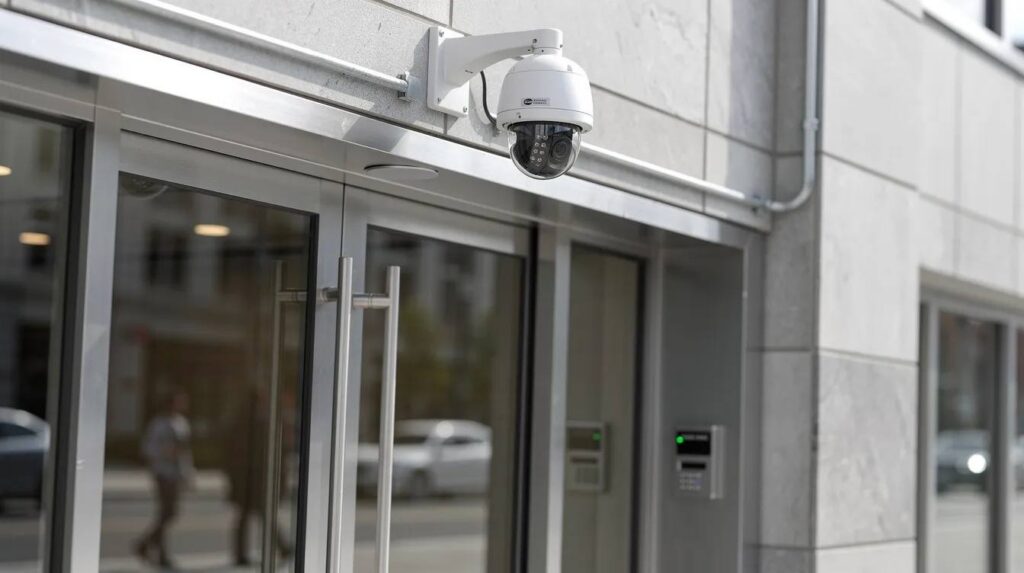
Consider retention periods, encryption, and adherence to company policies on video recording for your facility.
Intrusion, Smoke, and Environmental Sensors
Intrusion sensors (contacts, glass-break detectors, motion sensors) detect unauthorized entry attempts or after-hours movement. Fire and smoke detectors near rated doors trigger life-safety responses while doors compartmentalize flames.
Environmental sensors monitoring temperature and air quality integrate with doors in critical spaces like data centers. Smart notifications via cloud platforms ensure 24/7 awareness for your company’s security teams.
Planning a Commercial Security Door Solution
Planning follows a structured process: assessing vulnerabilities, mapping openings, understanding regulatory constraints, considering the structure of the building, and collaborating with stakeholders. Different door/technology combinations suit offices, retail, healthcare, education, and industrial sites differently.
The layout and structure of a commercial property play a crucial role in determining the number and type of security doors needed, including external entries, loading bays, and emergency exits. Approach projects in phases—prioritize highest-risk doors first.
Assessing Vulnerabilities and Risk
Conduct vulnerability assessments by reviewing local crime data, evaluating recent incidents, and identifying critical assets. Categorize doors by risk level based on visibility, isolation, and asset value.
Examples include retail stores facing smash-and-grab attempts, suburban office buildings seeing property crime increases, or schools updating security after 2023-2025 national guidance.
Mapping Doors and Access Paths
Survey all exterior and interior openings: main entrances, staff-only doors, loading docks, emergency exits, and high-value storage areas. Produce an annotated floor plan marking door types, swing direction, fire ratings, and connected systems.
Understanding how people, deliveries, and visitors flow through the building reveals where security gaps occur, including vulnerable entries such as sliding glass doors that need enhanced security. Plan secure vestibules or mantraps for data centers or high-value retail to control access effectively.
Industry-Specific and Regulatory Requirements
Requirements vary by sector, and high-risk environments such as schools increasingly rely on reinforced window and door glass security solutions:
- Healthcare: HIPAA privacy, patient safety protocols
- Financial: Controlled substances storage, vault access
- Education: Emergency lockdown capabilities
- Manufacturing: Chemical storage safety
Collaborating with Stakeholders
Collaboration with key stakeholders, including property owners, managers, and security professionals, is vital in planning effective commercial security door solutions tailored to specific needs. Document decisions in a formal door schedule approved before procurement. Engaging an experienced security integrator early shortens timelines and avoids integration pitfalls.
Moving Toward Smart, Connected Door Security
The trend through 2026 is toward smart, networked door systems sharing data with broader building and security platforms. These systems have the ability to provide centralized management and analytics, allowing for enhanced monitoring, event correlation linking doors to cameras, automation rules, and remote diagnostics.
Open standards and APIs enable integrating door hardware and third-party systems into one ecosystem. Keep door controllers updated and segmented against cyber threats.
Centralized Management and Analytics
Centralized platforms let security teams manage hundreds of doors across multiple sites—adjusting schedules, generating compliance reports, and identifying patterns. Predictive maintenance analytics use door event data to schedule service before failures occur.
Integrating access control systems with commercial security doors enhances security by providing comprehensive information on access activity, including incidents such as unauthorized entry attempts.
Scalability and Future-Proofing
Start with core doors and expand coverage over time. Choose doors and overhead security doors that support firmware updates, new credential types, and future integrations without replacing core components.
Modular, backward-compatible systems let organizations upgrade readers and software without discarding existing architecture. Planning for scalability reduces total investment costs and ensures viability beyond 2030.
Why Choose Our Team for Your Commercial Security Door Systems
We specialize in designing, supplying, and integrating commercial security door systems tailored to each client’s risk profile and industry. Our team brings hands-on experience providing solutions for a wide range of businesses, including office, healthcare, industrial, and retail projects, plus familiarity with 2024-2026 building and fire codes.
We provide end-to-end support—from site assessment and door specification through installation, system integration, and ongoing service. Unlike generic door vendors, we understand both physical door construction and electronic security, ensuring every opening works as part of a unified system.
Our Process and Service Advantages
Our process includes:
- Initial consultation and on-site survey
- Risk and code review
- Door schedule development
- Technology integration planning
- Phased installation with minimal disruption
- Post-install training
We offer preventative maintenance plans, remote system health monitoring, and priority response for critical failures. Request a consultation on our website to discuss how we can secure your space with the right commercial security doors for your needs.
Frequently Asked Questions About Commercial Security Door Systems
How much do commercial security door systems cost per opening in 2026? Door costs range from $300-$3,000+, depending on materials. A complete integrated system with access control, installation, and commissioning typically runs $5,000-$10,000+ per opening.
Can I retrofit existing doors with modern access control? Often yes, but it depends on door construction and frame design. Some retrofits are cost-prohibitive—a site assessment determines feasibility while maintaining existing architecture.
How long does installation take for an occupied building? Single-door retrofits may take a few hours. Larger projects over 20+ openings require phased, off-hours work over several weeks to minimize disruption.
What maintenance do fire-rated doors and electronic locks require? Fire-rated doors need annual inspection of self-closing mechanisms and seal integrity. Electronic locks require annual battery replacement and regular lubrication to maintain peak performance.
How do you help clients choose doors between wood, metal, and glass? We assess your environment, security requirements, traffic patterns, and aesthetics to recommend the right commercial security doors—often a mix of materials across different building areas.