Table of Contents
- Why Security Doors Matter in Schools Today
- Core Functions of Security Doors in K-12 Environments
- Types of School Security Doors
- Key Features to Specify
- Code Compliance & U.S. Regulations (2024–2026)
- Lockdown, Egress, and Everyday Use
- Inspection, Maintenance, and Upgrades
- How to Choose the Right Strategy
- Why Choose Our Business
- Frequently Asked Questions
- Conclusion and Next Steps
Introduction: Why Security Doors Matter in Schools Today
Since 2018, school safety has become a top priority for educational institutions across the United States. Federal initiatives like the STOP School Violence Act and the Bipartisan Safer Communities Act of 2022 have directed over $1 billion annually toward K-12 security upgrades, with physical barriers—including doors—receiving significant attention in 2024-2026 allocations.
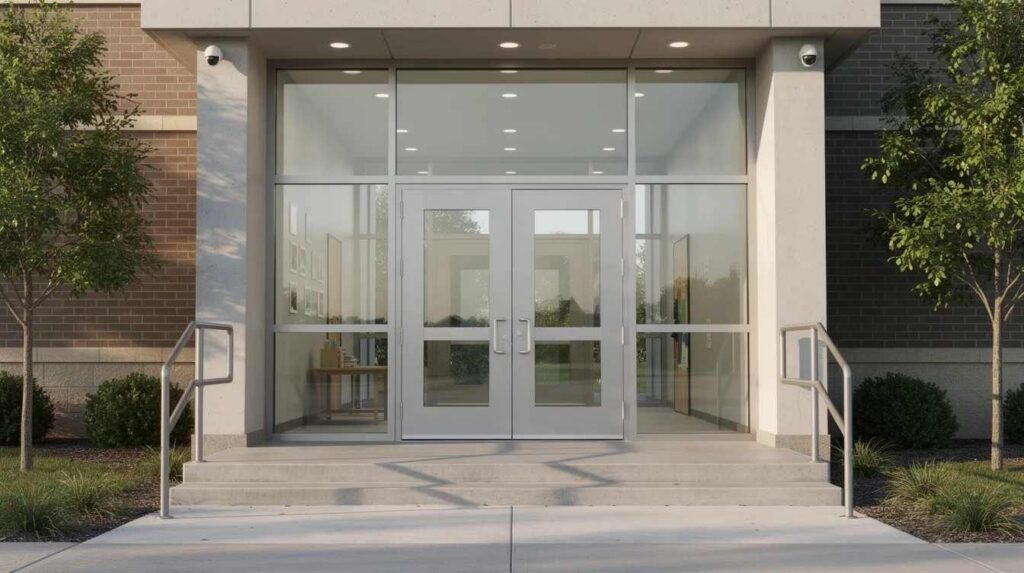
Security doors for schools encompass far more than a single product type. The term covers exterior entrance doors that greet visitors, interior classroom doors that protect students during instruction, and specialized bullet resistant openings in high-risk areas like front vestibules. Each serves a distinct purpose within a layered security strategy.
The challenge for school districts lies in balancing two competing goals: deterring intruders and ensuring rapid, safe evacuation during fire or other emergencies. Modern door solutions must satisfy NFPA, IBC, and ADA requirements while maintaining a welcoming school environment that doesn’t feel like a fortress. Every second a secure door delays an intruder increases the chance of successful intervention by law enforcement. This guide provides practical guidance, regulatory context, and concrete product examples that facilities directors, superintendents, and architects can act on immediately.
Core Functions of Security Doors in K-12 and Campus Environments
Security doors operate on the “delay, deter, detect, and direct” paradigm. Properly specified doors slow forced entry, deter potential threats, support access control systems for detection, and safely direct egress during emergencies.
- Delay forced entry: School security doors are designed to deter forced entry and provide added protection during lockdowns, featuring reinforced cores, continuous hinges, and tamper-proof hardware. This buys critical minutes—typically 2-5 minutes—for 911 response and lockdown activation.
- Support layered security: Doors form part of a perimeter-to-classroom defense, working alongside fencing, main entrances, corridor controls, and individual room protection.
- Enable lockdown strategies: Integration with electronic systems ensures only authorized personnel can enter specific areas, preventing security breaches like theft or vandalism. Integration with systems allows for instant building-wide lockdowns and tracking of visitor entry.
- Integrate with technology: Security solutions require connection with electronic access control, video surveillance, and mass notification systems to function as part of a complete physical security approach.
- Serve multiple functions: A single opening may need to function as a security door, fire door, and bullet resistant barrier simultaneously—each tested to different standards (ASTM F3038, NFPA 252, UL 752).
Types of Security Doors for Schools
Most schools mix several door types based on location and risk level. Here’s what facilities managers should know about each category:
| Door Type | Typical Location | Key Specifications |
|---|---|---|
| Exterior entrance doors | Main entrances, perimeter | 12-16 gauge steel, security glazing, multi-point locks |
| Classroom doors | Interior classrooms, corridors | 18-20 gauge steel or solid-core wood, inside-locking hardware |
| Fire-rated doors | Stairwells, fire barriers | 20/45/60/90-minute ratings per NFPA 80 and IBC 716 |
| Bullet resistant doors | Vestibules, administration | UL 752 Levels 1-8 rated assemblies |
| Specialty doors | Gyms, special education | Panic hardware, soft-closure mechanisms |
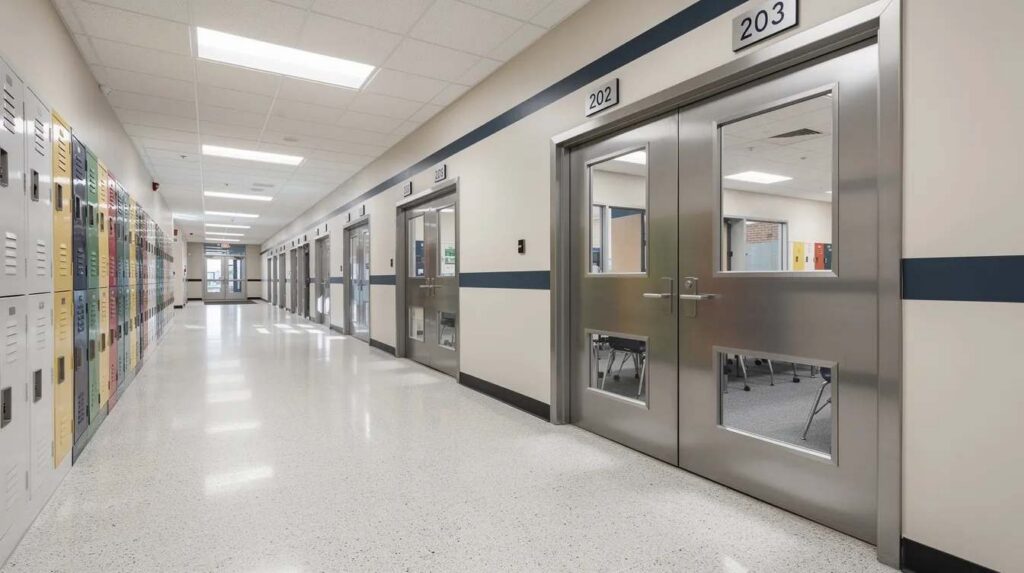
| Classroom doors with windows are commonly used in K-12 education, constructed from 18- or 20-gauge steel or solid-core wood, and are compliant with NFPA 80, ADA, and local fire codes. Fire-rated school doors are required in hallways, stairwells, and some classrooms, and are available with fire ratings of 20, 45, 60, and 90 minutes, meeting NFPA 80 and IBC 716 standards. |
Bullet-resistant doors are designed to deter forced entry and provide protection during lockdowns, often featuring reinforced cores and tamper-proof hardware. For vestibules and secure reception areas, UL 752 Level 3 bullet-resistant door assemblies are common, stopping multiple .357 Magnum rounds.
In 2024-2026, 65% of budgeted upgrades target hardened main entrances and classroom doors first when school districts face limited funds.
Key Features to Specify in School Security Doors
Performance depends as much on hardware, glazing, and frame details as on the door leaf itself.
- Door leaf construction: 18-gauge steel outperforms 20-gauge by 50% in kick tests, absorbing 300 ft-lbs of impact. Doors should be made of durable materials like fiberglass-reinforced polymer (FRP) to withstand heavy traffic and ensure long-term functionality.
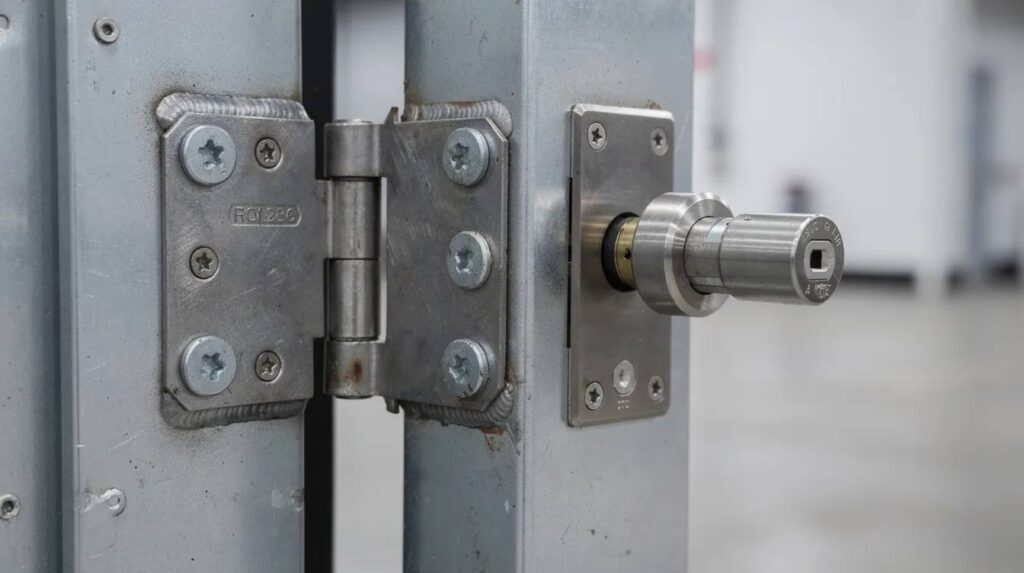
- Frame and hinge selection: Reinforced 16-gauge steel frames with 5-knuckle continuous hinges (300,000-cycle rating) resist prying and student abuse. Tamper-resistant fasteners prevent hardware removal.
- Locking hardware: “Intruder function” locks allow teachers to lock the door from the inside without using a key or stepping into the hallway. Modern systems often allow for one-step, intuitive locking from the inside without requiring a key, essential when motor skills are impaired by stress.
- Glazing options: Standard glass is a weak point; upgrading to film-protected or polycarbonate glass prevents an intruder from smashing a window to reach an internal lock. Security glazing solutions for doors and windows including security film or ballistic-rated glass should be installed on all exterior doors to enhance safety and delay unauthorized entry.
- Access control integration: Card readers, keypads, mobile credentials, intercoms, and video at main entries manage who enters and when, reducing unauthorized access by up to 40%.
- Accessibility compliance: Security doors must never interfere with quick evacuation and should be operable with one motion to meet fire and ADA standards. Lever handles must be positioned at 34-48 inches AFF with maximum 5 lbf operating force.
Regulatory Landscape: Codes, Laws, and Guidelines (2024-2026)
U.S. schools must navigate fire/life-safety codes, accessibility rules, and emerging school-safety laws when upgrading commercial doors.
- Fire and building codes: NFPA 80 governs fire doors (annual inspections, 3/4-inch maximum undercut), while IBC Chapter 10 mandates egress widths and prohibits barricades blocking free egress.
- ADA requirements: Clear width of 32 inches minimum, proper maneuvering clearance, and opening forces under 5 lbf. Security cannot override ADA accessibility obligations.
- State mandates: Since 2018, 47 states have enacted safety laws. Many states now require mandatory security inspections to identify weak access points and vulnerabilities in school doorways, often focusing on reinforcing window and door glass against forced entry. Florida’s Marjory Stoneman Douglas Act, for example, mandates annual door inspections.
- Alyssa’s Law: Adopted in 12 states by 2025, this legislation requires panic buttons tied to door unlocks, reducing response times by 50-70% in pilot programs.
- PASS guidelines: The PASS Guidelines recommend that all classroom doors should be able to be locked from inside or have an enforced policy that all doors remain locked at all times without exception.
- Barricade device restrictions: Non-compliant barricade devices can trap occupants inside during a fire or slow down first responders attempting to reach students. Work with code-literate door professionals to avoid solutions that violate fire codes.
Lockdown, Egress, and Everyday Use: Designing for Real-World Scenarios
Doors must perform both in daily traffic and during rare, high-stress events like intruder lockdowns or severe weather.
- Inside-locking classroom doors: Classroom doors should be able to lock from the inside to provide an additional layer of security during lockdown situations. This has become standard in 80% of new construction, outperforming external keys by 40% in drill performance.
- Main entrance vestibules: Mantrap configurations with two interlocked doors force visitors through a controlled check-in area, containing intruders 90% effectively.
- Closed-door policies: All exterior and classroom doors should be kept closed and locked at all times to prevent unauthorized access and enhance security. Heavy-duty closers (350,000-cycle tested) enforce this automatically.
- Emergency egress: All hardware must allow immediate exit without keys, tools, or special knowledge—even when doors are locked from outside.
- Avoiding circumvention: Wedges, magnets on strikes, and propped doors create 40% of exploitable gaps per district audits. Policy plus design reduces bypass temptation.
- Visual protection: Bullet-resistant glass options for schools provide protection, and blackout shades can disrupt an intruder’s line of sight during a lockdown.
Inspection, Maintenance, and Upgrades for Existing School Doors
Even the best door is ineffective if misaligned, broken, or left unlocked. Reliable security depends on ongoing maintenance.
- Quarterly inspections: Regular visual inspections of doors and hardware can help identify potential issues and ensure they function properly throughout the year. Check latching (1/2-inch minimum throw), hinge pin integrity, and glazing condition.
- Documented checklists: Create school door checklists tailored to your campus, incorporating state inspection requirements where applicable.
- Repair vs. replace decisions: Bent frames, repeatedly failing hardware, or doors that cannot maintain fire ratings should trigger replacement rather than patching—repairs fail 60% of the time in high-abuse scenarios, making forced-entry-resistant retrofit door systems a more reliable long-term option for critical openings.
- Retrofit options: Cost-effective upgrades include $300 ballistic-style security films yielding 3-minute delays, $800 lock upgrades adding inside function, and $2,000 sidelite swaps to Level 1 ballistic.
- Preventative maintenance: Lubricate quarterly, adjust closers bi-annually—this extends door life 50% and reduces unexpected downtime.
- Multi-year planning: Prioritize highest-risk entrance doors and vulnerable interior doors first, aligning projects with ESSER funds (depleting 2025) and bond cycles.
How to Choose the Right Security Door Strategy for Your School
Every campus is different. Selection should be based on threat assessment, budget, and long-term facilities plans.
- Risk assessment: Use FBI Active Shooter guidelines to identify 5-10 critical openings needing the highest protection.
- Zone segmentation: Assign door performance requirements by area—public zones (Level 1 ballistic vestibules using retrofitted door systems), semi-public corridors (reinforced steel doors), staff-only and secure areas (Level 3 protection).
- Stakeholder involvement: Include administrators, facilities managers, local law enforcement, and fire marshals early. Stakeholder buy-in boosts adoption 65%.
- Lifecycle costing: Durable steel doors offer 20-year ROI versus wood’s 10 years. Consider maintenance costs and future access control integration.
- Student wellness: Choose finishes and vision panels that preserve a welcoming, daylight-rich school environment. Aesthetic appeal matters—campuses shouldn’t feel like bunkers.
- Pilot programs: Test new door and hardware standards in one school building before district-wide rollout to validate performance and staff acceptance.
Why Choose Our Business for School Security Doors
We specialize in door solutions for K-12 environments and understand the operational realities schools face daily.
- Proven experience: Our team has completed projects ranging from 1960s high school retrofits with $1.2M phased installations to new K-8 buildings with ballistic vestibules.
- End-to-end support: We provide threat-informed door planning, product specification, code-conscious hardware selection, and coordination with access control vendors.
- Comprehensive product lines: Our school-focused offerings include standard steel doors, fire-rated assemblies, and bullet resistant door and glazing packages tested to UL 752 and other recognized U.S. standards, including won door specialty options.
- Fiscal flexibility: We help school districts phase projects over several fiscal years, aligning door upgrades with bond funding cycles and minimizing disruption to students and teachers.
- Compliance commitment: We avoid non-approved barricade devices and design solutions satisfying both safety codes and security goals. High-security doors are designed to withstand forced entry, including impacts and sometimes gunfire, discouraging attackers from attempting to breach a room.
- Ready to help: Contact us for a no-obligation security door review or consultation—available remotely or with an on-site visit depending on your location.
Frequently Asked Questions About Security Doors for Schools
This FAQ addresses common questions from superintendents, facility managers, and architects planning door upgrades.
What is the difference between a security door and a fire door in a school? Security doors are tested to ASTM F3038 for forced-entry resistance, while fire doors are tested to NFPA 252 for fire ratings. Many school openings require dual-purpose assemblies meeting both standards through third-party labeling.
Do we really need bulletproof doors, or are reinforced standard doors enough? Base this decision on threat assessment and location risk. High-risk zones like front vestibules may warrant UL 752-rated bulletproof glass and windows, while lower-risk interior spaces may need only reinforced 18-gauge steel with security film.
Can we retrofit existing classroom doors to improve lockdown capability? Yes. Realistic retrofits include upgrading locksets to intruder function ($800), adding 14-mil security films ($300), and replacing glass doors sidelites with security glazing as part of a comprehensive forced-entry protection strategy. These improvements can boost efficacy by 70%.
Are door barricade devices legal in schools? Many jurisdictions restrict or ban after-market barricades because they violate NFPA 101 life-safety egress requirements. Over 20 jurisdictions have explicitly banned sleeve locks—always consult your authority having jurisdiction and address weak points like sliding glass door-style openings and other vulnerable access points.
How often should school security doors be inspected? NFPA 80 mandates annual professional fire door inspections. In-house visual checks should occur quarterly, examining latches, hinges, closers, and glazing for damage or misalignment.
What information should we prepare before requesting a quote? Have floor plans ready, door counts (an average school has 150 openings), current hardware specifications, state mandates applicable to your district, and budget range. This helps us provide solutions matched to your resources and needs.
Conclusion and Next Steps
Secure, code-compliant doors are central to modern school safety and must be planned as part of a layered security strategy that addresses student protection goals across the entire campus.
- Start small: Small improvements—upgraded door locks, enforced closed-door policies—deliver immediate gains even before full door replacements in existing facilities.
- Use this guide: Share this article with your safety committee or school board when prioritizing door projects and improving school security across classrooms and common spaces.
- Schedule a consultation: Contact our team to review existing openings, discuss regulatory constraints, and create a phased improvement plan aligned with your education budget cycles.
- Spread the knowledge: Bookmark or share this guide with colleagues in facilities, safety, and administration so everyone works from a common understanding.
Safer schools start at the door. Thoughtfully implemented security measures support not only protection but also calm, confident learning environments where students and teachers can focus on education.