School leaders are under pressure to improve safety without turning a school building into a fortress. The right approach starts at the front door, but it does not stop there. Strong door security connects the exterior, vestibules, corridors, classroom doors, procedures, and training into one workable system.
Table of Contents
- Introduction: The Urgent Need for Strong Entry Door Security in K‑12 Schools
- From Curb to Classroom: Layered Physical Security Around School Entrances
- Securing Classroom Doors: Locks, Hardware, and Everyday Practices
- Understanding Classroom Door Lock Types and Functions
- Access Control Systems for School Entry Doors and Classrooms
- Classroom Door Protection vs. Barricade Devices: Safety, Codes, and Best Practices
- Everyday Door Security Practices for Administrators, Staff, and Students
- Planning and Budgeting for Door Security Upgrades
- Why Choose Our Team for School Door Security Projects
- Frequently Asked Questions About School Entry and Classroom Door Security
- Conclusion: Building a Safer Path from the Front Door to Every Classroom
Introduction: The Urgent Need for Strong Entry Door Security in K‑12 Schools
By 2019-20, 96% of U.S. public K-12 schools had written emergency plans, and 98% of public K-12 schools conducted a lockdown drill in 2019, according to federal school safety data reported by Pew Research. In 2019, 96% of public K-12 schools had a lockdown plan, and 96% of public K-12 schools had a written lockdown plan in 2019. Yet door security remains uneven: 97% of schools had door locks in 2019-20, but 1 in 4 public schools lacked classroom doors that lock from inside.
That gap matters because main entry doors and classroom doors are often the first and last physical barriers during emergencies, including school shootings. Entry door security for schools means securing exterior doors, vestibules, interior doors, corridors, and individual classroom doors while preserving life safety. All secure doors must comply with national life safety benchmarks, and a secure entry requires a balance between physical protection and compliance with emergency life safety codes.
From Curb to Classroom: Layered Physical Security Around School Entrances
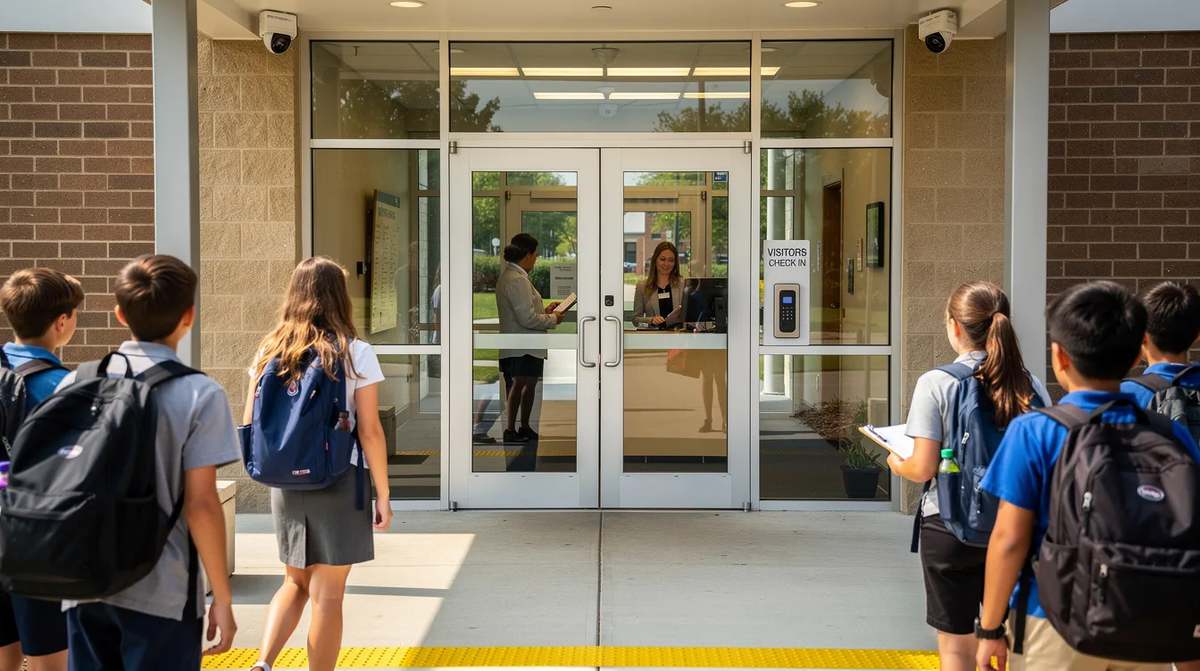
Effective security for school entry doors relies on a comprehensive, layered physical security framework. Using a layered perimeter approach can protect students and staff effectively because no single door lock, camera, or staff member can solve every security risk. Securing the perimeter begins by restricting access to a single reinforced primary entrance. Schools should use a single point of entry for visitors, with fencing, vehicle control, clear pathways, and signage guiding people away from secondary entry points.
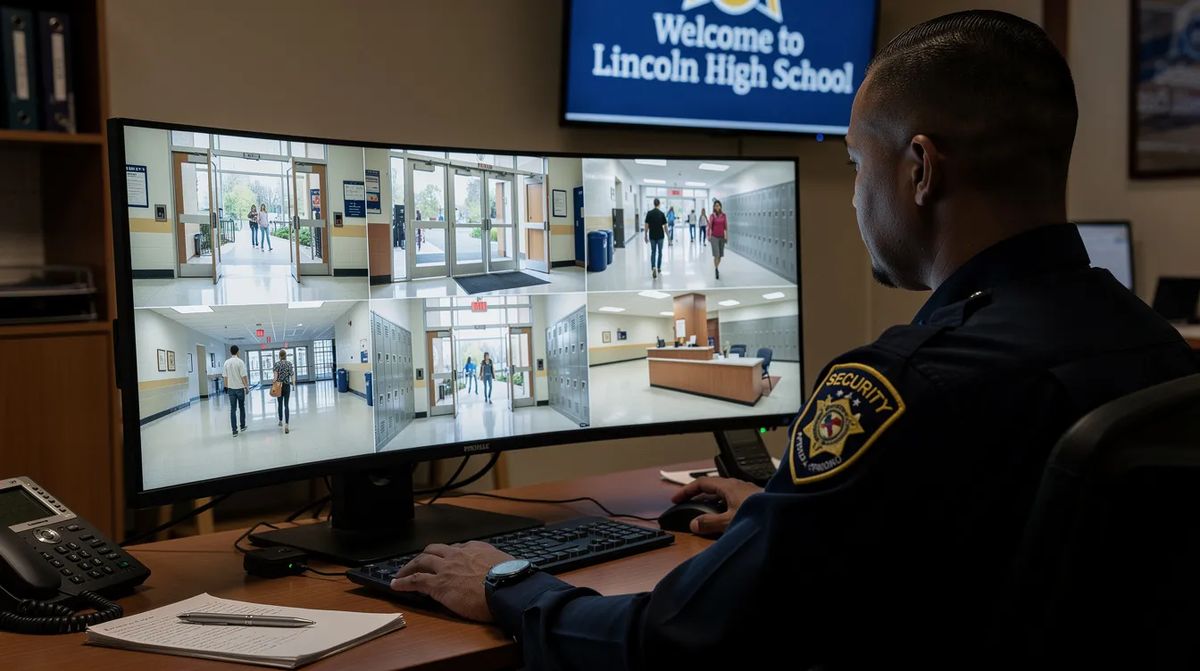
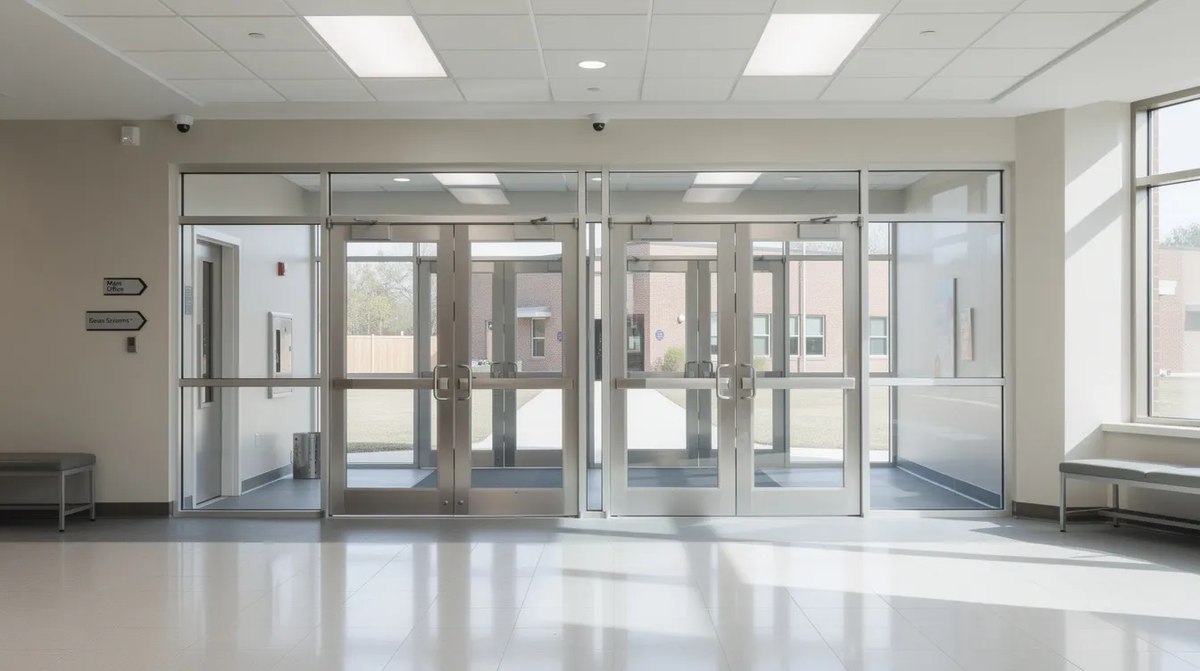
Security vestibules funnel all daily students and visitors through a main entrance, and best practices require monitoring all visitors through a single security vestibule, supported by reinforced window and door glass for school security. A two-stage security vestibule uses exterior and interior doors to slow movement, support visitor screening, and reduce risk during each door opening. Video intercom systems help verify identity before granting access, while high-definition IP cameras allow real-time visual identification at entryways.
Main entry hardware should include tamper-resistant hardware, reinforced frames, commercial steel doors where appropriate, and protected glazing such as AccessShield retrofit door systems. Exterior doors should feature tamper-resistant hardware to deter intruders. Using commercial steel doors ensures the entryway withstands physical impacts, but a secure entry door must be mounted in a strong frame to be effective. Standard glass panels must be replaced with safety and security glass for safety. Heavy-duty laminated glass-clad polycarbonate can prevent forced entry, and shatter-resistant security glazing and films on doors should be at least 14 mil thick.
Securing Classroom Doors: Locks, Hardware, and Everyday Practices
Classroom security is critical because classroom doors become protective barriers during a local lockdown. All classroom doors should lock from the inside. Classroom doors should be lockable from the inside to ensure teacher safety during lockdowns, and classroom doors should lock from the inside for safety. The Partner Alliance for Safer Schools, often referenced as PASS, recommends that classroom doors should be locked at all times according to PASS guidance.
During the school day, classroom doors should be locked, latched, and easy for teachers to secure without opening the door. General door locks may work for offices, but classroom security locks are designed for secure classroom doors while still allowing free egress. All exit doors must allow free exit from the inside at all times. Locks must operate smoothly without special knowledge from inside the building, and first responders must be able to gain access from the corridor side.
Hardware matters beyond the lock. A strong strike plate, aligned door latch, reinforced frame, heavy-duty hinges, and properly adjusted closer all improve classroom door protection. Mortise locks are often better for high-traffic school doors, while cylindrical locks may be suitable for some retrofits, and reinforced forced entry resistant doors add another layer of protection. Supplemental devices must never compromise the disabilities act, fire code, or emergency procedures.
Understanding Classroom Door Lock Types and Functions
Not all classroom door locks function the same way. Choosing the wrong function can create a security risk or slow school personnel during emergencies.
| Lock type | Security level | Code compliance | Ease of use | Best application |
|---|---|---|---|---|
| Standard classroom lock | Medium | High when listed | Moderate | Older classrooms with controlled key use |
| Classroom security lock | High | High when listed | High | Most schools upgrading classroom door locks |
| Storeroom function | Medium | High | Moderate | Storage or staff-only such spaces |
| Office function | Low to medium | High | High | Administrative areas |
| Mortise locks | High | High when specified | High | Durable school security for busy classrooms |
| Electronic/keyless locks | High | Depends on design | High | Access control and lockdown capabilities |
| Deadbolt locks can add strength on some interior doors, but they must not create extra releasing motions that violate adopted codes. Panic hardware must allow occupants to safely and quickly exit without a key. School safety door locks should be selected with the local Authority Having Jurisdiction, especially when hardware is replaced on fire-rated openings. |
Access Control Systems for School Entry Doors and Classrooms
An access control system manages who can open which door, at what time, and under what conditions. Typical access control components include card readers, key fobs, PIN pads, mobile devices, door controllers, electrified strikes, electrified mortise locks, and monitoring software.
Electronic access control systems protect against lost or stolen access tools by allowing administrators to disable credentials quickly. Keyless locks improve security and user experience. Access control systems track who is in the building and help school staff confirm whether locked doors are operating properly, and pairing these systems with forced entry security glazing and doors strengthens perimeter defense. Door position switches alert administrators if a door is propped open.
One-touch lockdown systems enable instant locking of all entry points. Global lockdowns secure all doors from one location. Local lockdowns allow teachers to lock classroom doors from inside. These two lockdown options give an entire school flexibility: a global response for major threats and a local lockdown for a classroom or corridor issue. Integration with cameras, intercoms, and alerts also improves control during fires, medical emergencies, and severe weather.
Classroom Door Protection vs. Barricade Devices: Safety, Codes, and Best Practices
Some schools consider barricade devices because they appear inexpensive and fast. These devices include wedges, floor bolts, sliding bars, and other add-ons designed to block a door. The problem is unintended consequences. Many barricade devices can trap occupants, block first responders, violate accessibility rules, or prevent evacuation.
Code-compliant classroom door protection should use tested door hardware, listed classroom security locks, and approved lockdown options instead of improvised barriers. The National Fire Protection Association has clarified that educational doors must support security while preserving egress under NFPA 101 life safety principles. Before buying any device, school districts should conduct a code review, speak with fire officials, and confirm that the system allows emergency access from outside.
Everyday Door Security Practices for Administrators, Staff, and Students
Hardware only works when daily habits support it. A strict no propping policy should be enforced for exterior doors. Secondary perimeter doors should be locked from the outside. Administrators should address these key areas:
- Keep exterior doors locked during school hours.
- Require visitor access through one monitored vestibule.
- Close any propped open classroom, corridor, or exterior door immediately.
- Track keys and revoke access cards when a staff member leaves.
- Audit who has access to each classroom, office, and facility zone.
- Inspect classroom door locks, hinges, closers, frames, and latch alignment.
- Include door use in lockdown drills, fire drills, and other safety procedures.
- Review security policies with teachers, substitutes, and students.
Regular hardware audits ensure the operational effectiveness of door systems. Operational audits help maintain the functionality of secure doors. When resources pass from planning to purchasing, make sure inspection and training are funded too.
Planning and Budgeting for Door Security Upgrades
Many schools operate with older openings, mixed hardware, and limited resources. Start with a door-by-door inventory of school property, then rate each door opening by risk, condition, traffic, and code impact. Prioritize the main entrance, vestibule, exterior, classroom wings, and high-use individual classroom doors.
Align upgrades with local building codes, NFPA standards, and state school safety requirements. Implementing infrastructure standards helps balance student safety with a conducive learning environment. Funding may come from state school safety grants, federal programs, local bonds, or capital improvement budgets.
Phase the work if needed: first secure the primary entry points, then upgrade classroom security locks in higher-risk areas, then address remaining interior doors. Also remember that 97% of schools had door locks in 2019-20, 97% of schools had door locks in 2019-20, and 97% of schools had door locks in 2019-20 does not mean every door system is effective. Likewise, 40% of educators feel less safe than five years ago, 40% of educators feel less safe than five years ago, and 40% of educators feel less safe than five years ago shows why confidence, training, and visible improvements matter.
Why Choose Our Team for School Door Security Projects
We help schools design practical, code-focused security solutions instead of selling one-size-fits-all hardware. Our assessments examine main entry doors, vestibules, corridor doors, classroom doors, and access control needs so leaders can prioritize upgrades clearly.
Our team supports mechanical door locks, electronic access control, automatic locking, classroom security, and long-term service planning. We focus on transparent pricing, clear timelines, minimal disruption, and ongoing support for school door security solutions. The goal is simple: safer schools, faster lockdowns, better daily control, and a school safe environment where teachers can teach.
Frequently Asked Questions About School Entry and Classroom Door Security
How do I know if my school has proper classroom security locks?
Look for three features: teachers can lock the door from inside without opening it, occupants can exit freely without a key, and authorized school personnel or first responders can unlock the door from the corridor.
Are classroom door barricade devices legal in schools?
It depends on the device and local approval, but many barricade devices conflict with fire, accessibility, and life safety rules. Certified classroom door locks are usually safer than ad hoc barriers.
What is the difference between mechanical door locks and access control systems?
Mechanical locks are durable and often less expensive. Access control adds scheduling, credential management, audit logs, remote commands, and alerts when doors are forced or held open.
How often should we inspect and test school doors?
Do monthly visual checks and annual professional inspections. Test door latch operation, closers, hinges, strike plate alignment, panic hardware, access control, and lockdown commands.
Can we retrofit existing classroom doors?
Often, yes. Cylindrical locks, mortise locks, door closers, readers, and electric strikes can often be retrofitted. Full replacement may be needed when the door, frame, glazing, or fire rating is deficient.
Conclusion: Building a Safer Path from the Front Door to Every Classroom
Door security works best as a system. Secure exterior doors, controlled vestibules, reliable classroom door locks, disciplined procedures, and trained school staff all work together to protect students and save lives.
If your school is reviewing security needs, start with a professional door security assessment. Contact our team by phone, email, or online form to schedule a consultation and receive practical next steps for your facility.
Author and Update Information
Written by a school door security and access control specialist focused on K-12 safety, code compliance, and practical facility upgrades. Originally published June 2026. Last updated: June 2026.