Glass windows bring natural light and views into our spaces, but they come with an inherent vulnerability. A single impact—whether from a burglar’s crowbar, a storm-thrown branch, or an accidental collision—can turn that glass into dangerous projectiles. Shatter proof film offers a practical retrofit solution that keeps broken pieces together, reduces injury risks, and buys precious time during break ins or natural disasters.
This guide covers everything you need to know about security window film in 2026, from how it works to choosing the right thickness for your property.
Table of Contents
Jump directly to the topic you need:
- What Is Shatter Proof Window Film?
- How Shatter Proof Film Works
- Types of Shatter Proof Film & Thickness Options
- 4 Mil vs 8 Mil Shatter Proof Film
- Key Benefits of Shatter Proof Film
- Where Shatter Proof Film Can Be Used
- DIY vs Professional Installation
- Step-by-Step Installation Overview
- FAQs About Shatter Proof Film
- Why Choose Our Business for Shatter Proof Film
- Pricing, Value, and Return on Investment
- Helpful Resources & Next Steps
What Is Shatter Proof Window Film?
Shatter proof film is an optically clear polyester layer applied to the interior glass surface of existing windows and doors. When glass breaks from impact, the safety film holds the broken pieces together rather than allowing dangerous shards to scatter across the room. This technology evolved from military and blast mitigation applications in the late 20th century into commercial products that now protect homes, schools, offices, and retail spaces worldwide.
It’s important to understand what this window film does—and what it doesn’t do. Security window films are a cost-effective solution used to strengthen and enhance the safety of regular glass, helping to protect against smash and grab attacks, break-ins, vandalism, and natural disasters. However, they don’t make glass unbreakable. Instead, shatter resistant window film and other shatterproof glass options is designed to manage the dangerous consequences of glass failure by holding broken pieces together upon impact, thereby reducing the risk of injury from flying glass shards.
You may encounter several alternative names for this product: safety film, anti-shatter film, shatter resistant film, fragment retention film, window security film, or smash and grab film. Modern iterations as of 2026 feature high optical clarity (86-89% visible light transmission), block up to 99% of harmful uv rays, and include scratch-resistant coatings for long-term durability.
How Shatter Proof Film Works
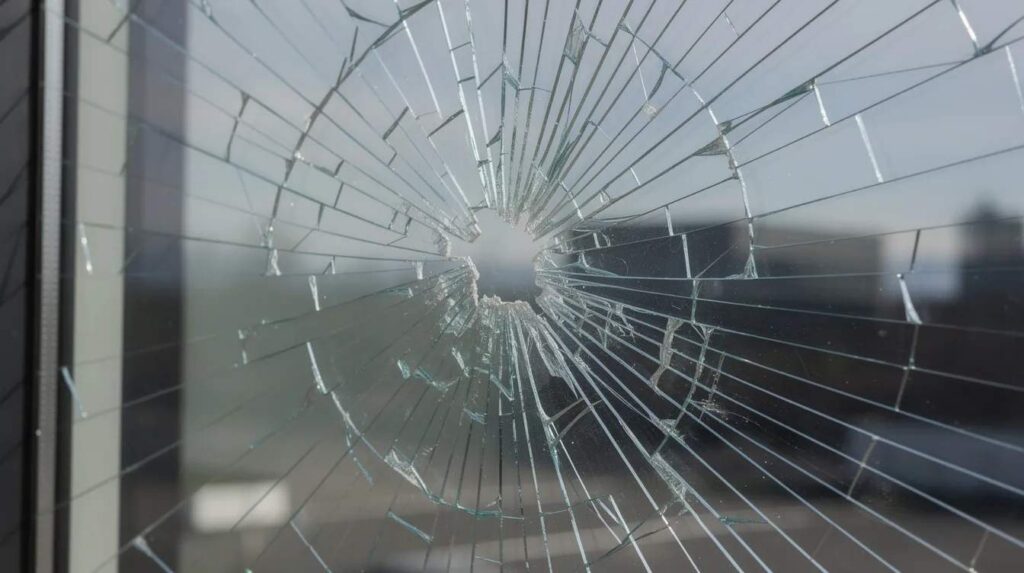
The effect is similar to what happens with laminated car windshields. When you’ve seen a cracked windshield that stays in one piece rather than spraying glass everywhere, you’ve witnessed the same principle that shatterproof window film applies to building glass. The film holds shattered glass together as a flexible sheet, preventing flying shards from causing injuries.
The construction involves multi-layer polyester (PET) stretched during manufacturing to align polymer chains for exceptional tear resistance. Film thickness is measured in mils (thousandths of an inch), with a pressure-sensitive adhesive on one side and a scratch-resistant hard coat on the exterior. When installed, the adhesive fuses deeply into the glass pores, creating a chemical bond that activates under moisture during wet installation.
Upon impact—whether from a baseball bat, sledgehammer, or explosive pressure—the film absorbs and dissipates energy. The glass may crack, but instead of shattering outward, it bows inward while staying attached to the film. Real-world testing shows that unprotected tempered glass shatters instantly under impact, while filmed glass remains intact after multiple blows. The application of shatter resistant window film significantly increases the time and effort required for an intruder to breach a window, which can enhance law enforcement response times during a break-in.
Performance improves further when combined with edge attachment systems. Structural sealant beads or mechanical anchors tie the film-glass assembly to the window frame, preventing the entire pane from being pushed through or peeled away after the initial breach.
Types of Shatter Proof Film & Thickness Options
Not all glass protection film performs the same way. The thickness and construction directly determine how much impact resistance and security you get from your investment.
The thickness of security window films is typically measured in mils, with common thicknesses being 4 mil, 7 mil, 8 mil, and 14 mil. To put this in perspective: 1 mil equals 0.001 inch, or approximately 25 microns. A 4 mil film measures roughly 100 µm thick, while an 8 mil film comes in at approximately 200 µm.
Here’s how different thicknesses typically apply:
4 mil – Basic fragment retention for homes, interior partitions, and shower enclosures where the primary concern is injury prevention from accidental breakage.
6 mil – Moderate residential and commercial use, offering improved hold against both accidents and minor vandalism.
8 mil – High-risk environments including retail shopfronts and storefront glass, ground-floor offices, and school windows where smash-and-grab attempts or severe storms are realistic threats.
12+ mil – Blast mitigation for critical infrastructure, banks, government buildings, and schools in high-threat areas.
The thickness of window film affects its ability to hold shattered glass together upon impact, with thicker films generally providing better retention of glass fragments. Clear variants prioritize invisibility with high visible light transmission (85-90%), while tinted or reflective resistant window film integrates solar control, rejecting 50-70% of total solar energy for added privacy and comfort.
Homeowners typically choose 4-8 mil films for sliding doors, sidelights, and nursery windows. Retailers and schools often select 8-12 mil paired with anchoring systems for street-facing glazing where security matters most.
4 Mil vs 8 Mil Shatter Proof Film
Both 4 mil and 8 mil films reduce injury risk from broken glass, but the difference in intrusion resistance is significant. Thicker window films, such as 8 mil, provide stronger impact resistance and better protection compared to standard 4 mil films, making them more effective for security purposes.
4 mil applications: This thickness works well for basic safety scenarios—interior glass partitions, shower doors, small office windows, and residential glass panes where the primary goal is preventing injuries from accidental impacts. It provides meaningful added protection without major expense.
8 mil applications: When security is a serious concern, 8 mil becomes the standard. Shopfronts, schools, ground-floor windows in urban areas, and any location exposed to higher risk of forced entry or storm damage benefit from the stronger hold and longer breach delays.
| Feature | 4 Mil Film | 8 Mil Film |
|---|---|---|
| Thickness | ~100 µm | ~200 µm |
| Typical Applications | Homes, showers, interior glass | Retail, schools, ground-floor offices |
| Impact Resistance | Moderate | High |
| Break-in Delay | 20-30 seconds | 50-90 seconds |
| Material Cost (per sq ft) | $2-4 | $4-7 |
| Neither 4 mil nor 8 mil is bulletproof. However, 8 mil measurably increases the number of strikes and force required to fully breach a standard quarter-inch pane—typically requiring 2-3 times more effort than 4 mil film. |
Key Benefits of Shatter Proof Film
The advantages extend well beyond simply preventing glass from shattering. Modern security film delivers multiple layers of protection, comfort, and compliance benefits.
Injury reduction – When glass windows break, the film keeps 99% of fragments contained rather than scattering across floors and occupants. This applies whether the break comes from a baseball through a window, seismic activity, or spontaneous glass failure.
Intrusion delay – Security window films significantly delay forced entry by holding shattered glass together, making break-ins harder and slower, although they do not make glass unbreakable. What takes seconds on unprotected glass can require minutes with proper film and anchoring—precious time for alarms to activate and responders to arrive.
Storm and blast mitigation – During hurricanes or earthquakes, the film helps maintain the structural integrity of the window, preventing debris and rain from entering the building. Specialized high-grade films and retrofit bullet-resistant security glazing panels are used by government agencies to reduce the hazard of flying glass fragments during explosions.
UV protection – High-quality films block up to 99% of harmful UV rays, preventing the fading of furniture and merchandise. This protects flooring, artwork, and retail inventory from sun damage.
Preserved views – Modern clear films maintain 85-90% visible light transmission, meaning your windows look virtually unchanged after installation.
A 2024 Los Angeles storefront demonstrated these benefits dramatically: 8 mil film held the glass in place after 15 sledgehammer blows, allowing police to arrive before intruders gained full entry. Florida schools equipped with security film before 2025 hurricane season retained window integrity despite 150 mph winds.
Some versions of the film reduce solar heat gain, helping to regulate indoor temperatures and lower cooling costs. When paired with solar-control variants, you gain reduced glare and a certain percentage decrease in cooling loads—benefits that add up over years of use.
Where Shatter Proof Film Can Be Used
Shatter proof film can be applied to most flat, standard glass surfaces that are clean and structurally sound. The film works on both new and existing buildings as a retrofit solution.
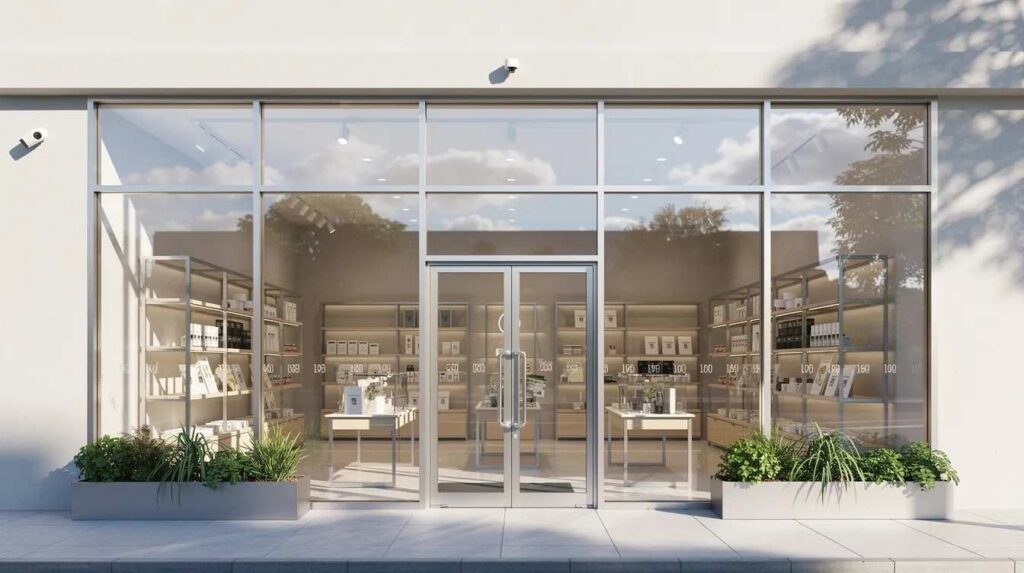
Typical locations include: homes (sliding doors, sidelights, shower enclosures, nursery windows, floor-to-ceiling glass), schools (entry doors, classroom windows, interior glazing near high traffic areas), offices (lobbies, conference rooms, glass partitions), retail (shopfronts, display cases, checkout areas), healthcare (waiting areas, corridors, pharmacy windows), and public buildings (libraries, transit stations, government offices) where burglar proof windows and doors are a core part of an overall security strategy.
Film is frequently used to help meet local building codes requiring safety glazing in critical locations—areas near doors, low-level panes accessible to children, and glass near stairs or in high traffic zones. This can be more economical than replacing the entire pane with laminated glass or tempered safety glass.
There are limitations to consider. Film isn’t ideal for heavily textured or frosted glass where adhesion may fail. Cracked glass or failing insulated units need replacement or specialist treatment before film application. Exterior application isn’t recommended because weathering degrades the adhesive over time.
Even thin protective films are used during manufacturing to prevent scuffs, scratches, and chemical splatter on glass surfaces—demonstrating how versatile this technology has become across industries, even when compared with engineered overglaze systems like DefenseLite.
Before and after scenario: A school district installed 8 mil anchored film on all ground-floor classroom windows and entry door sidelights. When a break-in attempt occurred six months later, the intruders abandoned their effort after failing to breach the filmed glass within their risk tolerance window—despite audible glass breaking. The opening remained secure enough to prevent entry until staff arrived.
DIY vs Professional Installation
Small, straightforward windows can be a DIY project for handy homeowners willing to invest the time. However, high-value or safety-critical sites benefit significantly from professional installation.
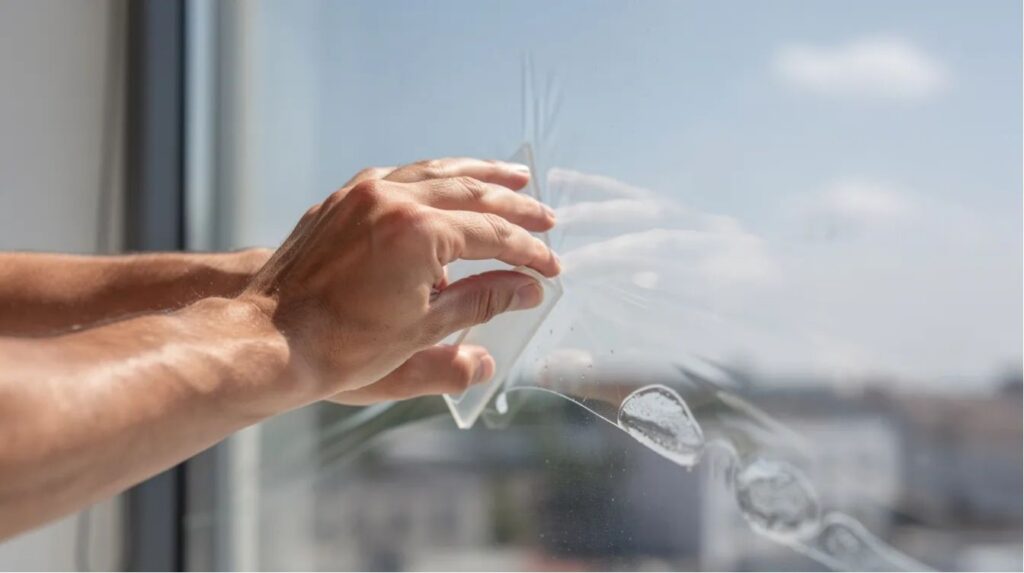
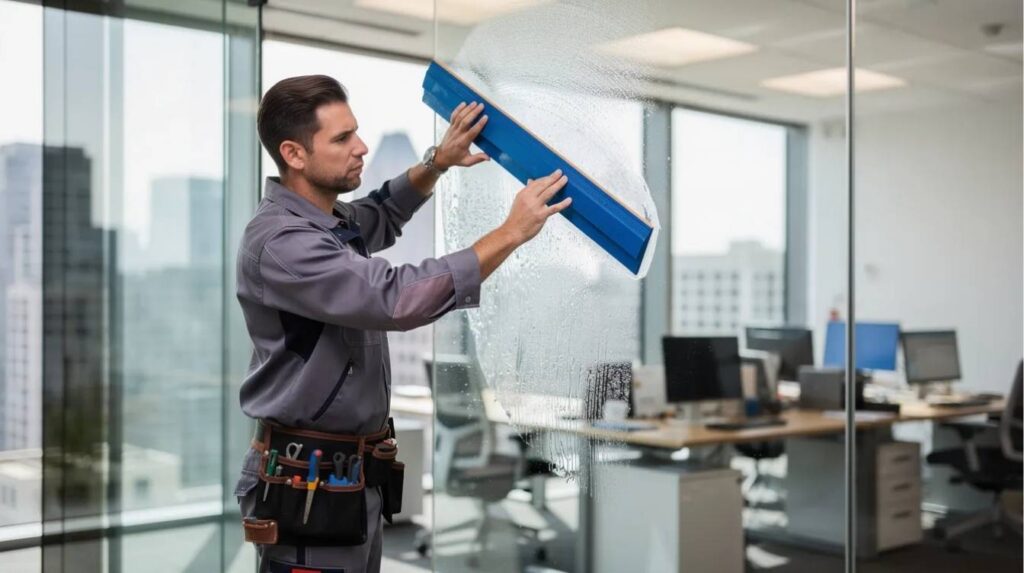
What a DIYer needs: spray bottle with water and a few drops of dish soap (the “slip solution”), a quality squeegee, utility knife with fresh blades, lint-free cloths, a razor scraper for surface prep, and considerable patience. The process involves wet application—the film floats on soapy water until positioned correctly, then gets squeegeed to remove bubbles and excess solution.
Common DIY pitfalls: Trapped dust particles create permanent bubbles. Creases form if the film is handled roughly. Cutting the film too small leaves exposed edges. Installing on dirty or sun-heated glass prevents proper adhesion. Edge lifting occurs when margins aren’t properly trimmed or sealed. User forums suggest 30-50% of DIY attempts have issues requiring rework or replacement.
Advantages of professional installation: Professionals bring industrial squeegees, heat guns for bubble-free seams, proper anchoring systems, and experience handling large sheets without contamination. They ensure correct film selection for your specific glass thickness, frame condition, and threat profile, and can also advise when higher-security systems like DefenseLite instead of standard security film are warranted. Most importantly, professional installation typically comes with manufacturer warranties (10-15+ years) that protect your investment.
Our recommendation: DIY makes sense for a couple of small residential windows or a shower screen where perfect results aren’t critical. Choose professional installation for whole-house coverage, large glass panes, entry doors, schools, retail spaces, and any space where safety compliance or warranty coverage matters.
Step-by-Step Installation Overview
This walkthrough gives homeowners a general sense of the process. Each step requires care and attention to achieve a quality result.
Step 1 – Measure and cut: Measure each glass pane precisely and cut film slightly oversize (about 1/8 inch extra on each edge) on a clean, flat, static-free surface. This margin allows for final positioning before trimming.
Step 2 – Clean glass thoroughly: Remove all stickers, paint spots, and silicone residue with a razor scraper. Clean the entire glass surface with ammonia-free cleaner, then wipe until completely dust-free. Any contamination trapped under the film becomes a permanent defect.
Step 3 – Mix application solution: Combine water with a small amount of mild dish soap (approximately 1:400 ratio) in a spray bottle. This “assembly fluid” lets the film float and reposition before final adhesion.
Step 4 – Wet the glass: Generously mist the entire glass surface so the film can slide into position easily. Don’t be shy with the solution—more is better at this stage.
Step 5 – Apply and position film: Carefully remove the backing liner, keeping the adhesive side wet with spray as you work. Place the film on the glass and slide it into final position, ensuring even margins on all edges.
Step 6 – Squeegee out solution: Work from the center outward toward each edge, removing bubbles and water. Use firm, overlapping strokes. Take care not to crease the film or push it out of position.
Step 7 – Trim edges: Using a sharp knife and straightedge, trim a small, even margin around the frame. Clean cuts prevent edge lifting over time.
Step 8 – Cure time: Films typically take 2-4 weeks to fully cure depending on thickness, humidity, and temperature. A slightly hazy or cloudy appearance is normal during this period and will clear completely once curing is complete.
FAQs About Shatter Proof Film
These questions come up frequently when property owners research glass protection options. If your specific situation isn’t covered here, contact our team for personalized guidance.
Is shatter proof window film bulletproof?
No. Shatter resistant window film is not bulletproof but is designed for impact resistance and shatter control, making it effective against forced entry and severe weather events. While the film may hold glass together after a gunshot and reduce some spall, the projectile will pass through. True ballistic protection requires specialized laminated glazing and framing systems rated to standards like UL 752 or other dedicated bulletproof windows and doors—not retrofit film alone.
How thick should security film be for burglary protection?
Basic safety from glass hazards starts around 4 mil. For meaningful burglary resistance, 8-12 mil combined with an edge attachment system is typically recommended. Consider your entry point type (a small side door versus a large shopfront), your property’s risk level, and whether the film will work alongside locks, alarms, and cameras. Contact us with photos or measurements for a site-specific recommendation.
Does security film go on the inside or outside of the glass?
Always on the inside. Interior application protects the adhesive layer from weather, UV degradation, and physical damage, extending the film’s lifespan to 10-20 years under normal conditions. Exterior application would compromise both durability and performance.
How long does shatter proof film last?
Quality films from reputable manufacturers last 10-15 years or longer with proper installation. Most professional installations include warranty coverage backed by manufacturers. Hard-coated films resist scratching through 1000+ abrasion cycles, maintaining clarity throughout their service life.
Will the film make my windows darker?
Modern clear safety films reduce visible light transmission by only 1-3%, which is imperceptible to most people. Your views remain essentially unchanged. Tinted security variants are available if you want additional privacy or solar control, but these are optional—not required for protection.
Does it block heat or only UV?
Standard safety films block up to 99% of UV rays. Solar-control variants go further, rejecting 40-60% of infrared heat and reducing cooling loads by 10-20%. If heat reduction is a priority alongside security, ask about dual-purpose films that combine both functions.
Can burglars still get through filmed glass?
Yes—eventually. Security film is a delay-and-deterrence measure, not an impenetrable barrier. However, what takes seconds on regular glass requires minutes with proper film and anchoring. Industry data suggests this delay activates alarms and triggers police response in approximately 80% of filmed-glass break-in attempts, causing intruders to abandon their efforts, especially when combined with ballistic and intrusion-resistant window films for active-shooter scenarios.
Will it work on my shower glass?
Yes, provided the glass is tempered and clean. Film enhances slip-and-fall safety by containing shattered glass if the door or panel breaks. This is a great product for households with children or elderly family members.
Is security window film worth it for a home?
For most homeowners, yes. The cost to protect a typical 20-window house runs $1,500-3,000—versus $10,000+ for laminated glass replacement or $50,000+ in potential losses from a single smash-and-grab incident. Add UV protection savings ($100-300 annually in reduced fading) and injury prevention value, and the ROI calculation favors film for most properties.
Why Choose Our Business for Shatter Proof Film
We specialize in safety and security window films—not general hardware or generic tinting. Our focus means we stay current on the latest 2024-2026 products, installation techniques, and attachment systems that maximize your protection.
Our process starts with understanding your property and priorities. We assess glass thickness (typically 1/8 to 1/2 inch for optimal film performance), frame condition, and your specific risks—whether that’s break ins, storm exposure, or compliance requirements. From there, we recommend the appropriate film thickness, type, and anchoring options or even integrated glass security systems with bulletproof windows and doors rather than pushing a one-size-fits-all solution.
When you work with us, you get professional, clean installation with clear communication about realistic performance expectations. We don’t oversell or make promises the film can’t keep. And if issues arise after installation, we’re here to help—not disappearing after the project is complete.
Ready to protect your property? Request a free consultation by providing your location, approximate number of windows, rough sizes, and main concerns (break-ins, storms, privacy, or safety compliance). We’ll respond with tailored recommendations and transparent pricing.
Pricing, Value, and Return on Investment
Exact costs depend on film type, thickness, window sizes, and installation complexity. Here are ballpark ranges to guide your planning:
DIY material costs: 4 mil films run $2-4 per square foot; 8 mil films cost $4-7 per square foot.
Professional installation: Add $3-6 per square foot for labor, bringing total installed cost to approximately $7-13 per square foot depending on project scope and complexity.
Comparison to alternatives: Applying film to existing windows is more affordable than replacing them with laminated or tempered safety glass, which typically costs $50-100 per square foot installed. Film delivers similar fragment retention benefits at 70-90% lower cost.
Example calculation: A three-bedroom house with 200 square feet of vulnerable glass might cost $1,400-2,600 for professional 8 mil installation. Compare this to a single smash-and-grab loss averaging $10,000-50,000 in stolen property and repairs, or a glass injury claim averaging $15,000 in medical costs.
Reputable manufacturers offer 10-15 year warranties on interior-applied film installed under normal conditions, protecting your investment over the long term.
Helpful Resources & Next Steps
Shatter proof film is a practical, proven way to upgrade existing glass for safety and security without the expense and disruption of full window replacement. Whether you’re protecting a family house, securing office space, or meeting compliance requirements for a school, the right film and installation approach makes all the difference.
Helpful resources we recommend: our guide to choosing window film thickness for your specific application, our gallery of completed projects showing before-and-after results, and our maintenance guide for keeping filmed glass clean and performing optimally.
Ready to take action? Contact us via phone, email, or our online form for tailored advice. We respond quickly and offer no-obligation consultations for projects of any size.
For safety officers, facility managers, and homeowners serious about protection, we recommend scheduling a site assessment. We’ll help you prioritize which windows and doors need protection first based on your risk profile and budget.
Take the next step toward safer, more secure glass in 2026. Your property—and everyone in it—deserves the peace of mind that comes with proper protection.